
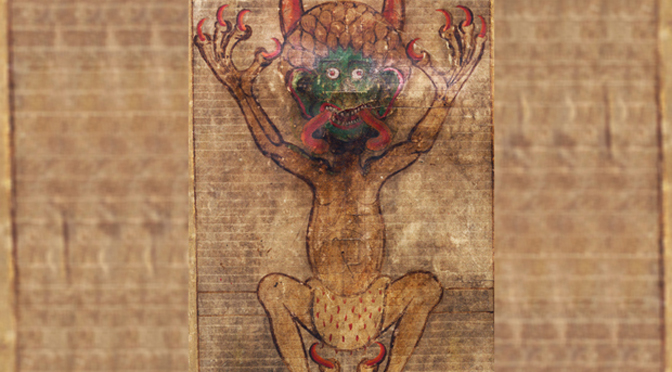

The Codex Gigas (English: Giant Book) is the largest extant medieval manuscript in the world.[1] It is also known as the Devil’s Bible because of a large illustration of the devil on the inside and the legend surrounding its creation. It is thought to have been created in the early 12th century in the Benedictine monastery of Podlažice in Bohemia (modern Czech Republic). It contains the Vulgate Bible as well as many historical documents all written in Latin. Eventually finding its way to the imperial library of Rudolf II, the entire collection was taken as war booty by the Swedish in 1648 during the Thirty Years’ War, and the manuscript is now preserved at the National Library of Sweden in Stockholm, on display for the general public.
Description
The codex is bound in a wooden folder covered with leather and ornate metal. At 92 cm (36 in) tall, 50 cm (20 in) wide and 22 cm (8.7 in) thick, it is the largest known medieval manuscript.[2] Weighing 74.8 kg (165 lb), Codex Gigas is composed of 310 leaves of vellum allegedly made from the skins of 160 donkeys or perhaps calfskin.[3] It initially contained 320 sheets, though some of these were subsequently removed.[4] It is unknown who removed the pages or for what purpose but it seems likely that they contained the monastic rules of the Benedictines.
Legend has it, that it was written by one scribe.[5] Acts 12:25 reads ab Hierosolymis (= ἀπὸ Ἰερουσαλὴμ, i.e. “from Jerusalem” – this reading is normal in Vulgate) along with manuscripts: D, Ψ, 181, 436, 614, 2412, ℓ 147, ℓ 809, ℓ 1021, ℓ 1141, ℓ 1364, ℓ 1439, ar, d, vg, Chrysostom; majority reads εἰς Ἰερουσαλὴμ (to Jerusalem).[6] Acts 18:26 supports reading τὴν ὁδὸν of Codex Bezae[7] (instead of τὴν ὁδὸν τοῦ θεοῦ present in other manuscripts and also supported by translations like the Vulgate).
History
The codex is believed to have been created by Herman the Recluse in the Benedictine monastery of Podlažice near Chrudim in the Czech Republic. The monastery was destroyed during the 15th century during the Hussite Revolution. Records in the codex end in the year 1229. The codex was later pledged to the Cistercians Sedlec Monastery and then bought by the Benedictine monastery in Břevnov. From 1477 to 1593, it was kept in the library of a monastery in Broumov until it was taken to Prague in 1594 to form a part of the collections of the Emperor Rudolf II.
At the end of the Thirty Years’ War in 1648, the entire collection was taken as war booty by the Swedish army. From 1649 to 2007, the manuscript was kept in the Swedish Royal Library in Stockholm.[8] The site of its creation is marked by a maquette in the town museum of Chrast.
On Friday, 7 May 1697, a fierce fire broke out at the royal castle in Stockholm, and the Royal Library suffered very badly. The codex was rescued from the flames by being thrown out of a window. The codex apparently injured a bystander and some of its leaves fluttered away and they are still missing today.[9] In September 2007, after 359 years, the Codex Gigas returned to Prague on loan from Sweden until January 2008, and was on display at the Czech National Library.[10][11][12]
A National Geographic documentary included interviews with manuscript experts who pointed towards evidence (handwriting analysis and a credit to Hermann Inclusus – “Herman the Recluse”) that indicates the manuscript was indeed the work of just one scribe.
Content
About half of the codex consists of the entire Latin Bible in the Vulgate version, except for the books of Acts and Revelation, which are from a pre-Vulgate version. They are in the order: Genesis–Ruth; Isaiah–Daniel; Hosea–Malachi; Job; Samuel and Kings; Psalms–Song of Solomon; Wisdom of Solomon; Wisdom of Jesus; Esdras; Tobit; Judith; Esther; and Maccabees. Between the Testaments are Josephus‘ Antiquities of the Jews and De bello iudaico, as well as Isidore of Seville‘s encyclopedia Etymologiae and medical works of Hippocrates, Theophilus, Philaretus, and Constantinus. Following a blank page, the New Testament commences with Matthew–Acts, James–Revelation, and Romans–Hebrews. Following the picture of the devil, Cosmas of Prague‘s Chronicle of Bohemia, a list of brothers in the Podlažice monastery, and a calendar with necrologium, magic formulae and other local records round out the codex. The entire document is written in Latin; in addition, it contains Hebrew, Greek, and Slavic alphabets (Cyrillic and Glagolitic).[1]
The manuscript includes illuminations in red, blue, yellow, green and gold. Capital letters are elaborately illuminated, frequently across the entire page. The codex has a unified look as the nature of the writing is unchanged throughout, showing no signs of age, disease or mood on the part of the scribe. This may have led to the belief that the whole book was written in a very short time (see Legend), but scientists are starting to believe and research the theory that it took over 20 years to complete.[14]
Folio 290 recto,[15] otherwise empty, includes a unique picture of the devil, about 50 cm tall. Directly opposite the devil is a full page depiction of the kingdom of heaven, thus juxtaposing contrasting images of Good and Evil. Several pages before this are written on a blackened parchment and have a very gloomy character, somewhat different from the rest of the codex. The reason for the variation in coloring is that the pages of the codex are of vellum. Vellum, or scraped and dried animal hide, “tans” when exposed to ultraviolet light. Over centuries, the pages that were most frequently turned to will developed this tell-tale darker color.
Legend
According to one version of a legend that was already recorded in the Middle Ages, the scribe was a monk who broke his monastic vows and was sentenced to be walled up alive. In order to avoid this harsh penalty he promised to create in one day a book to glorify the monastery forever, including all human knowledge. Near midnight, he became sure that he could not complete this task alone so he made a special prayer, not addressed to God but to the fallen angel Lucifer, asking him to help him finish the book in exchange for his soul. The devil completed the manuscript and the monk added the devil’s picture out of gratitude for his aid.[1][16][17] In tests to recreate the work, it is estimated that reproducing only the calligraphy, without the illustrations or embellishments, would have taken five years of non-stop writing.[14] In popular fiction, the 12 missing pages of the Codex Gigas are rumored to contain an apocalyptic text called “The Devil’s Prayer”.