Tag Archives: Aliens, Reptilians

Secret Sites part III, Pumapunku – Ancient technology or alien playground?

This complex monument group has fascinated me for years. Who the hell on Earth could do these kind of stone monuments at least 14,000 years ago? Those stones are so precisely cut, that it looks almost impossible to make them with ancient hand tools. If you ask me I would say that something similar modern day water cutting power tools was used. Another thing is the engineering work that has been used on that site. Those massive blocks of stone fits together and they have very sophisticated building method almost like nowadays buildings. So here is first the 12 facts about Puma Punku:

12 Facts about Puma Punku

  1. Puma Punku is so unique in the way that it was constructed and shaped and positioned, that it is the most intriguing ancient site on the planet.
  2. If you look at the stones carefully, you can see some intricate stonework, as though they used machine tools or even lasers. Evidence of ancient civilizations using modern technology? Sure.
  3. At Puma Punku you will find incredible stones with these perfect right angles, smooth as glass, this makes Puma Punku unique and over of the few places on earth to find this type of stone work.
  4. The massive stones were hewn at quarries over 60 miles away.
  5. Puma Punku is located  at an altitude of 12,800 feet, which means it is located above the natural tree line, this means that NO trees grew in that area which means that no trees were cut down in order to use wooden rollers, the question is how did they transport the stones?
  6. Tiahuanaco is located near Puma Punku, less than a quarter mile northeast of Puma Punku. Scientists believe Tiahuanaco was once the center of a civilization with more than 40,000 inhabitants.
  7. Tiahuanaco is probably the greatest Native American civilization that many people haven’t heard of.
  8. It’s said that in Tiahuanaco are all the races of mankind represented, even elongated skulls, people wearing turbans, people with broad noses, people with thin noses, people with thick lips, people with thin lips, and some of the statues are particularly unusual and are unlike the ones found in the nearby area.
  9. One of the most important archaeological artifacts ever discovered in Tiahuanaco or Puma Punku is the famous Fuente Magna Bowl discovered near Tiahuanaco.
  10. The Ceramic bowl, has  Sumerian cuneiform and Proto-Sumerian hieroglyphic written on it.
  11. The megalithic stones found at Puma Punku are among the largest on the planet.
  12. There are stones at Puma Punku that weigh over 100 tons.

by Ivan Petricevic ancient-code.com

– See more at: http://www.ancient-code.com/12-facts-about-puma-punku/#sthash.ZAaYqCvq.dpuf

Then we have some more information about the site:

Pumapunku also called “Puma Pumku” or “Puma Puncu”, is part of a large temple complex or monument group that is part of the Tiwanaku Site near Tiwanaku, Bolivia. Tiwanaku is significant in Incan traditions because it is believed to be the site where the world was created.[1] In Aymara, Puma Punku’s name means “The Door of the Puma”. The Pumapunku complex consists of an unwalled western court, a central unwalled esplanade, a terraced platform mound that is faced with megalithic stone, and a walled eastern court.[2][3][4] The Pumapunku is a terraced earthen mound that is faced with megalithic blocks. It is 167.36 meters wide along its north-south axis and 116.7 meters long along its east-west axis. On the northeast and southeast corners of the Pumapunku it has 20-meter wide projections that extend 27.6 meters north and south from the rectangular mound. The eastern edge of the Pumapunku is occupied by what is called the “Plataforma Lítica.” The Plataforma Lítica consists of a stone terrace that is 6.75 by 38.72 meters in dimension. This terrace is paved with multiple enormous stone blocks. The Plataforma Lítica contains the largest stone slab found in both the Pumapunku and Tiwanaku Site. This stone slab is 7.81 meters long, 5.17 meters wide and averages 1.07 meters thick. Based upon the specific gravity of the red sandstone from which it was carved, this stone slab has been estimated to weigh 131 metric tons.[5] The other stonework and facing of the Pumapunku consists of a mixture of andesite and red sandstone. The core of the Pumapunku consists of clay. The fill underlying selected parts of the edge of the Pumapunku consists of river sand and cobbles instead of clay. Excavations at the Pumapunku have documented “three major building epochs, in addition to small repairs and remodeling.”[2][3][4][5][6]

At its peak, Pumapunku is thought to have been “unimaginably wondrous”,[3] adorned with polished metal plaques, brightly colored ceramic and fabric ornamentation, trafficked by costumed citizens, elaborately dressed priests and elites decked in exotic jewelry. Current understanding of this complex is limited due to its age, the lack of a written record, the current deteriorated state of the structures due to treasure hunting, looting, stone mining for building stone and railroad ballast, and natural weathering.[2][3][5]

The area within the kilometer separating the Pumapunku and Kalasasaya complexes has been surveyed using ground-penetrating radar, magnetometry, induced electrical conductivity, and magnetic susceptibility. The geophysical data collected from these surveys and excavations have revealed in the area between the Pumapunku and Kalasasaya complexes the presence of numerous man-made structures. These structures include the wall foundations of buildings and compounds, water conduits, pool-like features, revetments, terraces, residential compounds, and widespread gravel pavements all of which now lie buried and hidden beneath the modern ground’s surface.[7][8]

Coordinates: 16°33′42″S 68°40′48″W
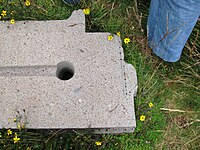
An example of high-precision small holes
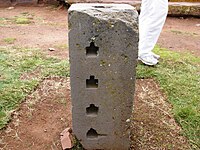
Stone block with a set of blind holes of complex shape
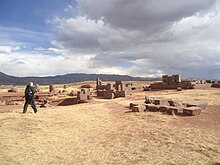
Stone blocks at Pumapunku

Age

Determining the age of the Pumapunku complex has been a focus of researchers since the discovery of the Tiwanaku site. As noted by Andean specialist, Binghamton University Anthropology professor W. H. Isbell,[2] a radiocarbon date was obtained by Vranich[3] from organic material from lowermost and oldest layer of mound-fill forming the Pumapunku. This layer was deposited during the first of three construction epochs and dates the initial construction of the Pumapunku to AD 536–600 (1510 ±25 B.P. C14, calibrated date). Since the radiocarbon date came from the lowermost and oldest layer of mound-fill underlying the andesite and sandstone stonework, the stonework must have been constructed sometime after AD 536–600. The excavation trenches of Vranich show that the clay, sand, and gravel fill of the Pumapunku complex lie directly on the sterile middle Pleistocene sediments. These excavation trenches also demonstrated the lack of any pre-Andean Middle Horizon cultural deposits within the area of the Tiwanaku Site adjacent to the Pumapunku complex.[3]

Engineering
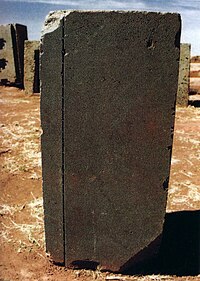
 

Detail of stone with precisely cut straight line and tooled holes within the line
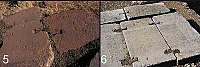
Demonstration of the building block technique

The largest of these stone blocks is 7.81 meters long, 5.17 meters wide, averages 1.07 meters thick, and is estimated to weigh about 131 metric tons (288,805lb). The second largest stone block found within the Pumapunka is 7.90 meters long, 2.50 meters wide, and averages 1.86 meters thick. Its weight has been estimated to be 85.21 metric tons. Both of these stone blocks are part of the Plataforma Lítica and composed of red sandstone.[5] Based upon detailed petrographic and chemical analyses of samples from both individual stones and known quarry sites, archaeologists concluded that these and other red sandstone blocks were transported up a steep incline from a quarry near Lake Titicaca roughly 10 km away. Smaller andesite blocks that were used for stone facing and carvings came from quarries within the Copacabana Peninsula about 90 km away from and across Lake Titicaca from the Pumapunka and the rest of the Tiwanaku Site.[3][5]

Archaeologists argue that the transport of these stones was accomplished by the large labor force of ancient Tiwanaku. Several theories have been proposed as to how this labor force transported the stones although these theories remain speculative. Two of the more common proposals involve the use of llama skin ropes and the use of ramps and inclined planes.[9]

In assembling the walls of Pumapunku, each stone was finely cut to interlock with the surrounding stones and the blocks fit together like a puzzle, forming load-bearing joints without the use of mortar. One common engineering technique involves cutting the top of the lower stone at a certain angle, and placing another stone on top of it which was cut at the same angle.[4] The precision with which these angles have been utilized to create flush joints is indicative of a highly sophisticated knowledge of stone-cutting and a thorough understanding of descriptive geometry.[6] Many of the joints are so precise that not even a razor blade will fit between the stones.[10] Much of the masonry is characterized by accurately cut rectilinear blocks of such uniformity that they could be interchanged for one another while maintaining a level surface and even joints. The blocks were so precisely cut as to suggest the possibility of prefabrication and mass production, technologies far in advance of the Tiwanaku’s Incan successors hundreds of years later.[9] Tiwanaku engineers were also adept at developing a civic infrastructure at this complex, constructing functional irrigation systems, hydraulic mechanisms, and waterproof sewage lines.

Architecture


Demonstration of the building block technique

Puma Punku was a large earthen platform mound with three levels of stone retaining walls.[11] Its layout is thought to have resembled a square.[11] To sustain the weight of these massive structures, Tiwanaku architects were meticulous in creating foundations, often fitting stones directly to bedrock or digging precise trenches and carefully filling them with layered sedimentary stones to support large stone blocks.[9] Modern day engineers argue that the base of the Pumapunku temple was constructed using a technique called layering and depositing. By alternating layers of sand from the interior and layers of composite from the exterior, the fills would overlap each other at the joints, essentially grading the contact points to create a sturdy base.[4][9]

Notable features at Pumapunku are I-shaped architectural cramps, which are composed of a unique copper-arsenic-nickel bronze alloy. These I-shaped cramps were also used on a section of canal found at the base of the Akapana pyramid at Tiwanaku. These cramps were used to hold the blocks comprising the walls and bottom of stone-lined canals that drain sunken courts. I-cramps of unknown composition were used to hold together the massive slabs that formed Pumapunku’s four large platforms. In the south canal of the Pumapunku, the I-shaped cramps were cast in place. In sharp contrast, the cramps used at the Akapana canal were fashioned by the cold hammering of copper-arsenic-nickel bronze ingots.[9][12] The unique copper-arsenic-nickel bronze alloy is also found in metal artifacts within the region between Tiwanaku and San Pedro de Atacama during the late Middle Horizon around 600–900.[13]

Cultural and spiritual significance

It is theorized the Pumapunku complex as well as its surrounding temples, the Akapana pyramid, Kalasasaya, Putuni and Kerikala functioned as spiritual and ritual centers for the Tiwanaku. This area might have been viewed as the center of the Andean world, attracting pilgrims from far away to marvel in its beauty. These structures transformed the local landscape; Pumapunku was purposely integrated with Illimani mountain, a sacred peak that the Tiwanaku possibly believed to be home to the spirits of their dead. This area was believed to have existed between heaven and Earth. The spiritual significance and the sense of wonder would have been amplified into a “mind-altering and life-changing experience”[14] through the use of hallucinogenic plants. Examinations of hair samples exhibit remnants of psychoactive substances in many mummies found in Tiwanaku culture mummies from Northern Chile, even those of babies as young as 1 year of age, demonstrating the importance of these substances to the Tiwanaku.[15]

As was characteristic of civilizations around this time, the Tiwanaku actively incorporated human sacrifice into their culture. The remains of dismembered bodies have been found throughout the area. Ceramic artifacts depict imagery of warriors, masked with puma skulls, decapitating their enemies and holding trophy skulls, adorned with belts of human heads with their tongues torn out.[14] It is believed that, because of certain markings on stones found at Puma Punku, the Gateway of the sun was originally part of Puma Punku.[16]

Peak and decline

The Tiwanaku civilization and the use of these temples appears to some to have peaked from 700 to 1000 AD. by which point the temples and surrounding area may have been home to some 400,000 people. By this point, an extensive infrastructure had been developed with a complex irrigation system running over 30 square miles (80 km2) to support potatoes, quinoa, corn and other various crops. At its peak the Tiwanaku culture dominated the entire Lake Titicaca basin as well as portions of Bolivia and Chile.[17][18]

The culture in question seems to have dissolved rather abruptly some time around 1000 AD and researchers are still seeking answers as to why. A likely scenario involves rapid environmental change, possibly involving an extended drought. Unable to support the massive crop yields necessary for their large population, the Tiwanaku are argued to have scattered into the local mountain ranges only to disappear shortly thereafter.[17][18] Puma Punku is thought to have been abandoned before it was finished.[19]

Source

Here is the full documentary about Pumapunku on History Channel:


So was this site created by ancient human’s with some forgotten technology (anti-gravity, power tools) or aliens? I don’t have a clue, but if I had to bet I would bet that aliens made these megalithic monuments. So no answers, again… but stay tuned for more SECRET SITES!!!

Secret Sites part I, Edward Leedskalnin’s Coral Castle


The Thirty Ton Stone.


This next miniseries is about secret sites. These sites can be so secret that you can’t even access them or then there is a some ancient technologies or mysteries on the site. First one in the series is Edward Leedskalnin’s Coral Castle. Very interesting place and I think that Edward possessed some old ancient wisdom and used it to create this awesome park/castle to his wife. Here is a small description about Ed:


Edward Leedskalnin (Latvian: Edvards Liedskalniņš) (January 12, 1887, Stāmeriena parish, Livonia; December 7, 1951, Miami) was an eccentric Latvian emigrant to the United States and amateur sculptor who single-handedly built the monument known as Coral Castle in Florida. He was also known for his unusual theories on magnetism.

Life

Edward Leedskalnin was born January 12, 1887, according to World War I draft registration records, in Stāmeriena parish, Latvia. Little is known of his childhood, aside from the fact that he was not wealthy and achieved only a fourth-grade education. However Edward was a sickly boy, and often spent his time inside reading books — eventually leading him to discontinue his schooling as it “bored him”. For Ed, his development of a yearning to obtain knowledge became a passionate and potent driving force in many endeavours throughout his later life.[1] At the age of 26, he was engaged to marry Agnes Scuffs, a girl ten years younger.[2] However, the girl that Leedskalnin referred to as his “Sweet Sixteen” broke the engagement the night before their wedding, so he emigrated to North America[3] where he found work in various lumber camps in Canada, California, and Texas.

Then, after contracting a case of tuberculosis, Leedskalnin moved to the warmer climate of Florida around 1919, where he purchased a small piece of land in Florida City. Over the next 20 years, Leedskalnin putatively constructed and lived within a massive coral monument he called “Rock Gate Park”, dedicated to the girl who had left him years before. Working alone at night, Leedskalnin eventually quarried and sculpted over 1,100 short tons (997,903 kg) of coral into a monument that would later be known as the Coral Castle. He used various basic tools, several made from timber and parts of an old Ford; first he built a house out of coral and timber, then he gradually built the monuments for which he is famous.[3] In spite of his private nature, he eventually opened his monument to the public, offering tours for 10 cents. He was a surprisingly accommodating host, even cooking hot dogs for visiting children in a pressure cooker of his own invention.[citation needed]

When people asked Leedskalnin how he had moved all of the stone by himself, he refused to give over his method and would only reply to whoever was asking with the same statement: “I understand the laws of weight and leverage and I know the secrets of the people who built the pyramids (being those at the site at Giza in Egypt).”[citation needed]

This building was originally located in Florida City in the 1920s; then in the mid-1930s Leedskalnin hired a truck and driver[3] to move it to its present location on a 10-acre (4.0 ha) site near Homestead, Florida. On November 9, 1951, he checked himself into Jackson Memorial Hospital in Miami. Leedskalnin suffered a stroke at one point, either before he left for the hospital or at the hospital. He died twenty-eight days later of pyleonephritis (a kidney infection) at the age of 64. His death certificate noted that his death was a result of “uremia; failure of kidneys, as a result of the infection and abscess.”[4]

Writings

During his lifetime, Leedskalnin published five pamphlets, advertising them in local newspapers.

Moral education

His first and longest booklet, a treatise on moral education, is printed on only the left-hand pages, and begins with the following preface:

Reader, if for any reason you do not like the things I say in the little book, I left just as much space as I used, so you can write your own opinion opposite it and see if you can do better.
The Author

In the first section, Leedskalnin vents his anger at his “Sweet Sixteen”, arguing that girls should be kept pure, and that boys are primarily a soiling influence upon them. On page 4 of A Book in Every Home, Leedskalnin writes:

Everything we do should be for some good purpose but as everybody knows there is nothing good that can come to a girl from a fresh boy. When a girl is sixteen or seventeen years old, she is as good as she ever will be, but when a boy is sixteen years old, he is then fresher than in all his stages of development. He is then not big enough to work but he is too big to be kept in a nursery and then to allow such a fresh thing to soil a girl — it could not work on my girl. Now I will tell you about soiling. Anything that is done, if it is done with the right party it is all right, but when it is done with the wrong party, it is soiling, and concerning those fresh boys with the girls, it is wrong every time.

The second section continues along the theme of moral education, with several aphorisms aimed at parents regarding the proper way to raise children. The last, “Political” section, reveals that the reclusive Leedskalnin had strong political views. He advocates voting for property owners only (and in proportion to their holdings), and argues that “Anyone who is too weak to make his own living is not strong enough to vote.”

Some writers[who?] have suggested that Leedskalnin’s booklet contains further information on his electromagnetic research and philosophies encoded in its pages, and the blank pages are provided for the reader to fill in their decrypted solutions. It has also been suggested that Leedskalnin’s frequent referral to his “Sweet Sixteen” may in fact refer to the numerological and/or scientific relevance of the number sixteen to his research and theories.[5]

Leedskalnin’s ideas may appear unusual. He wrote that a mother’s most important task is to ensure that her daughter remains “chaste and faithful”:[3]

In case a girl’s mamma thinks that there is a boy somewhere who needs experience then she, herself, could pose as an experimental station for that fresh boy to practise on and so save the girl. Nothing can hurt her any more. She has already gone through all the experience that can be gone through and so in her case it would be all right

Magnetism

Leedskalnin’s other four pamphlets addressed his theories on the interaction of electricity, magnetism and the body; Leedskalnin also included a number of simple experiments to validate his theories.

Contradicting the standard model of electromagnetism, his thesis is based upon the theory that the metal itself is not the magnet; & that the real magnets are circulating in the metal. These individual north and south pole magnets are particles smaller than atoms or photons; & each particle in the substance was an individual magnet by itself.[citation needed]

Leedskalnin claimed that all matter was being acted upon by what he called “individual magnets”. He also claimed that scientists of his time were looking in the wrong place for their understanding of electricity and that they were only observing “one half of the whole concept” with “one sided tools of measurement”. For instance:

Magnets in general are indestructible. For instance you can burn wood and flesh. You can destroy the body, but you cannot destroy the magnets that hold together the body. They go somewhere else. Iron has more magnets than wood, and every different substance has a different number of magnets that hold the substance together. If I make a battery with copper for positive terminal and beef for negative terminal I get more magnets out of it than when I used copper for positive terminal and sweet potato for negative terminal. From this you can see that no two things are alike.[3]

Source

Then we have a description about this awesome place called “Coral Castle” and I think that Edward used some ancient anti-gravity techniques to built it:

Coral Castle is a stone structure created by the Latvian AmericaneccentricEdward Leedskalnin (1887–1951) north of the city of Homestead, Florida in Miami-Dade County at the intersection of South Dixie Highway (U.S. 1) and SW 157th Avenue. The structure comprises numerous megalithic stones (mostly limestone formed from coral), each weighing several tons.[2] It currently serves as a privately operated tourist attraction. Coral Castle is noted for legends surrounding its creation that claim it was built single-handedly by Leedskalnin using reverse magnetism and/or supernatural abilities to move and carve numerous stones weighing many tons.[3]

History

According to the Coral Castle’s own promotional material, Edward Leedskalnin was jilted by his 16-year-old fiancée Agnes Scuffs in Latvia, just one day before the wedding. Leaving for America, he came down with allegedly terminal tuberculosis, but spontaneously healed, stating that magnets had some effect on his disease.

Edward spent over 28 years building the Coral Castle, refusing to allow anyone to view him while he worked. A few teenagers claimed to have witnessed his work, reporting that he had caused the blocks of coral to move like hydrogen balloons. The only tool that Leedskalnin spoke of using was a “perpetual motion holder.”

Leedskalnin originally built the castle, which he named Rock Gate Park, in Florida City, Florida around 1923. He purchased the land from Ruben Moser whose wife helped assist him when he had a very bad bout with tuberculosis.[4] Florida City, which borders the Everglades, is the southernmost city in the United States that is not on an island. It was an extremely remote location with very little development at the time. The castle remained in Florida City until about 1936 when Leedskalnin decided to move and take the castle with him to its final location on 28655 South Dixie Highway Miami, FL 33033. The Coral Castle website states that he chose to move in order to protect his privacy when discussion about developing land in the area of the castle started.[5] He spent three years moving the Coral Castle structures 10 miles (16 km) north from Florida City to its current location in Homestead, Florida.

Leedskalnin continued to work on the castle up until his death in 1951. The coral pieces that are part of the newer castle, not among those transported from the original location, were quarried on the property only a few feet away from the southern wall.

Leedskalnin charged visitors ten cents a head to tour the castle grounds. There are signs carved into rocks at the front gate to “Ring Bell Twice” and a second sign just inside the property that says “Adm. 10c Drop Below”. He would come down from his living quarters in the second story of the castle tower close to the gate and conduct the tour. Leedskalnin never told anyone who asked him how he made the castle. He would simply answer “It’s not difficult if you know how.”

When asked why he had built the castle, Leedskalnin would vaguely answer it was for his “Sweet Sixteen.” This is widely believed to be a reference to Agnes Scuffs (whose surname is given by some sources as “Skuvst”). In Leedskalnin’s own publication A Book in Every Home he implies his “Sweet Sixteen” was more an ideal than a reality. According to a Latvian account, the girl existed, but her name was actually Hermīne Lūsis.[6]

When Leedskalnin became ill in November 1951, he put a sign on the door of the front gate “Going to the Hospital” and took the bus to Jackson Memorial Hospital in Miami. Leedskalnin suffered a stroke at one point, either before he left for the hospital or at the hospital. He died twenty-eight days later of Pyelonephritis (a kidney infection) at the age of 64. His death certificate noted that his death was a result of “uremia; failure of kidneys, as a result of the infection and abscess.”[7]

While the property was being investigated, $3,500 was found among Leedskalnin’s personal belongings. Leedskalnin had made his income from conducting tours, selling pamphlets about various subjects (including magnetic currents) and the sale of a portion of his 10-acre (4.0 ha) property for the construction of U.S. Route 1.[5] Having no will, the castle became the property of his closest living relative in America, a nephew from Michigan named Harry.[8]

The Coral Castle website reports that the nephew was in poor health and he sold the castle to an Illinois family in 1953. However, this story differs from the obituary of a former Coral Castle owner, Julius Levin, a retired jeweler from Chicago, Illinois. The obituary states Levin had purchased the land from the state of Florida in 1952 and may not have been aware there was even a castle on the land.[9]

The new owners changed the name of Rock Gate Park to Coral Castle and turned it into a tourist attraction.[10]

In January 1981, Levin sold the castle to the Coral Castle, Inc. for $175,000.[11] They remain the owners today.

In 1984, the property was listed on the National Register of Historic Places.[1] It was added under the name of “Rock Gate,” but the name on the list was changed to “Coral Castle” in 2011.[12]

The Castle


A view from within Leedskalnin’s Coral Castle.

The grounds of Coral Castle consist of 1,100 short tons (1,000 t) of stones in the form of walls, carvings, furniture and a castle tower. Commonly referred to as being made up of coral, it is made of oolite, also known as oolitic limestone. Oolite is a sedimentary rock composed of small spherical grains of concentrically layered carbonate that may include localized concentrations of fossil shells and coral. Oolite is found throughout southeastern Florida from Palm Beach County to the Florida Keys.[13] Oolite is often found beneath only several inches of topsoil, such as at the Coral Castle site.

The stones are fastened together without mortar. They are set on top of each other using their weight to keep them together. The craftsmanship detail is so skillful and the stones are connected with such precision that no light passes through the joints. The 8-foot (2.4 m) tall vertical stones that make up the perimeter wall have a uniform height. Even with the passage of decades and a direct hit on August 24, 1992, by the Category 5Hurricane Andrew, the stones have not shifted.

Many of the features and carvings of the castle are notable. Among them are a two-story castle tower that served as Leedskalnin’s living quarters (walls consisting of 8-foot high pieces of stone), an accurate sundial, a Polaris telescope, an obelisk, a barbecue, a water well, a fountain, celestial stars and planets, and numerous pieces of furniture. The furniture pieces include a heart-shaped table, a table in the shape of Florida, twenty-five rocking chairs, chairs resembling crescent moons, a bathtub, beds and a throne.

With few exceptions, the objects are made from single pieces of stone that weigh on average 15 short tons (14 t) each. The largest stone weighs 30 short tons (27 t) and the tallest are two monoliths standing 25 ft (7.6 m) each.

A 9-short-ton (8.2 t) revolving 8-foot tall gate is a famous structure of the castle, documented on the television programs In Search of… and That’s Incredible! The gate is carved so that it fits within a quarter of an inch of the walls. It was well-balanced, reportedly so that a child could open it with the push of a finger. The mystery of the gate’s perfectly balanced axis and the ease with which it revolved lasted for decades until it stopped working in 1986. In order to remove it, six men and a 50-short-ton (45 t) crane were used. Once the gate was removed, the engineers discovered how Leedskalnin had centered and balanced it. He had drilled a hole from top to bottom and inserted a metal shaft. The rock rested on an old truck bearing. It was the rusting out of this bearing that resulted in the gate’s failure to revolve. Complete with new bearings and shaft, it was set back into place on July 23, 1986.[14] It failed in 2005 and was again repaired, however it does not rotate with the same ease it once did.

The Coral Castle remains a popular tourist attraction with various pop culture speculations regarding how Leedskalnin was able to construct the structure and move stones that weighed many tons. The Coral Castle site states that “if anyone ever questioned Ed about how he moved the blocks of coral, Ed would only reply that he understood the laws of weight and leverage well.”[5] He also stated that he had “discovered the secrets of the pyramids”,[15] which of course could be interpreted in either esoteric or engineering terms.

Source

Here is a small documentary about Edward:


And here is more about Ed’s techniques and “Coral Castle”. He left some clues to follow in the castle. These clues hold the secret of the Coral Castle (anti-gravity):

>> You can find many more videos in the YouTube if you are intersted about this mystery.

I think that Edward had some ancient information or he got the information somewhere, maybe from the aliens I don’t know. But definitely a topic to look for. Stay tuned for more SECRET SITES!!!

Creatures from beyond part VII, The Loch Ness Monster

nessie

Source

This is so legendary tale, that I’m going to describe just a little of Nessie and then try to focus on the latest information about it. Here is the description of Nessie:

The Loch Ness Monster is a cryptid, reputedly a large unknown animal that is said to inhabit Loch Ness in the Scottish Highlands. It is similar to other supposed lake monsters in Scotland and elsewhere, though its description varies from one account to the next. Popular interest and belief in the animal’s existence has varied since it was first brought to the world’s attention in 1933. Evidence of its existence is anecdotal, with minimal and much-disputed photographic material and sonar readings.

The most common speculation among believers is that the creature represents a line of long-surviving plesiosaurs.The scientific community regards the Loch Ness Monster as a modern-day myth, and explains sightings as including misidentifications of more mundane objects, outright hoaxes, and wishful thinking.Despite this, it remains one of the most famous examples of cryptozoology. The legendary monster has been affectionately referred to by the nickname Nessie (Scottish Gaelic: Niseag)since the 1950s.

Origins

The term “monster” was reportedly applied for the first time to the creature on 2 May 1933 by Alex Campbell, the water bailiff for Loch Ness and a part-time journalist, in a report in the Inverness Courier.On 4 August 1933, the Courier published as a full news item the assertion of a London man, George Spicer, that a few weeks earlier while motoring around the Loch, he and his wife had seen “the nearest approach to a dragon or pre-historic animal that I have ever seen in my life”, trundling across the road toward the Loch carrying “an animal” in its mouth.Other letters began appearing in the Courier, often anonymously, with claims of land or water sightings, either on the writer’s part or on the parts of family, acquaintances or stories they remembered being told.These stories soon reached the national (and later the international) press, which described a “monster fish”, “sea serpent”, or “dragon”,eventually settling on “Loch Ness Monster”.On 6 December 1933 the first purported photograph of the monster, taken by Hugh Gray, was published in the Daily Express,and shortly after the creature received official notice when the Secretary of State for Scotland ordered the police to prevent any attacks on it.In 1934, interest was further sparked by what is known as The Surgeon’s Photograph. In the same year R. T. Gould published a book,the first of many that describe the author’s personal investigation and collected record of additional reports pre-dating 1933. Other authors have claimed that sightings of the monster go as far back as the 6th century (see below).

History

Saint Columba (6th century)

The earliest report of a monster associated with the vicinity of Loch Ness appears in the Life of St. Columba by Adomnán, written in the 7th century.According to Adomnán, writing about a century after the events he described, the Irish monk Saint Columba was staying in the land of the Picts with his companions when he came across the locals burying a man by the River Ness. They explained that the man had been swimming the river when he was attacked by a “water beast” that had mauled him and dragged him under. They tried to rescue him in a boat, but were able only to drag up his corpse. Hearing this, Columba stunned the Picts by sending his follower Luigne moccu Min to swim across the river. The beast came after him, but Columba made the sign of the cross and commanded: “Go no further. Do not touch the man. Go back at once.”The beast immediately halted as if it had been “pulled back with ropes” and fled in terror, and both Columba’s men and the pagan Picts praised God for the miracle.

The oldest manuscript relating to this story was put online in 2012.Believers in the Loch Ness Monster often point to this story, which takes place on the River Ness rather than the loch itself, as evidence for the creature’s existence as early as the 6th century.However, sceptics question the narrative’s reliability, noting that water-beast stories were extremely common in medieval saints’ Lives; as such, Adomnán’s tale is likely a recycling of a common motif attached to a local landmark.According to the sceptics, Adomnán’s story may be independent of the modern Loch Ness Monster legend entirely, only becoming attached to it in retrospect by believers seeking to bolster their claims.In an article for Cryptozoology, A. C. Thomas notes that even if there were some truth to the story, it could be explained rationally as an encounter with a walrus or similar creature that had swum up the river.R. Binns acknowledges that this account is the most serious of various alleged early sightings of the monster, but argues that all other claims of monster sightings prior to 1933 are highly dubious and do not prove that there was a tradition of the monster before this date.

Spicers (1933)

Modern interest in the monster was sparked by a sighting on 22 July 1933, when George Spicer and his wife saw ‘a most extraordinary form of animal’ cross the road in front of their car.They described the creature as having a large body (about 4 feet (1.2 m) high and 25 feet (7.6 m) long), and long, narrow neck, slightly thicker than an elephant’s trunk and as long as the 10–12-foot (3–4 m) width of the road; the neck had undulations in it. They saw no limbs, possibly because of a dip in the road obscuring the animal’s lower portion.It lurched across the road towards the loch 20 yards (20 m) away, leaving only a trail of broken undergrowth in its wake.

In August 1933 a motorcyclist named Arthur Grant claimed to have nearly hit the creature while approaching Abriachan on the north-eastern shore, at about 1 a.m. on a moonlit night. Grant claimed that he saw a small head attached to a long neck, and that the creature saw him and crossed the road back into the loch. A veterinary student, he described it as a hybrid between a seal and a plesiosaur. Grant said he dismounted and followed it to the loch, but only saw ripples.Some believe this story was intended as a humorous explanation of a motorcycle accident.

Sightings of the monster increased following the building of a road along the loch in early 1933, bringing both workmen and tourists to the formerly isolated area Sporadic land sightings continued until 1963, when film of the creature was shot in the loch from a distance of 4 kilometres. Because of the distance at which it was shot, it has been described as poor quality.

Chief Constable William Fraser (1938)

In 1938, Inverness Shire Chief Constable William Fraser wrote a letter stating that it was beyond doubt the monster existed. His letter expressed concern regarding a hunting party that had arrived armed with a specially-made harpoon gun and were determined to catch the monster “dead or alive”. He believed his power to protect the monster from the hunters was “very doubtful”. The letter was released by the National Archives of Scotland on 27 April 2010.

C. B. Farrel (1943)

In May 1943, C. B. Farrel of the Royal Observer Corps was supposedly distracted from his duties by a Nessie sighting. He claimed to have been about 250 yards (230 m) away from a large-eyed, ‘finned’ creature, which had a 20-to-30-foot (6 to 9 m) long body, and a neck that protruded about 4–5 feet (1.2–1.5 m) out of the water.

Sonar contact (1954)

In December 1954 a strange sonar contact was made by the fishing boat Rival III. The vessel’s crew observed sonar readings of a large object keeping pace with the boat at a depth of 480 feet (146 m). It was detected travelling for half a mile (800 m) in this manner, before contact was lost, but then found again later.Many sonar attempts had been made previously, but most were either inconclusive or negative.

Latest Sightings

Sonar image (2011)

On 24 August 2011, Marcus Atkinson, a local Loch Ness boat skipper, photographed a sonar image of a long 5 ft wide unidentified object which was apparently following his boat for two minutes at a depth of 75 ft. Atkinson ruled out the possibility of any small fish or seal being what he believed to be the Loch Ness Monster. In April 2012, a scientist from the National Oceanography Centre said that this image is a bloom of algae and zooplankton.However, Roland Watson, a cryptozoologist and Loch Ness Monster researcher, has criticized this analysis, stating that the object in the image is very unlikely to be a bloom of algae and zooplankton, since algae needs sunlight to grow, and the waters of Loch Ness are very dark, and nearly devoid of sunlight, 75 feet down.

George Edwards’ photograph (2011)

On 3 August 2012, skipper George Edwards published a photograph he claims to be “The most convincing Nessie photograph ever”, which he claimed to have taken on 2 November 2011. Edwards’ photograph consists in a hump out of the water which, according to him, remained so for five to ten minutes. The Daily Mail reports that Edward had the photograph independently verified by specialists such as a Loch Ness Monster sighting devotee and a group of US military monster experts. Edwards spends 60 hours per week on the loch aboard his boat, Nessie Hunter IV, in which he takes tourists for a ride on the lake, and claims to have searched for the Loch Ness monster for 26 years.Said Edwards, “In my opinion, it probably looks kind of like a manatee, but not a mammal. When people see three humps, they’re probably just seeing three separate monsters.”

>> The Huffington Post article about George Edward’s photograph

However, other researchers of the Loch Ness phenomena have questioned the authenticity of the photograph. A subsequent investigation by Loch Ness researcher, Steve Feltham, suggests that the object in the water is in fact a fibreglass hump used previously in a National Geographic documentary which Edwards had participated in. Researcher Dick Raynor has also questioned Edward’s claims about finding a deeper bottom to Loch Ness, which he refers to as “Edwards Deep”. He also found inconsistencies between Edwards’ claims of the location and conditions of the photograph and the actual location and weather conditions of that day. Additionally, Raynor also stated that Edwards had previously told him he had faked a photograph in 1986, which he had promoted as genuine in the National Geographic documentary.

Source

Next video is from series “Stuff They don’t want You To Know”:


Here’s the Cryptozoologist Fredrick William Holiday who dedicated his life to investigate The Nessie:

Fredrick William Holiday, also known as “Ted Holiday” (1920–1979) was a British journalist, angler, cryptozoologist, and wildlife specialist.

Motivated by the early 1930s media reports, Holiday would dedicate the rest of his life to investigating the Loch Ness monster. In the 1960s, Holiday became a member of the Loch Ness Investigation Bureau. After several hundred hours of watching the Loch, Holiday claims that he reported four unidentified sightings. In his 1968 book, The Great Orm of Loch Ness, Holiday postulated that the creature in the Loch was an invertebrate creature similar in form to the extinct Tullimonstrum gregarium, but vastly larger.

Holiday also claimed that he noticed several unusual coincidences, including camera malfunction during certain Nessie sightings. For example, in August 1968, even though there were several witnesses along the shore, “Nessie” chose to appear in one of the very few places that were obscured from the various cameras. Holiday reported, “The observers were watchful and keen but they had seen nothing. The phenomenon had concealed itself so there was nothing for them to see.”

By 1972, Holiday modified his initial hypothesis that the Loch Ness monster was a literal physical animal. In his second book, The Dragon and the Disc, Holiday postulates that there are certain commonalities between paranormal phenomena and certain reported sightings on the Loch. Holiday also believed that there is a relationship between ancient dragon legends and contemporary UFO phenomena. Though he maintained in the book that he still believed that the monster was an invertebrate animal, there was a paranormal aspect to it reminiscent of ancient Water Horse legends which he could not fully explain.

His final work, The Goblin Universe, was published posthumously and includes an introduction by Colin Wilson.

Source

Here is on of Fredrick’s book called “The great Orm of Loch Ness: A practical inquiry into the nature and habits of watermonsters”:

orm_of_lochness

>> Amazon – The great Orm of Loch Ness: A practical inquiry into the nature and habits of watermonsters

So that’s Nessie… difficult subject to investigate because of hoaxed photographs, videos, computer graphics etc. That’s why I didn’t post them here. You can check them up and make your own conclusions. I think that major part of  The Nessie legend is based on tourism and making money. If you want my wildest guess about it… it could be a hologram to fright people, maybe there is a military base somewhere they want to protect… gotcha 😆  Stay tuned for more CREATURES FROM BEYOND!

Creatures from beyond part V, Men In Black (MIB) or McCoy

MIB

Maybe you have watched the movie trilogy called Men In Black and thought that what a cool series, but what if they are real? There have been hundreds or maybe thousands of cases where people have reported these Men In Black who interrogate them when they have seen something paranormal or an UFO.

First some description and then the cases:

Men in Black (MIB), in American popular culture and in UFO conspiracy theories, are men dressed in black suits who claim to be government agents who harass or threaten UFO witnesses to keep them quiet about what they have seen. It is sometimes implied that they may be aliens themselves. The term is also frequently used to describe mysterious men working for unknown organizations, as well as various branches of government allegedly designed to protect secrets or perform other strange activities. The term is generic, used for any unusual, threatening or strangely behaved individual whose appearance on the scene can be linked in some fashion with a UFO sighting.

Behavior

According to the accounts of those encountering them, Men in Black always seem to have detailed information on the persons they contact, as if the individuals had been under surveillance for a significant period of time. They have occasionally been described as seeming confused by the nature of everyday items such as pens, eating utensils or food, as well as using outdated slang, old cars or vintage styles of clothing. Reports indicate that they often claim to be from an agency collecting information on the unexplained phenomenon their subject has encountered. In other accounts, they seem to be trying to suppress information by trying to convince their target that the event in question did not happen. They have been described as behaving in either an exceedingly furtive manner or a completely outgoing one, with wide grins and disconcerting giggles.This observation might suggest that the “gigglers” were possibly, though not necessarily, pranksters, as various forms of unexpected, inappropriate, or even bizarre (as in robotic) behavior seem to be hallmarks of these mysterious beings.

Possible explanations

Folkloric explanations:

Although the phenomenon was initially and most frequently reported in the 1950s and 1960s, some researchers – John Keel and others – have suggested similarities between Men in Black reports and earlier demonic accounts. Keel suggests that MiBs are a modern-day manifestation of the same phenomena that were earlier interpreted as the devil or encounters with fairies. Similarly, folklorist Peter Rojcewicznoted that many Men in Black accounts parallel tales of people encountering the devil: neither Men in Black nor the devil are quite human, and witnesses often discover this fact midway through an encounter. The meaning of this parallel, however, has been the subject of debate. Even so, the term “the black man” was used for centuries in reference to the Devil,up until contemporary times when “black man” was used to replace the term “Negro” and the satanic sense was lost. A telling example may be found in an 1837 report in The Morning Chronicle. A certain John Henning, charged with running away with a chest of tea, defended himself with the claim that “he was ordered to carry it by a gentleman in black” who told him to carry it to Petticoat-lane.

The LORD MAYOR: Pray what sort of gentleman was he? – Prisoner: I can’t just tell, please you, my lord; I only know he was in black. The LORD MAYOR: I am afraid it was the gentleman in black that directed you in this matter. Had he a tail? – Prisoner: A tail! A pig-tail, do you mean, please you, my lord? No, I can’t say as he had. The LORD MAYOR: Did you look at his feet? What sort were they? – like a cow’s [a laugh]?

In witchcraft trials “The Black Man” was often reported as meeting with the accused and having sexual intercourse with them. In Washington Irving‘s story “The Devil and Tom Walker” set in 1727, Irving tells how Tom asks “the black man” who he is. The man says he goes by many names and is called the black miner sometimes or the black woodsman. He says that since the Indians are gone, he presides over the persecutions of various religious sects, supports slave dealers and is the master of the Salem witches. Tom replies that he must be “Old Scratch“, which is another name for the devil, and the black man acknowledges that he is Old Scratch. In 1932, H. P. Lovecraft also used the figure of The Black Man in his tale “The Dreams in the Witch-House” as a synonym for the Devil, but he also uses the term and description for Nyarlathotep, a malevolent entity of his own creation. In the Middle Ages the Black Man was not a man with African features, but rather a man colored black and dressed in black.

Military/CIA Explanations

More prosaically, paranormal researcher Jerome Clark cites Bill Moore, who asserts that “the Men in Black are really government agents in disguise … members of a rather bizarre unit of Air Force Intelligence known currently as the Air Force Special Activities Center (AFSAC) … As of 1991, the AFSAC, headquartered in Fort Belvoir, Virginia,” and “under the operational authority of Air Force Intelligence Command centered at Kelly Air Force Base in Texas.”  Curiously, Moore also reports that AFSAC was inspired by the tales of Men in Black from the 1950’s, and had nothing to do with those early accounts. Similarly, Clark notes that Dr. Michael D. Swords has speculated that the Barker/Bender Men in Black case (occurring shortly after the CIA-directed Robertson Panel issued its recommendations to spy on civilian UFO groups) might have been a psychological warfare experiment.

Source

Sightings

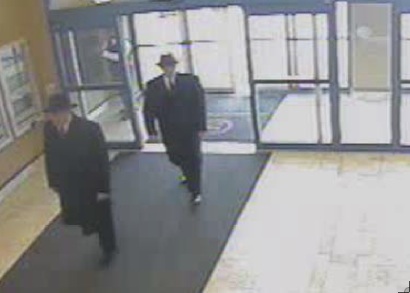
Most recent sightings that I have seen is this video where two men in black walks in a lobby. Of cource this is easy hoax, but something tells me that this might be a real case:

The original source of this video is from the Aerial Phenomen Investigations Team in MD. For complete details about this incident contact Antonio Paris from API. Quote from video source: “I work with the Aerial Phenomenon Investigations Team based in MD. One recent UFO investigation yielded actual footage of MIB on a hotel lobby camera. This video has a voice over of the person these MIB came for”. -M. Barnharrt


Here is a case from History channel’s UFO hunters:

This is a clip from the television show UFO Hunters. For the first time ever, the legendary Men in Black were caught on film, proving they are not a myth. This lends credence to all the eyewitness reports about the Men in Black harassing UFO eyewitnesses.


Here is the “Stuff they don’t want you to know” episode of Men In Black:


Then there is a full russian documentary about these Men In Black:


I have dealt with Dan Burisch case before, but he knows about these Men In Black too:

 MIBs: The Men in Black

Kerry Cassidy: OK, so tell us about…Dan Burisch

Dan Burisch: Sure, OK. Well, the Men in Black.

K: …about the Men in Black. Yeah.

D: Part of it is a psychological operation you have within Majestic and that they operate to scare people away from things that they’ve seen, that they don’t want them, you know, further bringing information out in the population. The so-called “people factor.” Anything about that, they attempt, or have attempted… I don’t even know that they’re still in operation… to suppress. Then you have the real McCoy. The real McCoy is not human. The real McCoy is in fact a P-45 J-Rod. They’re using, through the use of some sort of sinuous biomechanical technology, the skin of a dead human.

K: Wow…

D: The skin of a dead human. These are the ones that walk up to you and they look like they’re shuffling like they’ve just filled their drawers. When they speak through this technology that they are wrapping around them, they sound very bland, very monotone. And they don’t belong. You tell very quickly that they don’t belong.

K: Have you met one?

D: I’ve met several of them. They were operating around my work at Sunchase before we were moved to a different location. I can say they’re very “sallow” in appearance. They thought that it was an appropriate expression to sing me “Happy Birthday” one year over at, ah, I think it was at the start of 2003. It was either ‘03 or ‘04 …‘03 I think it was. Yeah…. and I did not like being around them. And they will not think twice of using force on you. They will hit you. They will push you. One did me.

Marcia, not that long ago, got her fill of both types, both the psychological operations people who attempted, a few years ago, to scare her off over at Winchester Park – these were… those were human beings. They were just striking fear in her – and one actual real McCoy… MIB. And this thing… I actually saw it first. It wandered on to… they get confused easily. And that’s a good thing… wandered on to our property at where we’re presently living. And I was walking home from her apartment at the time and I thought a child was swinging on the swingset. There’s a swingset out in front of my apartment. The closer I got, I thought that it was a little older kid wearing black. Then I noticed it had a hat on. And he said, “Swing! Fun!” He was lost in a memory, apparently, of the person that he was wearing. And I looked at him and I got very afraid inside because they carry weapons. They can be killed with weapons too. They were not supposed to be on our property. Our Security did not do its real job. We’re not worried about the real two-legged real humans that just walk around. It’s MIB 1these things…

K: So he was the size of a child? Is that what you’re saying?

D: No, he was… He… I thought it was a child on the swingset as I was walking. It was past dusk. It was dark out there.

K: So he was a normal size.

D: He was a normal size.

K: Man.

D: Yeah.

K: Full grown person.

MIB 3D: Yep. And wearing all black. And he had a black preacher’s type hat. Round brimmed…

K: How do you get rid of him?

D: Well… how do you get rid of him?

K: Yes.

D: Well, it would be very good if a person could actually… I’d better be careful suggesting that…

Marci: Uh huh.

D: …‘cause they are still human beings. They took him into… Security ultimately took him into custody. I just want to be careful liability-wise of making the suggestion about how to get rid of one of them. But…

Marci: People could miscue and we wouldn’t want to have problems.

D: No. Saying, “Well, you know, Dr. Burisch said do this or that.” There shouldn’t be that many walking around. Don’t worry about it.

But it… it wasn’t even sent there to deal with me. It was sent there to deal with her [pointing toward Marci]. And it found itself apparently lost in a memory in the swingset. And I said, “Good! Swing! Good.” Instead of going [makes disgusted face]. Walked in, keyed the door to my apartment, pressed the emergency button for Security, hoping that they were going to respond. Went in and told my mother-in-law what was going on. She looked out of the window and said, “Yep.” She’s been in a Majestic family all her life, and she said, “Yep.” Then the oldest got up and looked out the window and I said, “That’s what one looks like.” It was her first experience seeing one. Yeah.

K: Ohh.

D: And I said, “Doris, go over here.” And I unlocked something and I pulled something out for her and I said, “While I leave here, because I’m going to do the hurt bird routine and lead it away,” (because we had three kids). I said, “I don’t know what its intention is. It may have a lethal intention here and it’s just presently lost. Soon as it gets done swinging, it may pull a weapon out.” And I said, “So if it comes near here, defend yourself and the kids. Meanwhile I’m gonna grab something else,” and I grabbed a weapon, “and I’m gonna try to lead it away.” By the time I had the second weapon out and was armed, it was walking off already, toward her [points at Marci, laughs] apartment’s direction.

So I said, “OK. Well, I still have to get it in case it turns around because if it knows where I went into the apartment, I have to lead it away because there are kids in here. There are little girls in here.” Yep. And so I walked toward it, past it [laughs], walked clear by it, and it just continued shuffling ahead slowly up the sidewalk, gradually toward her apartment.

I got over to her apartment and I said, “Where the hell is Security?” She was pushing buttons over there and nobody had responded. Got on the radio. Nobody responds. I said, “You have an MIB walking toward your apartment right now.” She said, “An MIB?” I said, “Indeed.” I said, “They are dangerous, as you are well aware.” But it was her first experience with something like this. I said, “Come here and look. It can’t possibly…”… and I wanted to make sure it wasn’t walking back toward my apartment where the girls were. I said, “It can’t possibly have reached here by now.” [laughs] I mean, it’s walking slowly. And so she came out with me and she went over by the wall behind a bush and she didn’t see it initially. It was hidden like in the recesses of a light, as it was walking up in one of the shadowed areas. Because now the lights had kicked on on the exterior of the building and all that. And I walked up on to the sidewalk and saw it, and I turned my back on it at that point. They don’t run. So I turned my back on it and said, “You may watch me going that [points in illustration] way,” to Marci. And she said, ‘cause she’s not a faint-of-heart female, “Why?” And then she saw it over my shoulder and got her first .. . laid her first eyes on an ET. And her eyes got about that big [gesturing], which is a normal reaction. And she walked. [looks at Marci and says, “Giving you some credit.”] She actually walked from there back toward the corner of the building, before I saw her break into something more than a walk. She walked away from him.

By then, I’m still standing there and this thing walked by me. Now I’m wondering what… why it’s here, and I said, “Hi.” And it turned this close to me [gestures at arm length] and said, “Hello,” and then it just continued to walk [gestures away]. Walked right past me like I wasn’t even there, toward her. I thought, “Well, OK, it has an assignment. We don’t know what the assignment is.” Because it will not give up its intention behaviorally before it carries out its assignment. And I wasn’t sure if it was armed or what. So I walked by it again. [laughs] This is how slowly it was shuffling. It walked like it had poop in its pants. I mean that’s how he did… I mean, they are clearly not comfortable in the skin.

I walked by it again. Now I had made certain adjustments to the firearm I had on me because I was figuring that whatever was gonna happen, it was gonna happen fairly soon. And if it pulled a weapon out, I was going to do what I learned in the police department and do it well. For propabation.

Got back to her. Got all the way into her apartment. Locked the door. And I said, “Go get your gun.” She pulled the weapon out. “You’ve been a former cop, too. Do what you do. Do it well.” By that time we were both shaking, figuring, you know, it was gonna turn into something very bad.

It sat down on a stairway outside of her apartment and… it had a bag with it. It was a black bag of some sort, and I didn’t know what was in it. It could have been anything. It just sat there, and then it got up, and it walked past her apartment. And now I’m looking at her like, “What the hell is this?” Still no Security. Finally, after it had made its way all the way to the basketball court area… and it stood there and looked around, still confused… Security came up with its weapons [models sighting along rifle] drawn, and took it into custody. Put it in one of the vans and off it went. They cuffed it, you know, like a human being would be cuffed and they took it.

She got a couple photographs off. We actually, because it walked out toward the court… I was looking through the window and said, “Well there’s no way it could get us from here even if it does have a gun on it or whatever.” She stepped out on to her porch and she took a couple photographs with a… [queries Marci] It was a disposable?

Marc: I found a disposable camera that was up on the bookshelf near the door. And I just grabbed it and that’s all I had in my hands.

D: She took a couple photographs of it and we have since made those public on the Eagles Disobey forum. Those are real, the real McCoy. The best I could do enhancements that show, one after another, with it… bringing it out from the background. Those were the best enhancements I could do because the original photograph that we put up there, too, if you saw it, I mean, it was basically jet black. There is no carrying of the flash and it was not set for, you know, night speed or anything like that. It was an indoor/outdoor type daytime camera, a disposable camera. But it was all that was available. Now, Security took photographs and all that but they don’t share ‘em.

mib3_sm

K: Right.

D: At the same time I was doing my weekly reports and I detailed it in my weekly report and I allowed that weekly report to be made available through the website. I said the MIB was taken into custody and no one was injured. But, yeah, he just walked on to our property, assignment still to this day unknown.

K: Hmm.

Dismissed from Majestic

D: Well, following 20 years of service for the Majestic, last October the 12th, which was October 12, 2005, I was dismissed at the time of their adjournment, to complete a final set of orders, if you will, to present the information which I have learned over the last twenty years concerning the extraterrestrial intelligences to the world or to whomever wanted to hear. For the last year’s time we have been committed to a debriefing of my service since 1986 and even actually before that. We’ve ranged into speaking about my early life as well. We’re hoping that within a short period of time, the DVDs will be completed and this will be presented. And this will then conclude my service to Majestic, with a very big relief and “Thank God!”

Project Lotus

Right now we are presently in the middle of several different projects, inclusive of which is Project Lotus, which has basically been dispatched and dismissed to me after the years of service as well. This project…

K: Do you mean it was turned over to you?

D: Well, it’s been turned over. I don’t think that the folks from the former Majestic are continuing the research at all. I really don’t think that they want anything to do with it after the problems that we’ve had and the associated problems at a couple different facilities involving, we’ll say, extraneous energy emissions around the project that caused some damage to their equipment.

Extraneous Energy Emissions

K: To back up a tiny bit, could you tell us what is Project Lotus?

D: Sure. In May of 2001 we traveled to Frenchman Mountain here in Nevada to begin a real project looking for a bio-marker, for a possible precursor virus. It was a rather prosaic study, looking for evidence of panspermia. During the course of that initial investigation we came across some anomalous activity in some of our data sets. That anomalous activity was ultimately tracked down to very unusual electromagnetic activity associated with silicon oxides. And we have since tracked that anomalous activity to any silicon oxides present in minerals… to wit, the activity is the presence of an emission of electromagnetic bundles containing information. We are presently attempting to further define the nature of that electromagnetic anomalous activity. But we have in fact determined that the activity is associated with cells within the terrestrial environment… and that they have effects upon cells in our terrestrial environment, up to and including modifying the genetic material of extant cells in our environment.

K: Are you saying living cells?

D: Yes.

K: Uh huh.

D: We have, together with these electromagnetic emissions, that we have defined with relative precision to date, to be specific varieties of what we termed as particles. We had to call them something. They’re bundles of electromagnetic material, confined discrete bundles, that we believe are possibly related to… as far back as the ancient Pavitrakas of the Hindus… subtle matter particles, which could be imparted into our environment and effect changes. Thus far, we have not observed negative changes, meaning, the effects of these subtle matter particles, if you will, have not affected our environment negatively.

K: But you have had interruptions as the result of these particles being …

D: We’ve had…

K: Anomalous activities.

D: We’ve had anomalous thermal emissions when too much or too little energy was imparted to the silicon oxide-bearing material. We have had unusual drains of batteries around the activity. And we have not defined why. But, there have been two phenomena associated with Lotus that have been particularly striking to me as a biologist. We’ve had re-sets of cells which have occurred. And I say “re-sets” because I’m trying not to make it sound Frankenstein-like… where there have been heat-fixed yeast cells which have been used as, ah… offered, if you will, to this phenomena as target cells. And upon the receipt of material of these dead, heat-fixed yeast cells, we’ve had a re-start of the cells and we have the photographic and the….

K: So they’ve come back to life, is what you’re saying, as a result of this…

D: There has been a…

K: …energy?

D: Yes. I really don’t even like using those terms. It’s out of the book, off the edge of the pizza, so to speak. But we have had a re-start of the cells in that location.  However, the cells which have restarted from the dead cells are not the same cells, are not the same function, functioning, cells as the precursor cells, the precursor yeast cells. We don’t really know what they are.

K: You mean… are you saying that the cells changed and are functioning differently after being exposed to this energy?

D: Yes. We started out with a, essentially a fungal cell, a budding yeast cell which we heat-fixed, and the result was more termed what one would normally term an animal-like cell.

K: Really? So it…

D: Yes.

K: …actually changed it from one thing… it actually transformed it from one thing into another.

D: It transformed it from one thing to another, after imparting to it what we’ve come to call a template. There is an…

K: Is this…

D: …actual imparting of DNA…

K: Ahh.

D: …to the cell. So, we’re receiving DNA essentially across some sort of an electromagnetic barrier, through these… what we call portals, these emissions of electromagnetic energy that then impart further discrete bundles of electromagnetism to our environment.

K: So is…

D: We’re attempting to understand it. We don’t understand what we are truly looking at at the moment. We’ve not truly defined the Lotus as a system.

Ganesh particles

K: OK. But are the particles, are these the Ganesh particles that are coming through?

D: [nods head yes] We think that we defined three basic discrete varieties of particles that we have termed, Alpha, Beta, and C-type particles. The A-type particles were nicknamed “Ganesh” particles, and that’s what they are. They’re nicknames. We had to call them something, so we called them “Ganesh particles,” out of historical deference, if you will, for the Mover of Obstacles.

Shiva Portals

And we called the portals, “Shiva Portals,” as an opening or a changing. These are the admission, or emission, centers, if you will, for these Ganesh particles.

Selkies

And then we have still another variety of particle which we call “Selkies.” And Marcia actually named them. These are C-type particles, and they basically act as almost like crossing guards which line the periphery of an electromagnetic stream that leaves these portals, and basically act as guards or guideways surrounding the Ganesh particles, giving them a pathway to a target. Now the real question, I think, is: How is the decision being made for a target? And we’ve identified on the Selkies what appear to be acoustic antennae. And I say appear to be acoustic antennae, because changes of input into this system, acoustic changes, affect the behavior of the Selkie particles.

K: Sound. In other words…

D: Yes.

K: …sound is affecting the Selkie particles, causing them to redirect the energy, toward the target or away from the target?

Portals = Micro-Wormholes?

D: Causing them to redirect their positions which confine an electromagnetic stream, or a river if you will, being emitted from these portals. And you know, we’ve wondered what the portals are. They might be micro-wormholes.

K: I see.

D: We don’t know right now.

K: And these are nano-sized portals?

D: No. These are microscopic sized. Somewhere within the 20 to… well it would be very transient up to 50… but around the 10 to 20 micron size, micrometer size. And so they’re observable quite readily under a compound microscope if the conditions are held constant and if they are treated delicately. They’re extremely transient phenomena.

K: In other words, you don’t have control over them.

D: No. No. And in fact, we don’t do any direct propagations anymore. The last direct propagation was done last November and we received, for the second time, an anomalous growth of cells in the medium surrounding the crystal that we were using. We were using a quartz crystal, because of the silicon oxide nature of quartz crystal. And we received an anomalous growth of cells of unknown origin around the crystal, so we do not know where these cells were from. We’ve had that happen now twice and we’ve determined that we’re getting a little too good, if you will, at the science of propagating these portals and we’re possibly receiving a negative consequence as a result.

K: In other words, those could actually be an alien life-form.

D: Indeed.

K: OK.

D: Indeed they could be…

K: Very interesting.

D: …they could be extraterrestrial. The cells…

K: Cells. I mean, they’re microscopic, right?

D: Right. You know, we’ve received a mix of very unusual cells which we are not… I was not able to cytologically type. And also cells which appeared nearly prosaic to our ocean here microscopic one-celled organisms – haptophytes.

K: But they came out of nowhere.

D: The material that we had provided to the experiment prohibited a cross-contamination, the ability for this to have been a cross-contamination. So they came from somewhere. They came from somewhere.

Now, also, what we’ve done is a repeat of a very famous experiment called the Spallanzani experiment with beef broth, but we put a tweak on it, if you will. The Spallanzani experiments were experiments designed to either prove or disprove the idea of spontaneous generation. And so the question is then begged: Are we exhibiting spontaneous generation here? And I think that we have zero evidence that this is spontaneous generation. And allow me to explain why.

The Spallanzani experiment that we repeated… we did it exactly the way the famous experiment was originally done… with beef broth that had been boiled, but we actually had it autoclaved so that we had pressure and heat both acting on it, getting rid of all the spore-formers, everything that could have been present in there as a living organism. We left some open, some closed, and then we did a closed and an open experiment where we applied electricity and a silicon oxide-bearing crystal to it. And in the case where we had the closed study done, we received the growth of cells in that closed study which appeared, to me to be neural cells, and organized neural cells, to the point where we could actually tell morphologically that there was an A-B-A-B pattern which was developing. I wouldn’t say that I was in a panic, but [glances right]… Marcia is nodding her head rapidly, off the camera.

K: [laughs]

D: I was in a near panic to cease the study then and there so that we weren’t accidentally producing something with sentience.

K: Wow.

D: Not my right. That would have been an abomination of some variety. I don’t practice, the tools of science devoid of moral considerations. Some, nowadays, I think, have no problem, no compunction against that. I do. So the study was ceased immediately and the cells were photographed. Yes, we have the photographs of them. But the study was ceased and it was killed immediately.

K: OK. Well, this is really kind of earth-shaking information that you’ve got here, and…

D: [nods head yes] Uh huh. Very humbling.

K: …I’m getting it in a way that I understand that makes it very clear.

K: Thank you, Dan. That was quite… quite enlightening.

Source

Ok I think that there is something to grasp on about Men In Black. Like other creatures there is a lots of information in the Net and you just have to look for it and make up your own conclusions. I think that there is truth about Men In Black cases, because there is so many of them and the people stick with their stories. Finally, I have watched the Men In Black movie trilogy and it was pretty entertaining, but what made an impression to me was the part III’s soundtrack. I think it is awesome. It reminded me from John Carpenter’s In The Mouth Of Madness soundtrack, which is also awesome:


And remember… STAY TUNED FOR MORE CREATURES FROM BEYOND!

Masters Of Metal Part II, Megadeth

Second band in the series is rightly Megadeth. This band and especially Dave Mustaine is heavily interested about NWO, history and World politics. And hey if you didn’t know Dave was Metallica’s guitar player in the 1980’s, but they kicked him out. And if you watch these bands today it’s not hard to see how much better Megadeth is nowadays. Firstly I post one of my all time favorite songs on their best album Rust In Peace… this one is called Holy Wars…The Punishment Due:


And because this site deals with odd topics and mainly UFO stuff the second song is on the same album called Hangar 18:


Next one continues the story above so this one is called Return To Hangar, actually this is Hangar 18 & Return To Hangar live:


This next one is never stuff and is called Endgame from the album called Endgame. It’s about NWO agenda and dystopia stuff:


And finally here is Dave Mustaine in Infowars talking about patriotism and NWO:


I appreciate Dave’s bravery to talk about true things in the World.

>> Official Megadeth Website