Category Archives: Ancient Aliens

Donald Marshall: WHAT IS DRONING?

Some more information to Donald Marshall story:

Taken from vrillizards.webs.com/droning

DRONING PROCESS

Droning occurs when a Vril injects its quill/proboscis into the human eye where the lizard parasite takes over the human host brain. It is terribly painful for the human being until the human consciousness dies and the vril parasite consciousness is in full control. All (or most) memory and ability of former human is retained & the lizard consciousness now mimicks the former human’s behaviors. The former human is now a drone. These are the ‘people’ that are used by vril to infiltrate governments, religious, legal & financial systems, organizations and/or corporations. It is not uncommon for male or female drones to lose their hair at a younger age. Intelligence seems a little decreased-with a minimal capacity-if any, to understand sarcasm and/or dry humour. Offspring have increased risk of various birth abnormalities. Drones often seem incapable of empathy/sympathy and can quite often display psychotic behaviours. Drones enjoy perversion, sexual deviance and self gratification. The drone will seem to be an ill human until fully recovered from the parasitical infection which takes varying degrees of time, but is usually minimal. The eye that was droned with the proboscis will be affected and sometimes never fully recovers, leaving the affected eye to seem different from the other. Most drones appear completely normal and walk among us undetected.


The Vril proboscis connects with human eye and releases a foamy substance where the parasite injects itself into the human brain. The unfortunate human suffers temporary agony. Once the parasite is effectively in the brain, the human ceases to exist and the Vril is in full control of it’s host body.The age-old ‘eye of Horus’ symbol represents the age-old
~ Drones do NOT have lizard eyes. There are no major or obvious physical changes to the human body. The only change is that the human consciousness has ceased to exist and the Vril consciousness is now in control of the body.

~ Drones are NOT shapeshifters. Once the lizard takes over the human, there is no transferring in and out of the body as it is a permanent one time transfer until the lizard consciousness perishes. Shapeshifting is thought to be a metaphoric description of droning as it was difficult for people and/or their cultures to communicate the existance of Vril, much less the droning procedure in a way that would not bring them harm for attempting to expose the ancient secret or to preserve any information whatsoever.

~ Excessive or increased blinking and/or lip licking MAY POSSIBLY be lizard traits that transfer with the consciousness.
~ Drone offspring have increased chance of various syndromes and/or birth abrnomalities.
~ Drones are NOT nice people. They are a lizard consciouness who killled a human being via a parasite to assist the Vril agenda.
~ Most drones are ruthless, psychopatic, sexually driven and sadistic.
~ It is reported that the genitalia has an effect on male genitalia leading to the appearance of an underdeveloped penis.
~ Hair loss is reported to be a common trait among male and female drones. More skin anomalies appear such as moles, skin tags, age spots, etc.
THE SCIENCE OF PARASITES

After Reading Donald Marshall’s story where he claims to be a clone victim subject to tortuous acts by Queen Elizabeth & her gross elite friends, there was one part to his claims that I could NOT allow myself to believe….the parasitic ancient lizards called Vril. My conscious brain would not allow me to believe this part of Donald’s claims yet something was subconsciously driving me to look into it. Finally I decided to allow my ego to risk the potentials of embracing this ‘ludicracy.’

I communicated with Donald via skype several times and found that not only was he very REAL, he is very mentally stable as well. He’s humorous, kind & intelligent. He truly is an amazing, strong, courageous & moral human being. After getting good vibes from Donald, I kept up some really intense research and I believe I can offer merit to Donald’s claims about Vril Lizards. Please open that mind of yours to very real scientific possibilities that may just explain a few things.

I aim to link science to Vril lizard possibilities as I believe this is the one area that people are unable to wrap their minds around, as was I.

Humans, animals, insects & REPTILES can all become infected with a parasite. This is not a new concept and is widely known. Parasites ‘take over’ the thought process of the host (body) that it invades. An infected ant will be ‘driven’ to climb up on a blade of grass to purposely become eaten by grazing animals so that it can enter the stomach of sheep, cow, etc. and complete its life cycle. Sometimes the parasite can be transferred to a human that eats the newly infected animal, such as a pig. Pigs are very nasty creatures biologically and the bible FORBIDS any consumption of this meat or meat of any other ‘split hoofed’ animal. Sometimes humans can contract a parasite from an infected cat as well (Toxoplasma gondii). No matter how it gets contracted, once it enters the body it can in fact invade the brain. Parasites mimic their host yet the thought processes and further behaviors of infected persons alter significantly.

In the case of ‘Toxoplasma Gondii’ found in the stomachs of cats, the cats excrete the eggs and the eggs are eaten by smaller animals such as rats. The rats ingest the parasite and are ‘taken over’ to the point of losing their fear of cats and exposing themselves directly to a cat so that it can be ingested by and further infect that cat. Parasites instinctual nature is to ‘take over’ as much and as often as possible. There are various ways the parasites transfer from animals/bugs/reptiles to humans and once inside the human host, the natural process is to ‘take over’ the human thought process and control it. This is scientifically proven! Since humans are superior and there is nothing left to ‘take over’, the parasite is content to live in the human and the human becomes diseased. The parasite must feed and if it has infected the brain, then it begins to feed of the brain itself where the host begins to lose feelings like empathy & sympathy, they become sinister and self-driven. They eventually care for nothing but themselves and their self-preservation. They will hurt/destroy almost anyone/anything to get what they want/need. They become the most ruthless people on the planet.

See where this is going? Our world leaders fit this ‘psychopath’ description to a tee. Do you think all of our corrupt leaders, corporations, scientists, teachers, doctors, military, clergy, lawyers/judges, child welfare workers, police, etc. got infected by a cat scratch or could there be a different way they became infected? Since parasites are very common in lizards, I wonder if you could believe for even a fraction of a second that there may be truth to the fact that the illuminati’s best kept secret is Vril lizards. Could Vril lizards possibly transfer a parasite & ‘take over’ the elite characters on our planet and drive them to be the ‘evil’ that we just cannot understand in today’s world? I think so. If you’re not so sure, please keep reading.

When an uninfected rat senses a ‘predator’ cat nearby it becomes very frightened and aims to avoid the cat at all costs, as us ‘normal’ humans do when we sense an ‘evil’, ‘bad’, or ‘corrupt’ person. Yet when an infected rat senses the ‘predator’ cat it will present itself to the cat. This makes so much sense as far as I’m concerned. ‘WE’, the uninfected ‘rats’ naturally sense this same ‘fear’ when we are exposed to the ‘predator’ cat and we ‘run away’ from it, yet the infected ‘rats’ (psychopaths) among us do not fear the ‘predator’ qualities of the cat and instead desire & seek to become the same powerful ‘predator’. These people do not fear the bigger cats who could potentially ‘eat them’ and ‘desire’ to be as ‘powerful’ thereby giving up everything they are to become such. They don’t care about their former self…they now thrive for the power. Parasites and psychopaths often crave ‘evolving power’.

VARIOUS LINKS ABOUT PARASITE BEHAVIOR

PARASITE REX
SCIENTIFIC AMERICAN
HERP PARASITES
ZOMBIE INDUCING PARASITES
DIABOLICAL PARASITES

There’s tons more info out there folks….it’s time to wake up; a lot has happened while the world slumbered!

There are scores of interwoven conspiracy theories out there. This article is based on my opinions and/or observations. Please use your common sense when researching and stick to things that are scientifically suggestive. I do not claim in any way, shape or form claim to know everything on these matters, in fact, I’m just learning as I go & finally able to connect some dots. I sincerely hope you will too.

The author offers opinion through informed research. The author exercises freedom of speech with no intention towards: treason, sedition, blasphemous and defamatory libel, disruption of religious worship, hate propaganda, spreading false news, public mischief, obscenity, indecency and other forms. Content of expression is TRUE. The manner of expression is PEACEFUL. The intentions of the speaker are GENUINE AND NON-VIOLENT. The circumstances are a HUMAN RIGHTS ISSUE requiring information sharing.

Source

The Nag Hammadi Library (Archon info)

If you are interested in Archons and their deception you should definitely check this site out:

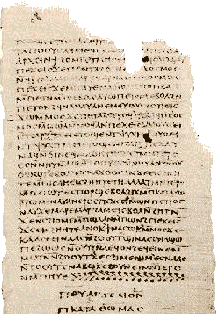
The Nag Hammadi Library, a collection of thirteen ancient codices containing over fifty texts, was discovered in upper Egypt in 1945.

This immensely important discovery includes a large number of primary Gnostic scriptures – texts once thought to have been entirely destroyed during the early Christian struggle to define “orthodoxy” — scriptures such as the Gospel of Thomas, the Gospel of Philip, and the Gospel of Truth.

The discovery and translation of the Nag Hammadi library, completed in the 1970’s, has provided impetus to a major re-evaluation of early Christian history and the nature of Gnosticism.

Several of the major texts in the Nag Hammadi collection have more than one English translation; where more than one translation is available, we have listed the translators’ names in parenthesis below the name of the text.

Texts marked with the {*} had more than one version extant within the Nag Hammadi codices; often these several versions were used conjointly by the translators to provide the single translation presented here.

An Overview of the Nag Hammadi Texts

When analyzed according to subject matter, there are six separate major categories of writings collected in the Nag Hammadi codices:

  • Writings of creative and redemptive mythology, including Gnostic alternative versions of creation and salvation:
    • The Apocryphon of John
    • The Hypostasis of the Archons
    • On the Origin of the World
    • The Apocalypse of Adam
    • The Paraphrase of Shem


  • Observations and commentaries on diverse Gnostic themes, such as the nature of reality, the nature of the soul, the relationship of the soul to the world:
    • The Gospel of Truth
    • The Treatise on the Resurrection
    • The Tripartite Tractate
    • Eugnostos the Blessed
    • The Second Treatise of the Great Seth
    • The Teachings of Silvanus
    • The Testimony of Truth
  • Liturgical and initiatory texts:
    • The Discourse on the Eighth and Ninth
    • The Prayer of Thanksgiving
    • A Valentinian Exposition
    • The Three Steles of Seth
    • The Prayer of the Apostle Paul
    • (The Gospel of Philip, listed under the sixth category below, has great relevance here also, for it is in effect a treatise on Gnostic sacramental theology)
  • Writings dealing primarily with the feminine deific and spiritual principle, particularly with the Divine Sophia:
    • The Thunder
    • Perfect Mind
    • The Thought of Norea
    • The Sophia of Jesus Christ
    • The Exegesis on the Soul
  • Writings pertaining to the lives and experiences of some of the apostles:
    • The Apocalypse of Peter
    • The Letter of Peter to Philip
    • The Acts of Peter and the Twelve Apostles
    • The (First) Apocalypse of James
    • The (Second) Apocalypse of James
    • The Apocalypse of Paul
  • Scriptures which contain sayings of Jesus as well as descriptions of incidents in His life:
    • The Dialogue of the Saviour
    • The Book of Thomas the Contender
    • The Apocryphon of James
    • The Gospel of Philip
    • The Gospel of Thomas


This leaves a small number of scriptures of the Nag Hammadi Library which may be called “unclassifiable.”

It also must be kept in mind that the passage of time and translation into languages very different from the original have rendered many of these scriptures abstruse in style. Some of them are difficult reading, especially for those readers not familiar with Gnostic imagery, nomenclature and the like. Lacunae are also present in most of these scriptures — in a few of the texts extensive sections have been lost due to age and deterioration of the manuscripts.

The most readily comprehensible of the Nag Hammadi scriptures is undoubtedly The Gospel of Thomas, with The Gospel of Philip and the The Gospel of Truth as close seconds in order of easy comprehension. (These texts were all also thankfully very well preserved and have few lacunae.)

There are various translations of most of these scriptures available; the most complete being the one volume collection The Nag Hammadi Library in English, edited by James Robinson, from which the translations presented here are principally quoted.

Read “The Dead Sea Scrolls“.

Alphabetical Index


Codex Index

Codex I (The Jung Codex)

  1. The Prayer of the Apostle Paul
  2. The Apocryphon of James:
  3. The Gospel of Truth:*
  4. The Treatise on the Resurrection
  5. The Tripartite Tractate

Codex II

  1. The Apocryphon of John* (long version)
  2. The Gospel of Thomas:
  3. The Gospel of Philip
  4. The Hypostasis of the Archons
  5. On the Origin of the World*
  6. The Exegesis on the Soul
  7. The Book of Thomas the Contender

Codex III

  1. The Apocryphon of John* (short version, used in long version translation above)
  2. The Gospel of the Egyptians*
  3. Eugnostos the Blessed*
  4. The Sophia of Jesus Christ
  5. The Dialogue of the Savior

Codex IV

  1. The Apocryphon of John* (long version)
  2. The Gospel of the Egyptians*

Codex V

  1. Eugnostos the Blessed*
  2. The Apocalypse of Paul
  3. The (First) Apocalypse of James
  4. The (Second) Apocalypse of James
  5. The Apocalypse of Adam

Codex VI

  1. The Acts of Peter and the Twelve Apostles
  2. The Thunder, Perfect Mind
  3. Authoritative Teaching
  4. The Concept of Our Great Power
  5. Plato, Republic 588A-589B
  6. The Discourse on the Eighth and Ninth
  7. The Prayer of Thanksgiving
  8. Asclepius 21-29


Codex VII

  1. The Paraphrase of Shem (fragmentary, translation not provided here)
  2. The Second Treatise of the Great Seth
  3. The Apocalypse of Peter
  4. The Teachings of Silvanus
  5. The Three Steles of Seth

Codex VIII

  1. Zostrianos
  2. The Letter of Peter to Philip

Codex IX

  1. Melchizedek
  2. The Thought of Norea
  3. The Testimony of Truth

Codex X

  1. Marsanes

Codex XI

  1. The Interpretation of Knowledge
  2. A Valentinian Exposition
    2a. On the Anointing
    2b. On the Baptism A
    2c. On the Baptism B
    2d. On the Eucharist A
    2e. On the Eucharist B
  3. Allogenes
  4. Hypsiphrone

Codex XII

  1. The Sentences of Sextus
  2. The Gospel of Truth:*
  1. Fragments (translation not provided here)

Codex XIII

  1. Trimorphic Protennoia
  2. On the Origin of the World*


Additional Information

Related Reports

Source

Is our species decaying?

I think also that Darwin’s theori is full of crap:


Image of Yasuo Kuniyoshi with robot baby

Is our species decaying?

Originally published: ufodigest.com, unexplained-mysteries.com & world-mysteries.com
10th April 2010

Yes it all goes against human vanity and we’ll all struggle against accepting it but it may well be the way things are going.

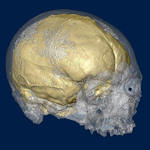
On March 15th 2010 scientists announced that they have recreated a 28,000-year-old skull from remains found in France and have found indications that the human brain is shrinking.1 Cro Magnon1 was discovered among five ancient skeletons in 1868. An initial assessment of the fossil’s skull suggested that the brain it encased was up to 20 per cent larger than modern brains, reversing an earlier trend towards bigger brains. This assessment involved the creation of a three dimensional replica of the brain known as an endocast, made by scanning the interior of the skull to obtain a picture of the impression left by the brain on the neurocranium.

Although this new evidence does not suggest that our ancestors were more intelligent as studies have found that the link between brain size and IQ is not well defined, it does raise some very interesting questions.

The researchers have speculated that the shrinkage in brain size might suggest that our brains are becoming more efficient like shrinking computers. But this may also be a sop to our vanity because if this is indeed the case, why did the human brain ‘evolve’ to be so big in the first place?

Evolutionary theory suggests that advantageous adaptations to the environment are naturally selected through time, in other words those individuals in any particular species who have those advantages will survive longer and produce more offspring. The more the brain grows, the more energy and nutrients it takes away from other vital organs. In fact the brain only takes up 2% of our body weight, but uses 20-25% of our energy intake by far the most of any organ. Thus the natural selection of a larger brain which is to a certain extent redundant and unnecessary is in complete contradiction to the selective mechanism that is presumed to govern human evolution.

Professor John Lorber did a study of individuals who somehow managed to function normally with an IQ over a hundred with only a sliver of brain tissue. One boy had an IQ of 126 and a first class honours degree in mathematics despite the fact he had “virtually no brain”. A CAT scan showed that his skull was lined with a thin layer of brain cells to a millimeter in thickness. The rest of his skull was filled with cerebrospinal fluid.

Of approximately sixty cases of hydrocephalus patients who had 95% of the cranial cavity filled with cerebrospinal fluid, half were profoundly retarded. The other half had IQs greater than 100. He admits that CT scans are not easy to read with pinpoint accuracy but also points out: “I can’t say whether the mathematics student has a brain weighing 50 grams or 150 grams, but it is clear that it is nowhere near the normal 1.5 kilograms.” 2

So if a smaller brain is all that’s necessary how and why did it ‘evolve’ to be so big, keeping all that wasted capacity for so long and wasting huge amounts of energy to maintain it? What then prompted it to shrink about 28,000 years ago? Could the larger brain could have belonged to a superior species who used it to full capacity? Did we devolve from them?

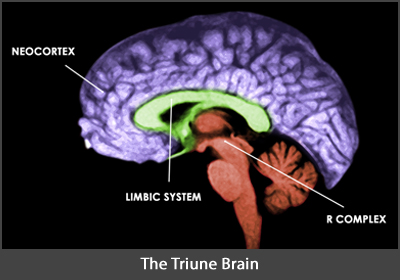
One of our greatest scientists Dr. Paul Maclean, at the Laboratory of Brain Evolution in Poolesville, Maryland, discovered that the brains of higher living organisms were divided into three distinct schemes of tissue. In other words, we have three distinct brains in our body. Dr.Maclean called it the “triune brain.” The three distinct tissue schemes that make up our brain correspond to three distinct behavioural modes. He identified the three tissue schemes respectively as the neocortex, the limbic system, and the cerebellum. 3

Image showing the human brain illustrating the triune brain

Interestingly, despite the overall shrinkage in brain size there has been a growth in the size of the cerebellum, seen by Maclean as the most primitive reactive section of the brain. So any ideas that mankind is evolving into a species centred on the higher brained neo-cortex functions (which govern our ability to reason and think holistically) are without foundation. If the more advanced feature, the neo-cortex is more a feature of the past brain than the present brain then what does that say about the evolutionary premise.

Startling though it might be is it possible that humans and indeed all species once came from ancestries that devolved down from grander, perhaps more ephemeral forms? Forms that perhaps may have had incredible abilities to manipulate physical materiality (matter) as a function of mind empowered by a capacity maybe as much as twenty times larger than ours now.

Our universe is subject to the second law of thermodynamics that breaks all things up into greater and greater states of chaos with time. It could thus be argued that the ordered complexities of living systems could never have arisen from within this system. Sir Fred Hoyle has pointed out that the odds for the origins of life in the first place are outlandishly high. He calculates that the chance of the vital two thousand enzymes being formed in exactly the correct way, which they must be or else complex living organisms simply could not operate, is “about the same as the chance of throwing an uninterrupted sequence of 50,000 sixes with unbiased dice!” 4

Scientists studying mutational phenomena have discovered that there is a blueprint, “an ancestral body plan” that guides development from one species form to another. Instead of inventing a new set of body plan genes for each new type of animal, it seems that natural selection has simply tinkered with an old one, a set known as Hox genes.5 If all organisms that now exist had from their very inception into the evolutionary process a blue-print of how they should evolve, then where did that blueprint come from in the first place? How did the first multi-cellular animals evolving some 700 million years ago contain the basic template of information that only needed to be shuffled around in order to form a human being? All the myriad changing environmental factors and chance mutations-which allowed survival within changed environments and thus evolution through the survival of the fittest-had not yet occurred at that point. So where did the most basic of living organisms, or indeed the chemical soup that produced them in the first place, get this genetic blueprint?

How then can we explain the fossil record that seems to suggest an increase in brain size up to 100,000 years ago? Could it be that the fossil record does not present a single species line of development from Australopithecus to Homo Sapiens Sapiens but instead presents the end points of several species lines as represented by their hominid remains? Michael Cremo has presented evidence that over the past 150 years archaeologists have discovered forms of human skeletal remains, human footprints, and human artefacts tens of millions, even hundreds of millions of years old, going all the way back to about 2 billion years. According to Cremo the archaeological establishment have picked and chosen only those artefacts that conform with evolutionary theory.

A further implication of human devolution is the fact that only 2-3% of the human genome actually codes for the proteins that form the body. Of the remaining 97-98% a fraction has been found to have controlling or regulatory factors to this formation but the rest appears to be redundant. Could this spare DNA also be a remnant of the past, a fossil within the human genome of a superior genotype that used the full 100% of that DNA?

If devolution is the governing momentum that drives living species and prior states are superior to current states it would follow that the earlier state is existentially the more superior one. I am not saying that evolutionary processes like survival of the fittest have no place in ancestral demarcation. They quite clearly do. I am saying that Evolution within an overall Devolutionary process may be the truer and more accurate format of it all. The one that fits all the facts.

Does this imply creationism – would God create imperfect beings from his own state of perfection just to watch the fun? Intelligent Design starts from that same basic premise. Or does it imply instead a non-physical state that would explain the quantum reality that is now accepted by quantum physics? An implicit centre of perfection and therefore perfect freedom to know all options including the option to no longer be perfectly free, perhaps this could be a new frame for the concept of God, a concept that could unite physics, biology and religious belief.

© Nigel Kerner 2010

REFERENCES
1 www.physorg.com
2 John Lorber, “Is Your Brain Really Necessary?” Science (1980) 210: 1232-1234
3 Maclean, Paul, “Ritual and Deceit,” Science Digest, (Nov/Dec 1980).
4 Hoyle, Fred, The Intelligent Universe, (Michael Joseph Ltd, 1983) 12, 19.
5 Reptiles Don’t Leave Evolution To Chance. (New Scientist 16 September 1995)

Source


Zecharia Sitchin, Sumerians, Anunnaki and Nibiru

This is the grandfather of Anunnaki and Nibiru. So if you want to know where all the rumors of these topics come from the source is this guy:

ZechariaSitchin.png
Born July 11, 1920
Baku, Azerbaijan SSR
Died October 9, 2010 (aged 90)
New York, New York
Nationality Azerbaijani
Citizenship United States
Education London School of Economics, University of London
Occupation Author
Known for Ancient astronauts


Zecharia Sitchin (Russian: Заха́рия Си́тчин; Azerbaijani: Zaxariya Sitçin) (July 11, 1920 – October 9, 2010)[1] was an Azerbaijani-born American author of books proposing an explanation for human origins involving ancient astronauts. Sitchin attributes the creation of the ancient Sumerian culture to the Anunnaki, which he states was a race of extraterrestrials from a planet beyond Neptune called Nibiru. He believed this hypothetical planet of Nibiru to be in an elongated, elliptical orbit in the Earth‘s own Solar System, asserting that Sumerian mythology reflects this view. Sitchin’s books have sold millions of copies worldwide and have been translated into more than 25 languages.

Sitchin’s ideas have been rejected by scientists and academics, who dismiss his work as pseudoscience and pseudohistory. His work has been criticized for flawed methodology and mistranslations of ancient texts as well as for incorrect astronomical and scientific claims.[2]

Early life

Sitchin was born in the Azerbaijan SSR, but was raised in Mandatory Palestine. He received a degree in economics from the University of London, and was an editor and journalist in Israel, before moving to New York in 1952. While working as an executive for a shipping company, he taught himself Sumerian cuneiform and visited several archaeological sites.[3][4]

Ideas and works

Similar to earlier authors such as Immanuel Velikovsky and Erich von Däniken, Sitchin advocated hypotheses in which extraterrestrial events supposedly played a significant role in ancient human history.

According to Sitchin’s interpretation of Mesopotamian iconography and symbology, outlined in his 1976 book The 12th Planet and its sequels, there is an undiscovered planetbeyond Neptune that follows a long, elliptical orbit, reaching the inner solar system roughly every 3,600 years. This planet is called Nibiru (although Jupiter was the planet associated with the god Marduk in Babylonian cosmology).[5] According to Sitchin, Nibiru (whose name was replaced with MARDUK in original legends by the Babylonian ruler of the same name in an attempt to co-opt the creation for himself, leading to some confusion among readers) collided catastrophically with Tiamat (a goddess in the Babylonian creation myth the Enûma Eliš), which he considers to be another planet once located between Mars and Jupiter. This collision supposedly formed the planet Earth, the asteroid belt, and the comets. Sitchin states that when struck by one of planet Nibiru’s moons, Tiamat split in two, and then on a second pass Nibiru itself struck the broken fragments and one half of Tiamat became the asteroid belt. The second half, struck again by one of Nibiru’s moons, was pushed into a new orbit and became today’s planet Earth.

According to Sitchin, Nibiru (called “the twelfth planet” because, Sitchin claimed, the Sumerians’ gods-given conception of the Solar System counted all eight planets, plus Pluto, the Sun and the Moon) was the home of a technologically advanced human-like extraterrestrial race called the Anunnaki in Sumerian myth, who Sitchin states are called the Nephilim in Genesis. He wrote that they evolved after Nibiru entered the solar system and first arrived on Earth probably 450,000 years ago, looking for minerals, especially gold, which they found and mined in Africa. Sitchin states that these “gods” were the rank-and-file workers of the colonial expedition to Earth from planet Nibiru.

Sitchin wrote that Enki suggested that to relieve the Anunnaki, who had mutinied over their dissatisfaction with their working conditions, that primitive workers (Homo sapiens) be created by genetic engineering as slaves to replace them in the gold mines by crossing extraterrestrial genes with those of Homo erectus.[6][7] According to Sitchin, ancient inscriptions report that the human civilization in Sumer, Mesopotamia, was set up under the guidance of these “gods”, and human kingship was inaugurated to provide intermediaries between mankind and the Anunnaki (creating the “divine right of kings” doctrine). Sitchin believes that fallout from nuclear weapons, used during a war between factions of the extraterrestrials, is the “evil wind” described in the Lament for Ur that destroyed Ur around 2000 BC. Sitchin states the exact year is 2024 BC.[8] Sitchin says that his research coincides with many biblical texts, and that biblical texts come originally from Sumerian writings.

Influence

Since the release of his first book The 12th Planet in 1976, now in its 45th printing, Sitchin wrote seven other books as part of his Earth Chronicles series, as well as six other companion books, all of which are still in print as of 2012. Sitchin’s books sold millions of copies worldwide and been published in more than 25 languages, as well as in braille.[9] New York Times reporter Corey Kilgannon noted that despite academic dismissal of his work, Sitchin had “a devoted following of readers”.[3]

Critic Michael Heiser called Sitchin “arguably the most important proponent of the ancient astronaut hypothesis over the last several decades”.[10] Sitchin was a frequent guest on the Coast to Coast AM radio show, which in 2010 presented Sitchin with a lifetime achievement award.[11]Gods of the New Millennium author Alan F. Alford admits he initially became “infatuated” with Sitchin’s hypotheses but later became a critic of Sitchin’s interpretations of myth.[12]

According to some writers, Sitchin’s ideas along with those of Erich von Däniken may have influenced the beliefs of the religious sect of Raëlism,[13][14] and writer Mark Pilkington sees the mythology of Japan’s Pana Wave religious group as rooted in Sitchin’s The 12th Planet and its sequels.[15]

The 1994 movie Stargate, directed by Roland Emmerich, and the 2009 video game The Conduit drew some conceptual inspiration from Sitchin’s ideas,[16][17] while screenwriter Roberto Orci says the villains of the film Cowboys & Aliens were inspired by Sitchin’s conceptualization of the Anunnaki as gold-mining aliens.[18]

Criticisms

Criticism of Sitchin’s work falls primarily into three categories: translations and interpretations of ancient texts; astronomical and scientific observations; and literalism of myth.

Translations and interpretations

When Sitchin wrote his books, only specialists could read the Sumerian language. However, sources such as the 2006 book Sumerian Lexicon[19] have made the language more accessible to non-experts.

Ancient language scholar Michael S. Heiser states he has found many inaccuracies in Sitchin’s translations and challenges interested parties to use this book to check their validity.[15][20] Prof. Ronald H. Fritze,[21] author of the book Invented Knowledge: False History, Fake Science and Pseudo-religions,[21] mentions the example of Sitchin’s claim that the Sumerian sign Din-Gir means “pure ones of the blazing rockets”, adding that “Sitchin’s assignment of meanings to ancient words is tendentious and frequently strained.”[22] Fritze also commented on Sitchin’s methodology, writing that “When critics have checked Sitchin’s references, they have found that he frequently quotes out of context or truncates his quotes in a way that distorts evidence in order to prove his contentions. Evidence is presented selectively and contradictory evidence is ignored.”[22]

Sitchin bases his arguments on his personal interpretations of pre-Nubian and Sumerian texts, and the seal VA 243. Sitchin wrote that these ancient civilizations knew of a twelfth planet, when in fact they only knew five.[23] Hundreds of Sumerian astronomical seals and calendars have been decoded and recorded, and the total count of planets on each seal has been five. Seal VA 243 has 12 dots that Sitchin identifies as planets. When translated, seal VA 243 reads “You’re his Servant” which is now thought to be a message from a nobleman to a servant. According to semitologist Michael S. Heiser, the so-called sun on Seal VA 243 is not the Sumerian symbol for the sun but is a star, and the dots are also stars.[23][24] The symbol on seal VA 243 has no resemblance to the hundreds of documented Sumerian sun symbols.

In a 1979 review of The Twelfth Planet, Roger W. Wescott,[25] Professor of Anthropology and Linguistics at Drew University, Madison, New Jersey, noted Sitchin’s amateurishness with respect to the primacy of the Sumerian language:

Sitchin’s linguistics seems at least as amateurish as his anthropology, biology, and astronomy. On p. 370, for example, he maintains that “all the ancient languages … including early Chinese … stemmed from one primeval source — Sumerian”. Sumerian, of course, is the virtual archetype of what linguistic taxonomists call a language-isolate, meaning a language that does not fall into any of the well-known language-families or exhibit clear cognation with any known language. Even if Sitchin is referring to written rather than to spoken language, it is unlikely that his contention can be persuasively defended, since Sumerian ideograms were preceded by the Azilian and Tartarian signaries of Europe as well as by a variety of script-like notational systems between the Nile and Indus rivers.

Astronomical and scientific observations

Sitchin’s “planetary collision” view does superficially resemble a theory by modern astronomers—the giant impact theory of the Moon‘s formation about 4.5 billion years ago by a body impacting with the newly-formed Earth. However, Sitchin’s proposed series of rogue planetary collisions differ in both details and timing. As with Immanuel Velikovsky‘s earlier Worlds in Collision thesis, Sitchin states that he has found evidence of ancient human knowledge of rogue celestial motions in a variety of mythological accounts. In Velikovsky’s case, these interplanetary collisions were supposed to have taken place within the span of human existence, whereas for Sitchin these occurred during the early stages of planetary formation, but entered the mythological account passed down via the alien race which purportedly evolved on Nibiru after these encounters.

According to former Immanuel Velikovsky assistant turned prolific critic,[27] C. Leroy Ellenberger,[27] “[Sitchin states that] from an equal start, the Nefilim evolved on Nibiru 45 million years ahead of comparable development on Earth with its decidedly more favorable environment. Such an outcome is unlikely, to say the least, since Nibiru would spend over 99% of its time beyond Pluto. Sitchin’s explanation that heat from radioactive decay and a thick atmosphere keep Nibiru warm is absurd and does not address the problem of darkness in deep space. Also unexplained is how the Nefilim, who evolved long after Nibiru arrived, knew what happened when Nibiru first entered the solar system.”[28]

The scenario outlined by Sitchin, with Nibiru returning to the inner solar system regularly every 3,600 years,

… implies an orbit with a semi-major axis of 235 astronomical units, extending from the asteroid belt to twelve times farther beyond the sun than Pluto. Elementary perturbation theory indicates that, under the most favorable circumstances of avoiding close encounters with other planets, no body with such an eccentric orbit would keep the same period for two consecutive passages. Within twelve orbits the object would be either ejected or converted to a short period object. Thus, the failed search for a trans-Plutonian planet by T.C. Van Flandern, of the U.S. Naval Observatory, which Sitchin uses to bolster his thesis, is no support at all.[28]

Sitchin in “the case of Adam’s alien genes”[29] states that 223 unique genes found by the Human Genome Sequencing Consortium are without the required predecessors on the genomic evolutionary tree. Later researchers have argued that the conclusion from the Human Genome Sequencing Consortium cannot be drawn due to a lack of a comprehensive gene database for comparison. An analysis by Salzberg identified 40 potential genes laterally transferred into the genome from prokaryotic organisms. Salzberg also argues that gene loss combined with sample size effects and evolutionary rate variation provide an alternative, more biologically plausible explanation.[30]

Literalism of myth

Peter James, co-author of the controversial book Centuries of Darkness,[31] has criticized Sitchin both for ignoring the world outside of Mesopotamia and more specifically for misunderstanding Babylonian literature:

He uses the Epic of Creation Enuma Elish as the foundation for his cosmogony, identifying the young god Marduk, who overthrows the older regime of gods and creates the Earth, as the unknown “Twelfth Planet”. In order to do this he interprets the Babylonian theogony as a factual account of the birth of the other “eleven” planets. The Babylonian names for the planets are established beyond a shadow of a doubt—Ishtar was the deity of Venus, Nergal of Mars, and Marduk of Jupiter—and confirmed by hundreds of astronomical/astrological tables and treatises on clay tablets and papyri from the Hellenistic period. Sitchin merrily ignores all this and assigns unwarranted planetary identities to the gods mentioned in the theogony. For example, Apsu, attested as god of the primeval waters, becomes, of all things, the Sun! Ea, as it suits Sitchin, is sometimes planet Neptune and sometimes a spaceman. And the identity of Ishtar as the planet Venus, a central feature of Mesopotamian religion, is nowhere mentioned in the book—instead Sitchin arbitrarily assigns to Venus another deity from Enuma Elish, and reserves Ishtar for a role as a female astronaut.
[32]

William Irwin Thompson comments on what he calls Sitchin’s ‘literalism’:

What Sitchin sees is what he needs for his hypothesis. So figure 15 on page 40 is radiation therapy, and figure 71 on page 136 is a god inside a rocket-shaped chamber. If these are gods, why are they stuck with our cheap B movie technology of rockets, microphones, space-suits, and radiation therapy? If they are gods, then why can’t they have some really divine technology such as intradimensional worm-hole travel, antigravity, starlight propulsion, or black hole bounce rematerializations? Sitchin has constructed what appears to be a convincing argument, but when he gets close to single images on ancient tablets, he falls back into the literalism of “Here is an image of the gods in rockets.” Suddenly, ancient Sumer is made to look like the movie set for Destination Moon. Erich Von Däniken’s potboiler Chariots of the Gods? has the same problem. Nazca plains in Peru is turned into a World War II landing strip. The gods can cross galactic distances, but by the time they get to Peru, their spaceships are imagined as World War II prop jobs that need an enormous landing strip. This literalization of the imagination doesn’t make any sense, but every time it doesn’t, you hear Sitchin say “There can be no doubt, but…”

Bibliography

Earth Chronicles volumes

  1. The 12th Planet, New York: Stein and Day, 1976, ISBN 0-8128-1939-X
  2. The Stairway to Heaven, 1980, Avon Books (Bear & Company, 1992, ISBN 0-939680-89-0; HarperCollins, 2007, ISBN 0-06-137920-4)
  3. The Wars of Gods and Men, 1985, Avon Books (Bear & Company, 1992, ISBN 0-939680-90-4)
  4. The Lost Realms, Avon Books, 1990, ISBN 0-380-75890-3
  5. When Time Began, 1993, (HarperColins, 2007, ISBN 0-06-137928-X, ISBN 978-0-06-137928-4)
  6. The Cosmic Code, Avon Books, 1998, ISBN 0-380-80157-4
  7. The End of Days: Armageddon and Prophecies of the Return, William Morrow/HarperCollins, 2007, ISBN 978-0-06-123823-9

Companion volumes

  • Genesis Revisited: Is Modern Science Catching Up With Ancient Knowledge?, (Avon Books, 1990, ISBN 0-380-76159-9)
  • Divine Encounters: A Guide to Visions, Angels and Other Emissaries, Avon Books, 1995, ISBN 0-380-78076-3
  • The Lost Book of Enki: Memoirs and Prophecies of an Extraterrestrial god, Bear & Company, 2001, ISBN 1-59143-037-2
  • The Earth Chronicles Expeditions, Bear & Company, 2004, ISBN 978-1-59143-076-6
  • Journeys to the Mythical Past, Bear and Company, 2007 ISBN 978-1-59143-080-3
  • The Earth Chronicles Handbook, Bear & Company, 2009, ISBN 978-1-59143-101-5
  • There Were Giants Upon the Earth: Gods, Demigods, and Human Ancestry: The Evidence of Alien DNA, (Bear & Company), 2010, ISBN 978-1-59143-121-3
  • The King Who Refused to Die: The Anunnaki and The Search for Immortality, Bear & Company, 2013, ISBN 978-1-59143-177-0

DVDs

  • Are We Alone in the Universe? (based on Genesis Revisited), documentary, 1978 (2003 DVD release)[34]
  • An Evening with Zecharia Sitchin, lecture and slide presentation, 1997
  • A Talk From The Heart! lecture and slide presentation, 2006
  • Signs of the Return, lecture and slide presentation, 2009
  • 2012—the End of Days? lecture and slide presentation, 2010
  • Zecharia at 90—Farewell Address, lecture, 2010

Source

Then some videos about Zecharia and his work:


“The ultimate arbiter of truth is experiment, not the comfort one derives from one’s a priori beliefs, nor the beauty or elegance one ascribes to one’s theoretical models.”
LAWRENCE M. KRAUSS, A Universe from Nothing

Anunnaki

This is just awesome topic and we have to start somewhere so first little info and then Coast To Coast AM interview.

The Anunnaki (also transcribed as: Anunna, Anunnaku, Ananaki and other variations) are a group of deities in ancient Mesopotamian cultures (i.e. Sumerian, Akkadian, Assyrian, and Babylonian). The name is variously written “da-nuna”, “da-nuna-ke4-ne”, or “da-nun-na”, meaning something to the effect of “those of royal blood”[1] or “princely offspring”.[2] According to The Oxford Companion to World Mythology, the Anunnaki “are the Sumerian deities of the old primordial line; they are chthonic deities of fertility, associated eventually with the underworld, where they became judges. They take their name from the old sky god An (Anu). [3]

Their relation to the group of gods known as the Igigi is unclear – at times the names are used synonymously but in the Atra-Hasisflood myth the Igigi are the sixth generation of the Gods who have to work for the Anunnaki, rebelling after 40 days and replaced by the creation of humans.[4]

Jeremy Black and Anthony Green offer a slightly different perspective on the Igigi and the Anunnaki, writing that “lgigu or Igigi is a term introduced in the Old Babylonian Period as a name for the (ten) “great gods”. While it sometimes kept that sense in later periods, from Middle Assyrian and Babylonian times on it is generally used to refer to the gods of heaven collectively, just as the term Anunnakku (Anuna) was later used to refer to the gods of the underworld. In the Epic of Creation, it is said that there are 300 lgigu of heaven.”[5]

The Anunnaki appear in the Babylonian creation myth, Enuma Elish.[6] In the late version magnifying Marduk, after the creation of mankind, Marduk divides the Anunnaki and assigns them to their proper stations, three hundred in heaven, three hundred on the earth. In gratitude, the Anunnaki, the “Great Gods”, built Esagila, the splendid: “They raised high the head of Esagila equaling Apsu. Having built a stage-tower as high as Apsu, they set up in it an abode for Marduk, Enlil, Ea.” Then they built their own shrines.

The Annunaki are mentioned in The Epic of Gilgamesh when Utnapishtim tells the story of the flood. The seven judges of hell are called the Annunaki, and they set the land aflame as the storm is approaching.[7]

According to later Assyrian and Babylonian myth, the Anunnaki were the children of Anu and Ki, brother and sister gods, themselves the children of Anshar and Kishar (Skypivot and Earthpivot, the Celestial poles), who in turn were the children of Lahamu and Lahmu (“the muddy ones”), names given to the gatekeepers of the Abzu (House of Far Waters) temple at Eridu, the site at which the creation was thought to have occurred. Finally, Lahamu and Lahmu were the children of Tiamat (Goddess of the Ocean) and Abzu (God of Fresh Water).

Source


Here you can find various articles about Anunnaki, Nibiru etc.

>> http://www.bibliotecapleyades.net/sumer_anunnaki/anunnaki/1-anunnaki-main.html