It’s very disturbing when big corporations plans new ideas without any public approval. One of this is how they want to change our food with genetic modifications and with nanotechnology. I think it’s very dangerous and should be studied a lot more than they are doing. Here’s something about nanotech in our food:
Agency Approves First Use of Viruses as a Food Additive
By THE ASSOCIATED PRESS
Published: August 19, 2006
WASHINGTON, Aug. 18 (AP) ? A mix of bacteria-killing viruses may be sprayed on cold cuts, wieners and sausages to combat common microbes that kill hundreds of people a year, federal health officials ruled Friday.
The ruling, by the Food and Drug Administration, is the first approval of viruses as a food additive, said Andrew Zajac of the Office of Food Additive Safety at the agency. Treatments that use bacteriophages to attack harmful bacteria have been a part of folk medicine for hundreds of years in India and for decades in the former Soviet Union.
The approved mix of six viruses is intended to be sprayed onto ready-to-eat meat and poultry products, including sliced ham and turkey, said John Vazzana, the president and chief executive of Intralytix, which developed the additive.
The viruses, called bacteriophages, are meant to kill strains of the Listeria monocytogenes bacterium, the food agency said. The bacterium can cause a serious infection called listeriosis, primarily in pregnant women, newborns and adults with weakened immune systems. In the United States, an estimated 2,500 people become seriously ill with listeriosis each year, according to the federal Centers for Disease Control and Prevention. Of those, 500 die.
Luncheon meats are particularly vulnerable to Listeria because after they are bought they are typically not cooked or reheated, which can kill harmful bacteria like Listeria, Mr. Zajac said.
The preparation of bacteriophages – the name is from the Greek for ‘bacteria eater’ – attacks only strains of the Listeria bacterium and not human or plant cells, the food agency said.
“As long as it used in accordance with the regulations, we have concluded it’s safe,” Mr. Zajac said.
People normally come into contact with bacteriophages through food, water and the environment, and they are found in our digestive tracts, the agency said.
Consumers will not be aware which meat and poultry products have been treated with the spray, Mr. Zajac said. The Department of Agriculture will regulate the actual use of the product.
The viruses are grown in a preparation of the very bacteria they kill, and then purified. The food agency had concerns that the virus preparation could contain toxic residues from the bacteria, but testing did not reveal residues, which in small quantities are not likely to cause health problems anyway, the agency said.
“The F.D.A. is applying one of the toughest food-safety standards which they have to find this is safe,” said Caroline Smith DeWaal, director of food safety for the Center for Science in the Public Interest, a consumer advocacy group. “They couldn’t approve this product if they had questions about its safety.”
Intralytix, based in Baltimore, first petitioned the food agency in 2002 to allow the viruses to be used as an additive. It has since licensed the product to a multinational company, which intends to market it worldwide, Mr. Vazzana said.
N.Y. Times Cites Consumers Union & OCA
Nanotech Food is Ten Times Scarier Than Genetically Engineered
Engineering Food at Level of Molecules
By Barnaby J. Feder
The New York Times, Oct 10, 2006
Straight to the Source
What if the candy maker Mars could come up with an additive to the coating of its M&M’s and Skittles that would keep them fresher longer and inhibit melting? Or if scientists at Unilever could shrink the fat particles (and thereby the calories) in premium ice cream without sacrificing its taste and feel?
Tastes Like Nanotechnology
These ideas are still laboratory dreams. The common thread in these research projects and in product development at many other food companies is nanotechnology, the name for a growing number of techniques for manipulating matter in dimensions as small as single molecules.
Food companies remain wary of pushing the technology – which is named for the nanometer, or a billionth of a meter – too far and too fast for safety-conscious consumers. But they are tantalized by nanotechnology’s capacity to create valuable and sometimes novel forms of everyday substances, like food ingredients and packaging materials, simply by reducing them to sizes that once seemed unimaginable.
Most of the hoopla and a lot of the promise for nanotechnology lies in other industries, including electronics, energy and medicine. But the first generation of nanotechnology-based food industry products, including synthetic food colorings, frying oil preservatives and packaging coated with antimicrobial agents, has quietly entered the market.
The commercial uses of the technology now add up to a $410 million sliver of the $3 trillion global food market, according to Cientifica, a British market research firm that specializes in nanotechnology coverage. Cientifica forecasts that nanotechnology’s share will grow to $5.8 billion by 2012, as other uses for it are developed.
Mindful of the adverse reaction from some consumers over the introduction of genetically engineered crops, the food industry hopes regulators will come up with supportive guidelines that will also allay consumers’ fears. That has put a spotlight on the Food and Drug Administration’s first public hearing today on how it should regulate nanotechnology, with a portion of the agenda specifically about food and food additives. No policy changes are expected this year.
“To their credit, the F.D.A. is trying to get a handle on what’s out there,” said Michael K. Hansen, senior scientist at Consumers Union, one of 30 groups that have signed up to speak at the meeting.
But coping with nanotechnology will be a daunting challenge for the agency, according to a report last week by a former senior F.D.A. official, whose analysis was sponsored by the Pew Charitable Trusts and the Woodrow Wilson International Center for Scholars, a Washington policy group. Michael R. Taylor, a former deputy commissioner for policy at the agency, said the F.D.A. lacked the resources and, in the case of cosmetics, dietary supplements and food, the full legal authority needed to protect consumers and also foster innovation.
Industry representatives and analysts are worried that nanotechnology will suffer the same fate as genetic engineering, which was quickly embraced as a breakthrough for drug makers but has been fiercely opposed, especially in Europe, when used in crops, fish and livestock.
Many of the same groups fighting genetic engineering in agriculture have been arguing for regulators to clamp down on nanotechnology, in general, and its use in food and cosmetics, in particular, until more safety testing has been completed.
“I’m amazed at how far it’s gone already,” said Ronnie Cummins, director of the Organic Consumers [Association], an advocate for organic products based in Finland, Minn. “Compared to nanotechnology, I think the threat of genetic engineering is tame.”
So far, there have been no confirmed reports of public health or environmental problems related to nanotechnology. But troubling laboratory tests suggest some nanoscale particles may pose novel health risks by, for instance, slipping easily past barriers to the brain that keep larger particles out. Thus, the same attributes that could make the technology valuable for delivering drugs could also make it hazardous.
More important, everyone agrees that there have been few rigorous studies of the actual behavior of the newly engineered nanoscale materials in humans and the environment. Those that have been completed fall far short of duplicating the range of conditions the nanoparticles would encounter in general commerce. And few laboratory studies have focused on the fate of particles that are eaten rather than inhaled or injected.
“Lack of evidence of harm should not be a proxy for reasonable certainty of safety,” the Consumers Union said in testimony submitted to the F.D.A. for today’s meeting. The language was carefully chosen.
“Reasonable certainty of safety” is what food companies must demonstrate to the F.D.A. before they can introduce a new food additive.
The Consumers Union and some other groups are suggesting that the agency automatically classify all new nanoscale food ingredients, including those now classified as safe in larger sizes, as new additives. And they want the same standards extended to cover food supplement companies, some of which have been marketing traditional herbal and mineral therapies in what they say are new nanoscale forms that increase their effectiveness. Some are also calling for mandatory labeling of products with synthetic nanoscale ingredients, no matter how small the quantity.
F.D.A. officials said last week that treating every new nanotechnology product that consumers swallow as a food additive might compromise the agency’s mandate to foster innovation and might not be within its authority. Such a move would also be hobbled by the lack of agreement on safety testing standards for the wide range of nanoscale innovations in the pipeline. In addition, the agency lacks the staff to handle that scale of oversight.
“That would be a sea change for us,” said Laura Tarantino, director of the F.D.A.’s Office of Food Additive Safety.
Simply defining nanotechnology may also be a hurdle. BASF has been widely considered a pioneer for products like its synthetic lycopene, an additive that substitutes for the natural lycopene extracted from tomatoes and other fruits. Lycopene, widely used as a food coloring, is increasingly valued for its reported heart and anticancer benefits. But BASF’s particles average 200 to 400 nanometers in diameter, about the same as the natural pigment, and well above the 100-nanometer threshold that many experts consider true nanotechnology.
Unilever has never disclosed the dimensions of its shrunken fat particles. Trevor Gorin, a Unilever spokesman in Britain, said in an e-mail message that reports about the project have been misleading.
Given the uncertainty about the risks of consuming new nano products, many analysts expect near-term investment to focus on novel food processing and packaging technology. That is the niche targeted by Sunny Oh, whose start-up company, OilFresh, based in Sunnyvale, Calif., is marketing a novel device to keep frying oil fresh. OilFresh grinds zeolite, a mineral, into tiny beads averaging 20 nanometers across and coats them with an undisclosed material. Packed into a shelf inside the fryer, the beads interfere with chemical processes that break down the oil or form hydrocarbon clusters, Mr. Oh says. As a result, restaurants can use oil longer and transfer heat to food at lower temperatures, although they still need traditional filters to remove food waste from the oil.
Mr. Oh said OilFresh will move beyond restaurants into food processing by the end of the month, when it delivers a 1,000-ton version of the device to a “midsized potato chip company” that he said did not want to be identified.
The desire to avoid controversy has made even the largest food companies, like Kraft Foods, leery about discussing their interest in nanotechnology. Kraft, the second-largest food processor after Nestle, was considered the industry’s nanotechnology pacesetter in 2000. That is when it announced the founding of an international alliance of academic researchers and experts at government labs to pursue basic research in nanotechnology sponsored by Kraft.
The Nanotek Consortium, as Kraft called the group, produced a number of patents for the company, but Kraft pulled back from its high-profile connection with nanotechnology two years ago. Manuel Marquez, the research chemist Kraft appointed to organize the consortium, moved to Philip Morris USA, a sister subsidiary of Altria that now sponsors the consortium under a new name – the Interdisciplinary Network of Emerging Science and Technologies.
Kraft still sends researchers to industry conferences to make what it calls “generic” presentations about the potential uses of nanotechnology in the food industry. But the company declines to specify its use of or plans for the technology.
F.D.A. officials say companies like Kraft are voluntarily but privately providing them with information about their activities. But many independent analysts say the level of disclosure to date falls far short of what will be needed to create public confidence.
“Most of the information is in companies and very little is published,” said Jennifer Kuzma, an associate director of the Center for Science, Technology, and Public Policy at the University of Minnesota, who has been tracking reports of nanotechnology use in food and agriculture.
U.S. FDA Told to Watch Nanotech Products for Risks
By Lisa Richwine
Reuters
October 11, 2006
BETHESDA, Md. — The growing number of cosmetics, drugs other products made using nanotechnology need more attention from U.S. regulators to make sure they are safe for humans and the planet, consumer and environmental groups told a government hearing Tuesday.
Nanotechnology is the design and use of particles as small as one-billionth of a meter. A human hair, by contrast, is about 80,000 nanometers across. Materials at nano-size can have completely different properties from larger versions, such as unusual strength or the ability to conduct electricity.
Witnesses at a meeting called by the U.S. Food and Drug Administration agreed nanotechnology holds promise for a vast range of products, including new medicines to treat diseases or delivery systems to get drugs to body parts now hard to reach.
But some complained that dozens of cosmetics and a handful of drugs made with nanomaterials already have made it to the market while regulators have done little to track their use or safety.
“Unfortunately, so far the U.S. government has acted as a cheerleader, not a regulator, in addressing the nanotech revolution. Health and environmental effects have taken a back seat,” said Kathy Jo Wetter of ETC Group, an organization that tracks the impact of new technologies.
The FDA has treated products made with nanotechnology the same way it handles others. For drugs with nanomaterials, that means companies must provide evidence of safety and effectiveness before they reach the market. But cosmetics, foods and dietary supplements are not subject to FDA oversight before they are sold — with or without nanoparticles.
While no harm has been documented, concerns have arisen that the tiny particles are unpredictable and could have unforeseen impacts in the human body or in the environment.
As they called for close FDA oversight, many experts said they felt the agency was ill-equipped to regulate the new technology in the midst of other responsibilities.
“New nano-enabled drugs and medical devices … place burdens on an oversight agency that is already stretched extremely thin,” said David Rejeski, director of the Project on Emerging Nanotechnologies, a group aimed at helping society anticipate and manage effects of nanotechnology.
The FDA has created an internal task force on nanotechnology, and officials said they called the meeting to learn what scientific issues the agency should address.
The task force is due to report to the commissioner in nine months, said Dr. Randall Lutter, FDA’s associate commissioner for policy and planning.
“It’s not only the risks, it’s also looking at the potential. There’s a lot of opportunity… to bring great things to patients,” he said at the meeting.
Industry groups and some other experts urged the agency not to overreact.
“The key is to manage the risk while achieving the maximum benefit from these materials. It would be wrong for us to over-regulate,” said Martin Philbert of the University of Michigan School of Public Health.
Engineering Food at Level of Molecules
The New York Times
Published: October 10, 2006
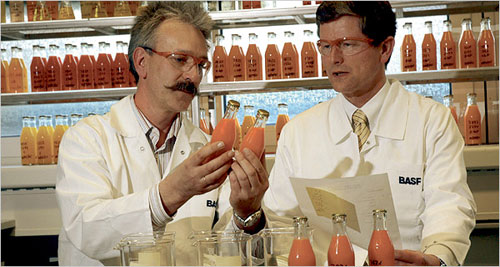
At the BASF Beverage Lab in Ludwigshafen, Germany, Andreas Hasse, left, and Clemes Sambale
assess drinks that were made with synthetic beta-carotene, a nanoparticle used to add color and health benefits.
What if the candy maker Mars could come up with an additive to the coating of its M&M’s and Skittles that would keep them fresher longer and inhibit melting? Or if scientists at Unilever could shrink the fat particles (and thereby the calories) in premium ice cream without sacrificing its taste and feel?
These ideas are still laboratory dreams. The common thread in these research projects and in product development at many other food companies is nanotechnology, the name for a growing number of techniques for manipulating matter in dimensions as small as single molecules.
Food companies remain wary of pushing the technology — which is named for the nanometer, or a billionth of a meter — too far and too fast for safety-conscious consumers. But they are tantalized by nanotechnology’s capacity to create valuable and sometimes novel forms of everyday substances, like food ingredients and packaging materials, simply by reducing them to sizes that once seemed unimaginable.
Most of the hoopla and a lot of the promise for nanotechnology lies in other industries, including electronics, energy and medicine. But the first generation of nanotechnology-based food industry products, including synthetic food colorings, frying oil preservatives and packaging coated with antimicrobial agents, has quietly entered the market.
The commercial uses of the technology now add up to a $410 million sliver of the $3 trillion global food market, according to Cientifica, a British market research firm that specializes in nanotechnology coverage. Cientifica forecasts that nanotechnology’s share will grow to $5.8 billion by 2012, as other uses for it are developed.
Mindful of the adverse reaction from some consumers over the introduction of genetically engineered crops, the food industry hopes regulators will come up with supportive guidelines that will also allay consumers’ fears. That has put a spotlight on the Food and Drug Administration’s first public hearing today on how it should regulate nanotechnology, with a portion of the agenda specifically about food and food additives. No policy changes are expected this year.
“To their credit, the F.D.A. is trying to get a handle on what’s out there,” said Michael K. Hansen, senior scientist at Consumers Union, one of 30 groups that have signed up to speak at the meeting.
But coping with nanotechnology will be a daunting challenge for the agency, according to a report last week by a former senior F.D.A. official, whose analysis was sponsored by the Pew Charitable Trusts and the Woodrow Wilson International Center for Scholars, a Washington policy group. Michael R. Taylor, a former deputy commissioner for policy at the agency, said the F.D.A. lacked the resources and, in the case of cosmetics, dietary supplements and food, the full legal authority needed to protect consumers and also foster innovation.
Industry representatives and analysts are worried that nanotechnology will suffer the same fate as genetic engineering, which was quickly embraced as a breakthrough for drug makers but has been fiercely opposed, especially in Europe, when used in crops, fish and livestock.
Many of the same groups fighting genetic engineering in agriculture have been arguing for regulators to clamp down on nanotechnology, in general, and its use in food and cosmetics, in particular, until more safety testing has been completed.
“I’m amazed at how far it’s gone already,” said Ronnie Cummins, director of the Organic Consumers Group, an advocate for organic products based in Finland, Minn. “Compared to nanotechnology, I think the threat of genetic engineering is tame.”
So far, there have been no confirmed reports of public health or environmental problems related to nanotechnology. But troubling laboratory tests suggest some nanoscale particles may pose novel health risks by, for instance, slipping easily past barriers to the brain that keep larger particles out. Thus, the same attributes that could make the technology valuable for delivering drugs could also make it hazardous.
More important, everyone agrees that there have been few rigorous studies of the actual behavior of the newly engineered nanoscale materials in humans and the environment. Those that have been completed fall far short of duplicating the range of conditions the nanoparticles would encounter in general commerce. And few laboratory studies have focused on the fate of particles that are eaten rather than inhaled or injected.
“Lack of evidence of harm should not be a proxy for reasonable certainty of safety,” the Consumers Union said in testimony submitted to the F.D.A. for today’s meeting. The language was carefully chosen.
“Reasonable certainty of safety” is what food companies must demonstrate to the F.D.A. before they can introduce a new food additive.
The Consumers Union and some other groups are suggesting that the agency automatically classify all new nanoscale food ingredients, including those now classified as safe in larger sizes, as new additives. And they want the same standards extended to cover food supplement companies, some of which have been marketing traditional herbal and mineral therapies in what they say are new nanoscale forms that increase their effectiveness. Some are also calling for mandatory labeling of products with synthetic nanoscale ingredients, no matter how small the quantity.
F.D.A. officials said last week that treating every new nanotechnology product that consumers swallow as a food additive might compromise the agency’s mandate to foster innovation and might not be within its authority. Such a move would also be hobbled by the lack of agreement on safety testing standards for the wide range of nanoscale innovations in the pipeline.
In addition, the agency lacks the staff to handle that scale of oversight.
“That would be a sea change for us,” said Laura Tarantino, director of the F.D.A.’s Office of Food Additive Safety.
Simply defining nanotechnology may also be a hurdle. BASF has been widely considered a pioneer for products like its synthetic lycopene, an additive that substitutes for the natural lycopene extracted from tomatoes and other fruits. Lycopene, widely used as a food coloring, is increasingly valued for its reported heart and anticancer benefits. But BASF’s particles average 200 to 400 nanometers in diameter, about the same as the natural pigment, and well above the 100-nanometer threshold that many experts consider true nanotechnology.
Unilever has never disclosed the dimensions of its shrunken fat particles. Trevor Gorin, a Unilever spokesman in Britain, said in an e-mail message that reports about the project have been misleading.
Given the uncertainty about the risks of consuming new nano products, many analysts expect near-term investment to focus on novel food processing and packaging technology. That is the niche targeted by Sunny Oh, whose start-up company, OilFresh, based in Sunnyvale, Calif., is marketing a novel device to keep frying oil fresh. OilFresh grinds zeolite, a mineral, into tiny beads averaging 20 nanometers across and coats them with an undisclosed material. Packed into a shelf inside the fryer, the beads interfere with chemical processes that break down the oil or form hydrocarbon clusters, Mr. Oh says. As a result, restaurants can use oil longer and transfer heat to food at lower temperatures, although they still need traditional filters to remove food waste from the oil.
Mr. Oh said OilFresh will move beyond restaurants into food processing by the end of the month, when it delivers a 1,000-ton version of the device to a “midsized potato chip company” that he said did not want to be identified.
The desire to avoid controversy has made even the largest food companies, like Kraft Foods, leery about discussing their interest in nanotechnology. Kraft, the second-largest food processor after Nestlé, was considered the industry’s nanotechnology pacesetter in 2000. That is when it announced the founding of an international alliance of academic researchers and experts at government labs to pursue basic research in nanotechnology sponsored by Kraft.
The Nanotek Consortium, as Kraft called the group, produced a number of patents for the company, but Kraft pulled back from its high-profile connection with nanotechnology two years ago. Manuel Marquez, the research chemist Kraft appointed to organize the consortium, moved to Philip Morris USA, a sister subsidiary of Altria that now sponsors the consortium under a new name — the Interdisciplinary Network of Emerging Science and Technologies.
Kraft still sends researchers to industry conferences to make what it calls “generic” presentations about the potential uses of nanotechnology in the food industry. But the company declines to specify its use of or plans for the technology.
F.D.A. officials say companies like Kraft are voluntarily but privately providing them with information about their activities. But many independent analysts say the level of disclosure to date falls far short of what will be needed to create public confidence.
“Most of the information is in companies and very little is published,” said Jennifer Kuzma, an associate director of the Center for Science, Technology, and Public Policy at the University of Minnesota, who has been tracking reports of nanotechnology use in food and agriculture.
Open Letter to the FDA to Stop Corporations from Lacing Foods, Body Care Products, & Supplements with Dangerous Nanoparticles
By Ronnie Cummins, National Director
Organic Consumers Association
Sept 23, 2006
Acting FDA Commissioner Andrew C. Von Eschenbach
Division of Dockets Management (HFA-305)
Food and Drug Administration
5630 Fishers Lane, Room 1061
Rockville, MD 20852
Dear Commissioner Von Eschenbach,
I write to express my serious concerns about the FDA’s regulatory oversight of nanomaterials in consumer products. Many consumer products containing engineered nanomaterials are already available on U.S. market shelves, including food and food packaging products.
Millions of dollars are being spent by government and industry to apply nanotechnology in areas of food processing, food packaging, and agricultural production. Current nano-food products on the market include a canola oil, a chocolate “slim” shake, a nano-bread, and several nano-food additives and supplements used in soft drinks, lemonades, fruit juices, and margarines. Many food packaging products use nano-composites, nano-clays, and nano-coatings. In addition, if industry observers are correct, hundreds of more new food and agriculture products are under development and many could be on the market in as few as two years. By 2010 the nano-food market will be $20 billion. Many of the world’s leading food companies – including H.J. Heinz, Nestle, Hershey, Unilever, and Kraft – are investing heavily in nanotechnology applications.
Scientists have found that the fundamental properties of matter can change at the nano-scale, creating physical and chemical properties distinct from those of the same material in bulk form. We know that the new properties of nanomaterials create new risks, like enhanced toxicity. Studies have raised numerous red flags, and many types of nanoparticles have proven to be toxic to human tissue and cells.
Nanoparticles can gain assess to the blood stream following ingestion. Once inside the body, the super-tiny size of these materials gives them unprecedented mobility and access to the human body; they can access cells, tissues, and organs that larger particles cannot. The length of time that nanoparticles remain in organs and what dose may cause harmful effects remains unknown.
It does not appear that FDA is ready for this wave of nano-food products. I am very concerned about the rapid introduction of these potentially hazardous nanomaterials into our bodies and into our environment without adequate scientific study to ensure that we understand their risks and can prevent harm occurring to people and the environment. The FDA’s failure to undertake or review new testing of these nanomaterials despite these known and foreseeable dangers suggests the agency’s review process is not acting to ensure consumer health and safety.
For these reasons, I strongly request that FDA use its upcoming Public Meeting and its new Nanotechnology Task Force to discuss the human health and environmental risks presented by nanomaterials in consumer products, including food and food packaging products. FDA should act quickly to shore up its regulation of these substances to account for their fundamentally different properties and their associated dangers, including require new nano-specific testing and the labeling of all nanomaterial products, including nano-food products.
Currently, FDA’s reliance on manufacturers’ assurances of safety make me and my family into guinea pigs. FDA must instead independently review all testing and assess the safety of these products as well as force manufacturers to label their nanomaterial products. Only with labeling can I make educated decisions about what I buy and put in and on my body. Until such actions are taken, I fully support a moratorium on the manufacture of nanomaterial consumer products and the recall of products currently on the market.
Ronnie Cummins
National Director
Organic Consumers Association
Finland, Minnesota 55603
FDA not ‘nano-ready’, says report
By Clarisse Douaud
10/5/2006
A former FDA deputy commissioner for policy has denounced the agency’s capacity to properly regulate nanotechnology products including supplements, a criticism that could inflame debate leading up to the agency’s first major public meeting on the atomic technology.
In a report commissioned by the Woodrow Wilson Center’s project on emerging nanotechnologies, University of Maryland School of Medicine professor Michael Taylor concluded the US Food & Drug Administration’s resource base is severely eroded. This is despite what appears to be a recent nanotechnology policy kick-start at the FDA.
The report reveals regulatory weaknesses affecting new products, such as certain dietary supplements and cosmetics, using the technology. Critics say questions over nanotechnology safety have not been answered and the FDA is not in a position to effectively police it.
“Unless the FDA addresses potential nanotechnology risks now, public confidence in a host of valuable nanotechnology-based products could be undermined,” wrote Taylor, who was deputy commissioner for policy at the Food and Drug Administration from 1991 to 1994 and currently conducts research on policy, resource, and institutional issues affecting public health agencies.
Nanotechnology is the ability to control things at an atomic and molecular scale of between one and 100 nanometers and has been met with enthusiasm across a variety of industries. Critics highlight the murky area of how nanoparticles affect toxicity and say the particles should be treated as new, potentially harmful materials and tested for safety accordingly.
“There are important gaps in FDA’s legal authority that hamper its ability to understand and manage nanotechnology’s potential risks,” wrote Taylor. “This is particularly true in the area of cosmetics and dietary supplements, and in the oversight of products after they reach the marketplace.”
Unlike pharmaceuticals, which must go through a series of pre-market approvals, finished dietary supplements need no pre-market approval. Under the Dietary Supplement Health and Education Act (DSHEA), which is part of the Food and Cosmetics Act, only ingredients not marketed in the US before October 1994 must be approved by FDA before use in consumer products.
Thus, as it stands, pre-market regulation of nanotechnology in dietary supplements does not fall under FDA’s regulatory umbrella, nor – according to Taylor – can it fit into the agency’s budget.
But Taylor points out in the report that the FDA is restricted in what it can do due to a dire lack of funding under the current administration. In order to continue activities mandated in 1996, FDA’s 2006 budget would have to increase by 49 percent, according to Taylor, and under President Bush’s 2007 FDA budget this funding gap will grow to 56 percent.
“But FDA’s lack of ‘nano-readiness’ is about more than dollars,” said Taylor.
“Business and health leaders alike should join in ensuring that FDA has the scientific tools and knowledge it needs to say ‘yes’ to safe and effective new products,” said Taylor.
The market stands to benefit from nanotechnology and therefore also stands to lose a lot, according to Taylor, if it is not thoroughly regulated.
In 2005, nanotechnology was incorporated into more than $30bn in manufactured goods, according to Lux Research, almost double the previous year. The market analyst projects that by 2014, 15 percent of all global manufactured goods will incorporate nanotechnology.
The Washington, DC-based Woodrow Wilson International Center for Scholars initiated its project on emerging nanotechnologies in 2005 with the aim of helping business, government and the public manage possible implications of the technology.
FDA’s nanotechnology public meeting will take place October 10, 2006 in Bethesda, Maryland.
According to FDA, the purpose of the meeting is to help the agency in its understanding of developments in nanotechnology materials relating to FDA-regulated products.
“FDA is interested in learning about the kinds of new nanotechnology material products under development in the areas of foods (including dietary supplements), food and color additives, animal feeds, cosmetics, drugs and biologics, and medical devices…” states an online FDA notice for the upcoming meeting.
Nanotechnology Risks Unknown
Insufficient Attention Paid to Potential Dangers, Report Says
By Rick Weiss
Washington Post Staff Writer
Tuesday, September 26, 2006; Page A12
The United States is the world leader in nanotechnology — the newly blossoming science of making incredibly small materials and devices — but is not paying enough attention to the environmental, health and safety risks posed by nanoscale products, says a report released yesterday by the independent National Research Council.
If federal officials, business leaders and others do not devise a plan to fill the gaps in their knowledge of nanotech safety, the report warns, the field’s great promise could evaporate in a cloud of public mistrust.
“There is some evidence that engineered nanoparticles can have adverse effects on the health of laboratory animals,” the congressionally mandated report said, echoing concerns raised by others at a House hearing last week. Until the risks are better understood, “it is prudent to employ some precautionary measures to protect the health and safety of workers, the public, and the environment.”
The 176-page report, “A Matter of Size,” was prepared under the auspices of the National Academies, chartered to advise Congress on matters of science. It focuses on the National Nanotechnology Initiative, which coordinates and prioritizes federal research in nanotechnology — the fledgling but potentially revolutionary science that deals with materials as small as a billionth of a meter.
At that size, even conventional substances behave in unconventional ways. Some materials that do not conduct electricity or are fragile, for example, are excellent conductors and are extremely strong when made small enough. But nanoparticles can also enter human cells and trigger chemical reactions in soil, interfering with biological and ecological processes.
The report concludes that the U.S. research effort is vibrant and almost certainly the strongest in the world, though a few other countries are close behind. Among the more important unmet needs, it says, is stronger collaboration with the departments of Education and Labor to boost the supply of scientists and technicians with the skills the sector needs.
The report’s concerns about the lack of a federal focus on nanotech health and safety were foreshadowed at a House Science Committee hearing Thursday at which Republicans and Democrats alike took the Bush administration to task over the lack of a plan to learn more about nanotech’s risks.
Committee Chairman Sherwood L. Boehlert (R-N.Y.) accused the administration of “sauntering” toward solutions “at a time when a sense of urgency is required.”
Ranking Democrat Bart Gordon (Tenn.) went further, calling the administration’s latest summary of nanotech research needs, released at the hearing, “a very juvenile piece of work.”
Andrew Maynard, chief science adviser for the Project on Emerging Nanotechnologies, funded in part by the Smithsonian Institution, said the government is spending about $11 million a year on nanotechnology’s potential harms when industry and environmental groups have jointly called for at least $50 million to $100 million a year. Equally important, Maynard said, is the need for a coordinated strategy to spend that money wisely.
About 300 consumer products already contain nanoscale ingredients, Maynard said, including several foods and many cosmetics, with little or no research to document their safety.
The industry is expected to be worth about $2 trillion by 2014.
Norris Alderson, associate commissioner for science at the Food and Drug Administration and chairman of the working group that created the administration’s summary research plan presented to Congress last week, said the document — which was supposed to be delivered six months ago — was meant as “a first step.” Asked by Boehlert if he understood that much more is expected of him and his working group, Alderson responded:
“I think your message is loud and clear.”
Source