Secret Sites part III, Pumapunku – Ancient technology or alien playground?

This complex monument group has fascinated me for years. Who the hell on Earth could do these kind of stone monuments at least 14,000 years ago? Those stones are so precisely cut, that it looks almost impossible to make them with ancient hand tools. If you ask me I would say that something similar modern day water cutting power tools was used. Another thing is the engineering work that has been used on that site. Those massive blocks of stone fits together and they have very sophisticated building method almost like nowadays buildings. So here is first the 12 facts about Puma Punku:

12 Facts about Puma Punku

  1. Puma Punku is so unique in the way that it was constructed and shaped and positioned, that it is the most intriguing ancient site on the planet.
  2. If you look at the stones carefully, you can see some intricate stonework, as though they used machine tools or even lasers. Evidence of ancient civilizations using modern technology? Sure.
  3. At Puma Punku you will find incredible stones with these perfect right angles, smooth as glass, this makes Puma Punku unique and over of the few places on earth to find this type of stone work.
  4. The massive stones were hewn at quarries over 60 miles away.
  5. Puma Punku is located  at an altitude of 12,800 feet, which means it is located above the natural tree line, this means that NO trees grew in that area which means that no trees were cut down in order to use wooden rollers, the question is how did they transport the stones?
  6. Tiahuanaco is located near Puma Punku, less than a quarter mile northeast of Puma Punku. Scientists believe Tiahuanaco was once the center of a civilization with more than 40,000 inhabitants.
  7. Tiahuanaco is probably the greatest Native American civilization that many people haven’t heard of.
  8. It’s said that in Tiahuanaco are all the races of mankind represented, even elongated skulls, people wearing turbans, people with broad noses, people with thin noses, people with thick lips, people with thin lips, and some of the statues are particularly unusual and are unlike the ones found in the nearby area.
  9. One of the most important archaeological artifacts ever discovered in Tiahuanaco or Puma Punku is the famous Fuente Magna Bowl discovered near Tiahuanaco.
  10. The Ceramic bowl, has  Sumerian cuneiform and Proto-Sumerian hieroglyphic written on it.
  11. The megalithic stones found at Puma Punku are among the largest on the planet.
  12. There are stones at Puma Punku that weigh over 100 tons.

by Ivan Petricevic ancient-code.com

– See more at: http://www.ancient-code.com/12-facts-about-puma-punku/#sthash.ZAaYqCvq.dpuf

Then we have some more information about the site:

Pumapunku also called “Puma Pumku” or “Puma Puncu”, is part of a large temple complex or monument group that is part of the Tiwanaku Site near Tiwanaku, Bolivia. Tiwanaku is significant in Incan traditions because it is believed to be the site where the world was created.[1] In Aymara, Puma Punku’s name means “The Door of the Puma”. The Pumapunku complex consists of an unwalled western court, a central unwalled esplanade, a terraced platform mound that is faced with megalithic stone, and a walled eastern court.[2][3][4] The Pumapunku is a terraced earthen mound that is faced with megalithic blocks. It is 167.36 meters wide along its north-south axis and 116.7 meters long along its east-west axis. On the northeast and southeast corners of the Pumapunku it has 20-meter wide projections that extend 27.6 meters north and south from the rectangular mound. The eastern edge of the Pumapunku is occupied by what is called the “Plataforma Lítica.” The Plataforma Lítica consists of a stone terrace that is 6.75 by 38.72 meters in dimension. This terrace is paved with multiple enormous stone blocks. The Plataforma Lítica contains the largest stone slab found in both the Pumapunku and Tiwanaku Site. This stone slab is 7.81 meters long, 5.17 meters wide and averages 1.07 meters thick. Based upon the specific gravity of the red sandstone from which it was carved, this stone slab has been estimated to weigh 131 metric tons.[5] The other stonework and facing of the Pumapunku consists of a mixture of andesite and red sandstone. The core of the Pumapunku consists of clay. The fill underlying selected parts of the edge of the Pumapunku consists of river sand and cobbles instead of clay. Excavations at the Pumapunku have documented “three major building epochs, in addition to small repairs and remodeling.”[2][3][4][5][6]

At its peak, Pumapunku is thought to have been “unimaginably wondrous”,[3] adorned with polished metal plaques, brightly colored ceramic and fabric ornamentation, trafficked by costumed citizens, elaborately dressed priests and elites decked in exotic jewelry. Current understanding of this complex is limited due to its age, the lack of a written record, the current deteriorated state of the structures due to treasure hunting, looting, stone mining for building stone and railroad ballast, and natural weathering.[2][3][5]

The area within the kilometer separating the Pumapunku and Kalasasaya complexes has been surveyed using ground-penetrating radar, magnetometry, induced electrical conductivity, and magnetic susceptibility. The geophysical data collected from these surveys and excavations have revealed in the area between the Pumapunku and Kalasasaya complexes the presence of numerous man-made structures. These structures include the wall foundations of buildings and compounds, water conduits, pool-like features, revetments, terraces, residential compounds, and widespread gravel pavements all of which now lie buried and hidden beneath the modern ground’s surface.[7][8]

Coordinates: 16°33′42″S 68°40′48″W
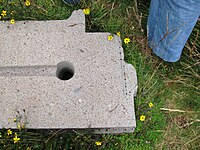
An example of high-precision small holes
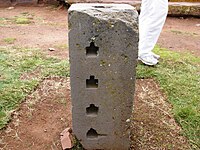
Stone block with a set of blind holes of complex shape
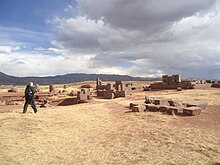
Stone blocks at Pumapunku

Age

Determining the age of the Pumapunku complex has been a focus of researchers since the discovery of the Tiwanaku site. As noted by Andean specialist, Binghamton University Anthropology professor W. H. Isbell,[2] a radiocarbon date was obtained by Vranich[3] from organic material from lowermost and oldest layer of mound-fill forming the Pumapunku. This layer was deposited during the first of three construction epochs and dates the initial construction of the Pumapunku to AD 536–600 (1510 ±25 B.P. C14, calibrated date). Since the radiocarbon date came from the lowermost and oldest layer of mound-fill underlying the andesite and sandstone stonework, the stonework must have been constructed sometime after AD 536–600. The excavation trenches of Vranich show that the clay, sand, and gravel fill of the Pumapunku complex lie directly on the sterile middle Pleistocene sediments. These excavation trenches also demonstrated the lack of any pre-Andean Middle Horizon cultural deposits within the area of the Tiwanaku Site adjacent to the Pumapunku complex.[3]

Engineering
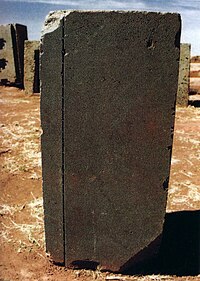
 

Detail of stone with precisely cut straight line and tooled holes within the line
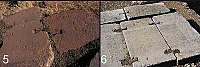
Demonstration of the building block technique

The largest of these stone blocks is 7.81 meters long, 5.17 meters wide, averages 1.07 meters thick, and is estimated to weigh about 131 metric tons (288,805lb). The second largest stone block found within the Pumapunka is 7.90 meters long, 2.50 meters wide, and averages 1.86 meters thick. Its weight has been estimated to be 85.21 metric tons. Both of these stone blocks are part of the Plataforma Lítica and composed of red sandstone.[5] Based upon detailed petrographic and chemical analyses of samples from both individual stones and known quarry sites, archaeologists concluded that these and other red sandstone blocks were transported up a steep incline from a quarry near Lake Titicaca roughly 10 km away. Smaller andesite blocks that were used for stone facing and carvings came from quarries within the Copacabana Peninsula about 90 km away from and across Lake Titicaca from the Pumapunka and the rest of the Tiwanaku Site.[3][5]

Archaeologists argue that the transport of these stones was accomplished by the large labor force of ancient Tiwanaku. Several theories have been proposed as to how this labor force transported the stones although these theories remain speculative. Two of the more common proposals involve the use of llama skin ropes and the use of ramps and inclined planes.[9]

In assembling the walls of Pumapunku, each stone was finely cut to interlock with the surrounding stones and the blocks fit together like a puzzle, forming load-bearing joints without the use of mortar. One common engineering technique involves cutting the top of the lower stone at a certain angle, and placing another stone on top of it which was cut at the same angle.[4] The precision with which these angles have been utilized to create flush joints is indicative of a highly sophisticated knowledge of stone-cutting and a thorough understanding of descriptive geometry.[6] Many of the joints are so precise that not even a razor blade will fit between the stones.[10] Much of the masonry is characterized by accurately cut rectilinear blocks of such uniformity that they could be interchanged for one another while maintaining a level surface and even joints. The blocks were so precisely cut as to suggest the possibility of prefabrication and mass production, technologies far in advance of the Tiwanaku’s Incan successors hundreds of years later.[9] Tiwanaku engineers were also adept at developing a civic infrastructure at this complex, constructing functional irrigation systems, hydraulic mechanisms, and waterproof sewage lines.

Architecture


Demonstration of the building block technique

Puma Punku was a large earthen platform mound with three levels of stone retaining walls.[11] Its layout is thought to have resembled a square.[11] To sustain the weight of these massive structures, Tiwanaku architects were meticulous in creating foundations, often fitting stones directly to bedrock or digging precise trenches and carefully filling them with layered sedimentary stones to support large stone blocks.[9] Modern day engineers argue that the base of the Pumapunku temple was constructed using a technique called layering and depositing. By alternating layers of sand from the interior and layers of composite from the exterior, the fills would overlap each other at the joints, essentially grading the contact points to create a sturdy base.[4][9]

Notable features at Pumapunku are I-shaped architectural cramps, which are composed of a unique copper-arsenic-nickel bronze alloy. These I-shaped cramps were also used on a section of canal found at the base of the Akapana pyramid at Tiwanaku. These cramps were used to hold the blocks comprising the walls and bottom of stone-lined canals that drain sunken courts. I-cramps of unknown composition were used to hold together the massive slabs that formed Pumapunku’s four large platforms. In the south canal of the Pumapunku, the I-shaped cramps were cast in place. In sharp contrast, the cramps used at the Akapana canal were fashioned by the cold hammering of copper-arsenic-nickel bronze ingots.[9][12] The unique copper-arsenic-nickel bronze alloy is also found in metal artifacts within the region between Tiwanaku and San Pedro de Atacama during the late Middle Horizon around 600–900.[13]

Cultural and spiritual significance

It is theorized the Pumapunku complex as well as its surrounding temples, the Akapana pyramid, Kalasasaya, Putuni and Kerikala functioned as spiritual and ritual centers for the Tiwanaku. This area might have been viewed as the center of the Andean world, attracting pilgrims from far away to marvel in its beauty. These structures transformed the local landscape; Pumapunku was purposely integrated with Illimani mountain, a sacred peak that the Tiwanaku possibly believed to be home to the spirits of their dead. This area was believed to have existed between heaven and Earth. The spiritual significance and the sense of wonder would have been amplified into a “mind-altering and life-changing experience”[14] through the use of hallucinogenic plants. Examinations of hair samples exhibit remnants of psychoactive substances in many mummies found in Tiwanaku culture mummies from Northern Chile, even those of babies as young as 1 year of age, demonstrating the importance of these substances to the Tiwanaku.[15]

As was characteristic of civilizations around this time, the Tiwanaku actively incorporated human sacrifice into their culture. The remains of dismembered bodies have been found throughout the area. Ceramic artifacts depict imagery of warriors, masked with puma skulls, decapitating their enemies and holding trophy skulls, adorned with belts of human heads with their tongues torn out.[14] It is believed that, because of certain markings on stones found at Puma Punku, the Gateway of the sun was originally part of Puma Punku.[16]

Peak and decline

The Tiwanaku civilization and the use of these temples appears to some to have peaked from 700 to 1000 AD. by which point the temples and surrounding area may have been home to some 400,000 people. By this point, an extensive infrastructure had been developed with a complex irrigation system running over 30 square miles (80 km2) to support potatoes, quinoa, corn and other various crops. At its peak the Tiwanaku culture dominated the entire Lake Titicaca basin as well as portions of Bolivia and Chile.[17][18]

The culture in question seems to have dissolved rather abruptly some time around 1000 AD and researchers are still seeking answers as to why. A likely scenario involves rapid environmental change, possibly involving an extended drought. Unable to support the massive crop yields necessary for their large population, the Tiwanaku are argued to have scattered into the local mountain ranges only to disappear shortly thereafter.[17][18] Puma Punku is thought to have been abandoned before it was finished.[19]

Source

Here is the full documentary about Pumapunku on History Channel:


So was this site created by ancient human’s with some forgotten technology (anti-gravity, power tools) or aliens? I don’t have a clue, but if I had to bet I would bet that aliens made these megalithic monuments. So no answers, again… but stay tuned for more SECRET SITES!!!

Secret Sites part II, Georgia Guidestones NWO’s Ten Commandments?


Georgia Guidestones
Coordinates 34.231984°N 82.894506°W
Location Elbert County, Georgia, USA
Designer R. C. Christian (pseudonym)
Material Granite
Height 19′ 3″ (5.87 m)
Opening date March 1980


This next secret site holds a very dark mystery and is called “Gerorgia Guidestones”. This monument tells the destruction of mankind as we know it and we don’t know who designed it and why. Here it is:

The Georgia Guidestones is a granite monument in Elbert County, Georgia, USA. A message clearly conveying a set of ten guidelines is inscribed on the structure in eight modern languages, and a shorter message is inscribed at the top of the structure in four ancient languages’ scripts: Babylonian, Classical Greek, Sanskrit and Egyptian hieroglyphs.

The structure is sometimes referred to as an “American Stonehenge.”[1] The monument is 19 feet 3 inches (5.87 m) tall, made from six granite slabs weighing 237,746 pounds (107,840 kg) in all.[2] One slab stands in the center, with four arranged around it. A capstone lies on top of the five slabs, which are astronomically aligned. An additional stone tablet, which is set in the ground a short distance to the west of the structure, provides some notes on the history and purpose of the Guidestones.

History

In June 1979, an unknown person or persons under the pseudonym R. C. Christian hired Elberton Granite Finishing Company to build the structure.[2]

Inscriptions

A message consisting of a set of ten guidelines or principles is engraved on the Georgia Guidestones in eight different languages, one language on each face of the four large upright stones. Moving clockwise around the structure from due north, these languages are: English, Spanish, Swahili, Hindi, Hebrew, Arabic, Chinese and Russian.

  1. Maintain humanity under 500,000,000 in perpetual balance with nature.
  2. Guide reproduction wisely — improving fitness and diversity.
  3. Unite humanity with a living new language.
  4. Rule passion — faith — tradition — and all things with tempered reason.
  5. Protect people and nations with fair laws and just courts.
  6. Let all nations rule internally resolving external disputes in a world court.
  7. Avoid petty laws and useless officials.
  8. Balance personal rights with social duties.
  9. Prize truth — beauty — love — seeking harmony with the infinite.
  10. Be not a cancer on the earth — Leave room for nature — Leave room for nature.

Explanatory tablet

A few feet to the west of the monument, an additional granite ledger has been set level with the ground. This tablet identifies the structure and the languages used on it, lists various facts about the size, weight and astronomical features of the stones, the date it was installed and the sponsors of the project. It also speaks of a time capsule buried under the tablet, but the fields on the stone reserved for filling in the dates on which the capsule was buried and is to be opened are missing, so it is not clear whether the time capsule was ever put in place. Each side of the tablet is perpendicular to one of the cardinal directions, and is inscribed so that the northern edge is the top of the inscription.

The complete text of the explanatory tablet is detailed below. The accompanying image shows the overall layout. The tablet is somewhat inconsistent with respect to punctuation and also misspells “pseudonym”. The original spelling, punctuation and line breaks in the text have been preserved in the transcription which follows.

At the center of each tablet edge is a small circle, each containing a letter representing the appropriate compass direction (N, S, E, W).

At the top center of the tablet is written:

The Georgia Guidestones
Center cluster erected March 22, 1980

Immediately below this is the outline of a square, inside which is written:

Let these be guidestones to an Age of Reason

Around the edges of the square are written the names of four ancient languages, one per edge. Starting from the top and proceeding clockwise, they are:Babylonian (in cuneiform script), Classical Greek, Sanskrit and Ancient Egyptian (in hieroglyphics).

On the left side of the tablet is the following column of text:

Astronomic Features
1. channel through stone
indicates celestial pole.
2. horizontal slot indicates
annual travel of sun.
3. sunbeam through capstone
marks noontime throughout
the year

Author: R.C. Christian
(a pseudonyn) [sic]

Sponsors: A small group
of Americans who seek
the Age of Reason

Time Capsule
Placed six feet below this spot
On
To Be Opened on

The words appear as shown under the time capsule heading; no dates are engraved.

Physical data

On the right side of the tablet is the following column of text (metric conversions added):

PHYSICAL DATA

1. OVERALL HEIGHT – 19 FEET 3 INCHES [5.87 m].
2. TOTAL WEIGHT – 237,746 POUNDS [107,840 kg].
3. FOUR MAJOR STONES ARE 16 FEET,
   FOUR INCHES [4.98 m] HIGH, EACH WEIGHING
   AN AVERAGE OF 42,437 POUNDS [19,249 kg].
4. CENTER STONE IS 16 FEET, FOUR-
   INCHES [4.98 m] HIGH, WEIGHS 20,957
   POUNDS [9,506 kg].
5. CAPSTONE IS 9-FEET, 8-INCHES [2.95 m]
   LONG, 6-FEET, 6-INCHES [1.98 m] WIDE;
   1-FOOT, 7-INCHES [0.48 m] THICK. WEIGHS
   24,832 POUNDS [11,264 kg].
6. SUPPORT STONES (BASES) 7-FEET,
   4 INCHES [2.24 m] LONG 2-FEET [0.61 m] WIDE.
   1 FOOT, 4-INCHES [0.41 m] THICK, EACH
   WEIGHING AN AVERAGE OF 4,875
   POUNDS [2,211 kg].
7. SUPPORT STONE (BASE) 4-FEET,
   2½ INCHES [1.28 m] LONG, 2-FEET, 2-INCHES [0.66 m]
   WIDE, 1-FOOT, 7-INCHES [0.48 m] THICK.
   WEIGHT 2,707 POUNDS [1,228 kg].
8. 951 CUBIC FEET [26.9 m³] GRANITE.
9. GRANITE QUARRIED FROM PYRAMID
   QUARRIES LOCATED 3 MILES [5 km] WEST
   OF ELBERTON, GEORGIA.

Guidestone languages

Below the two columns of text is written the caption “GUIDESTONE LANGUAGES”, with a diagram of the granite slab layout beneath it. The names of eight modern languages are inscribed along the long edges of the projecting rectangles, one per edge. Starting from due north and moving clockwise around so that the upper edge of the northeast rectangle is listed first, they are English, Spanish, Swahili, Hindi, Hebrew, Arabic, Mandarin and Russian. At the bottom center of the tablet is the following text:

Additional information available at Elberton Granite Museum & Exhibit
College Avenue
Elberton, Georgia

Astronomical features

The four outer stones are oriented to mark the limits of the 18.6 year lunar declination cycle.[3] The center column features a hole through which the North Star can be seen regardless of time, as well as a slot that is aligned with the Sun’s solstices and equinoxes. A 7/8″ aperture in the capstone allows a ray of sun to pass through at noon each day, shining a beam on the center stone indicating the day of the year.[2]

Location

The Georgia Guidestones are located on a hilltop in Elbert County, Georgia, approximately 90 miles (140 km) east of Atlanta, 45 miles (72 km) from Athens, and 9 miles (14 km) north of the center of Elberton. The stones are standing on a rise a short distance to the east of Georgia Highway 77 (Hartwell Highway), and are visible from that road. Small signs beside the highway indicate the turnoff for the Guidestones, which is identified by a street sign as “Guidestones Rd.” It is located on the highest point in Elbert County.

Ownership

Elbert County owns the Georgia Guidestones site. According to the Georgia Mountain Travel Association’s detailed history: “The Georgia Guidestones are located on the farm of Mildred and Wayne Mullenix…”[3] The Elbert County land registration system shows what appears to be the Guidestones as County land purchased on October 1, 1979.[4][5]

The monument was unveiled in March 1980, in front of 100 people.[6] Another account specifies March 22, 1980 and says 400 people attended.[2]

In popular culture

The Georgia Guidestones are featured extensively in the Travel Channel episode “Mysteries at the Museum: Monumental Mysteries Special” featuring Don Wildman.[7]

The Georgia Guidestones are featured prominently in the International Emmy nominated conspiracy web series Guidestones.

The guidestones were featured in the Brad Meltzer’s Decoded episode “Apocalypse in Georgia”.

Reception

Yoko Ono and others have praised the inscribed messages as “a stirring call to rational thinking”, while opponents have labeled them as the “Ten Commandments of the Antichrist“.[2]

In 2008, the stones were defaced with polyurethane paint and graffiti with slogans such as “Death to the new world order”.[8] Wired magazine called the defacement “the first serious act of vandalism in the Guidestones’ history”.[2]

Conspiracy theories

The Guidestones have become a subject of interest for conspiracy theorists. One of them, an activist named Mark Dice, demanded that the Guidestones “be smashed into a million pieces, and then the rubble used for a construction project”,[9] claiming that the Guidestones are of “a deep Satanic origin”, and that R. C. Christian belongs to “a Luciferian secret society” related to the New World Order.[2] At the unveiling of the monument, a local minister proclaimed that he believed the monument was “for sun worshipers, for cult worship and for devil worship”.[6]

Radio host and conspiracy theorist Alex Jones, in his 2008 documentary Endgame: Elite’s Blueprint For Global Enslavement, said that “the message of the mysterious Georgia Guidestones, purportedly built by representatives of a secret society called the Rosicrucian Order or Rosicrucians, which call for a global religion, world courts, and for population levels to be maintained at around 500 million, over a 6.5 billion reduction from current levels. The stones imply that humans are a cancer upon the earth and should be culled in order to maintain balance with nature.”[10]

Computer hardware expert Van Smith said the monument’s dimensions predicted the height of the Burj Khalifa, the tallest building in the world which opened in Dubai over thirty years after the Georgia Guidestones were designed. Smith said the builders of the Guidestones were likely aware of the Burj Khalifa project which he compared to the biblical Tower of Babel.[11]

Source

Here is a small documentary about this site:


Here is a different kind of approach to the subject:


Until today there is no answer to this mystery. So are these just guidelines how to live or are these blueprint for NWO to fullfill their apocalytic order of the World? Check it out and stay tuned for more SECRET SITES!!!
Secret Sites part I, Edward Leedskalnin’s Coral Castle


The Thirty Ton Stone.


This next miniseries is about secret sites. These sites can be so secret that you can’t even access them or then there is a some ancient technologies or mysteries on the site. First one in the series is Edward Leedskalnin’s Coral Castle. Very interesting place and I think that Edward possessed some old ancient wisdom and used it to create this awesome park/castle to his wife. Here is a small description about Ed:


Edward Leedskalnin (Latvian: Edvards Liedskalniņš) (January 12, 1887, Stāmeriena parish, Livonia; December 7, 1951, Miami) was an eccentric Latvian emigrant to the United States and amateur sculptor who single-handedly built the monument known as Coral Castle in Florida. He was also known for his unusual theories on magnetism.

Life

Edward Leedskalnin was born January 12, 1887, according to World War I draft registration records, in Stāmeriena parish, Latvia. Little is known of his childhood, aside from the fact that he was not wealthy and achieved only a fourth-grade education. However Edward was a sickly boy, and often spent his time inside reading books — eventually leading him to discontinue his schooling as it “bored him”. For Ed, his development of a yearning to obtain knowledge became a passionate and potent driving force in many endeavours throughout his later life.[1] At the age of 26, he was engaged to marry Agnes Scuffs, a girl ten years younger.[2] However, the girl that Leedskalnin referred to as his “Sweet Sixteen” broke the engagement the night before their wedding, so he emigrated to North America[3] where he found work in various lumber camps in Canada, California, and Texas.

Then, after contracting a case of tuberculosis, Leedskalnin moved to the warmer climate of Florida around 1919, where he purchased a small piece of land in Florida City. Over the next 20 years, Leedskalnin putatively constructed and lived within a massive coral monument he called “Rock Gate Park”, dedicated to the girl who had left him years before. Working alone at night, Leedskalnin eventually quarried and sculpted over 1,100 short tons (997,903 kg) of coral into a monument that would later be known as the Coral Castle. He used various basic tools, several made from timber and parts of an old Ford; first he built a house out of coral and timber, then he gradually built the monuments for which he is famous.[3] In spite of his private nature, he eventually opened his monument to the public, offering tours for 10 cents. He was a surprisingly accommodating host, even cooking hot dogs for visiting children in a pressure cooker of his own invention.[citation needed]

When people asked Leedskalnin how he had moved all of the stone by himself, he refused to give over his method and would only reply to whoever was asking with the same statement: “I understand the laws of weight and leverage and I know the secrets of the people who built the pyramids (being those at the site at Giza in Egypt).”[citation needed]

This building was originally located in Florida City in the 1920s; then in the mid-1930s Leedskalnin hired a truck and driver[3] to move it to its present location on a 10-acre (4.0 ha) site near Homestead, Florida. On November 9, 1951, he checked himself into Jackson Memorial Hospital in Miami. Leedskalnin suffered a stroke at one point, either before he left for the hospital or at the hospital. He died twenty-eight days later of pyleonephritis (a kidney infection) at the age of 64. His death certificate noted that his death was a result of “uremia; failure of kidneys, as a result of the infection and abscess.”[4]

Writings

During his lifetime, Leedskalnin published five pamphlets, advertising them in local newspapers.

Moral education

His first and longest booklet, a treatise on moral education, is printed on only the left-hand pages, and begins with the following preface:

Reader, if for any reason you do not like the things I say in the little book, I left just as much space as I used, so you can write your own opinion opposite it and see if you can do better.
The Author

In the first section, Leedskalnin vents his anger at his “Sweet Sixteen”, arguing that girls should be kept pure, and that boys are primarily a soiling influence upon them. On page 4 of A Book in Every Home, Leedskalnin writes:

Everything we do should be for some good purpose but as everybody knows there is nothing good that can come to a girl from a fresh boy. When a girl is sixteen or seventeen years old, she is as good as she ever will be, but when a boy is sixteen years old, he is then fresher than in all his stages of development. He is then not big enough to work but he is too big to be kept in a nursery and then to allow such a fresh thing to soil a girl — it could not work on my girl. Now I will tell you about soiling. Anything that is done, if it is done with the right party it is all right, but when it is done with the wrong party, it is soiling, and concerning those fresh boys with the girls, it is wrong every time.

The second section continues along the theme of moral education, with several aphorisms aimed at parents regarding the proper way to raise children. The last, “Political” section, reveals that the reclusive Leedskalnin had strong political views. He advocates voting for property owners only (and in proportion to their holdings), and argues that “Anyone who is too weak to make his own living is not strong enough to vote.”

Some writers[who?] have suggested that Leedskalnin’s booklet contains further information on his electromagnetic research and philosophies encoded in its pages, and the blank pages are provided for the reader to fill in their decrypted solutions. It has also been suggested that Leedskalnin’s frequent referral to his “Sweet Sixteen” may in fact refer to the numerological and/or scientific relevance of the number sixteen to his research and theories.[5]

Leedskalnin’s ideas may appear unusual. He wrote that a mother’s most important task is to ensure that her daughter remains “chaste and faithful”:[3]

In case a girl’s mamma thinks that there is a boy somewhere who needs experience then she, herself, could pose as an experimental station for that fresh boy to practise on and so save the girl. Nothing can hurt her any more. She has already gone through all the experience that can be gone through and so in her case it would be all right

Magnetism

Leedskalnin’s other four pamphlets addressed his theories on the interaction of electricity, magnetism and the body; Leedskalnin also included a number of simple experiments to validate his theories.

Contradicting the standard model of electromagnetism, his thesis is based upon the theory that the metal itself is not the magnet; & that the real magnets are circulating in the metal. These individual north and south pole magnets are particles smaller than atoms or photons; & each particle in the substance was an individual magnet by itself.[citation needed]

Leedskalnin claimed that all matter was being acted upon by what he called “individual magnets”. He also claimed that scientists of his time were looking in the wrong place for their understanding of electricity and that they were only observing “one half of the whole concept” with “one sided tools of measurement”. For instance:

Magnets in general are indestructible. For instance you can burn wood and flesh. You can destroy the body, but you cannot destroy the magnets that hold together the body. They go somewhere else. Iron has more magnets than wood, and every different substance has a different number of magnets that hold the substance together. If I make a battery with copper for positive terminal and beef for negative terminal I get more magnets out of it than when I used copper for positive terminal and sweet potato for negative terminal. From this you can see that no two things are alike.[3]

Source

Then we have a description about this awesome place called “Coral Castle” and I think that Edward used some ancient anti-gravity techniques to built it:

Coral Castle is a stone structure created by the Latvian AmericaneccentricEdward Leedskalnin (1887–1951) north of the city of Homestead, Florida in Miami-Dade County at the intersection of South Dixie Highway (U.S. 1) and SW 157th Avenue. The structure comprises numerous megalithic stones (mostly limestone formed from coral), each weighing several tons.[2] It currently serves as a privately operated tourist attraction. Coral Castle is noted for legends surrounding its creation that claim it was built single-handedly by Leedskalnin using reverse magnetism and/or supernatural abilities to move and carve numerous stones weighing many tons.[3]

History

According to the Coral Castle’s own promotional material, Edward Leedskalnin was jilted by his 16-year-old fiancée Agnes Scuffs in Latvia, just one day before the wedding. Leaving for America, he came down with allegedly terminal tuberculosis, but spontaneously healed, stating that magnets had some effect on his disease.

Edward spent over 28 years building the Coral Castle, refusing to allow anyone to view him while he worked. A few teenagers claimed to have witnessed his work, reporting that he had caused the blocks of coral to move like hydrogen balloons. The only tool that Leedskalnin spoke of using was a “perpetual motion holder.”

Leedskalnin originally built the castle, which he named Rock Gate Park, in Florida City, Florida around 1923. He purchased the land from Ruben Moser whose wife helped assist him when he had a very bad bout with tuberculosis.[4] Florida City, which borders the Everglades, is the southernmost city in the United States that is not on an island. It was an extremely remote location with very little development at the time. The castle remained in Florida City until about 1936 when Leedskalnin decided to move and take the castle with him to its final location on 28655 South Dixie Highway Miami, FL 33033. The Coral Castle website states that he chose to move in order to protect his privacy when discussion about developing land in the area of the castle started.[5] He spent three years moving the Coral Castle structures 10 miles (16 km) north from Florida City to its current location in Homestead, Florida.

Leedskalnin continued to work on the castle up until his death in 1951. The coral pieces that are part of the newer castle, not among those transported from the original location, were quarried on the property only a few feet away from the southern wall.

Leedskalnin charged visitors ten cents a head to tour the castle grounds. There are signs carved into rocks at the front gate to “Ring Bell Twice” and a second sign just inside the property that says “Adm. 10c Drop Below”. He would come down from his living quarters in the second story of the castle tower close to the gate and conduct the tour. Leedskalnin never told anyone who asked him how he made the castle. He would simply answer “It’s not difficult if you know how.”

When asked why he had built the castle, Leedskalnin would vaguely answer it was for his “Sweet Sixteen.” This is widely believed to be a reference to Agnes Scuffs (whose surname is given by some sources as “Skuvst”). In Leedskalnin’s own publication A Book in Every Home he implies his “Sweet Sixteen” was more an ideal than a reality. According to a Latvian account, the girl existed, but her name was actually Hermīne Lūsis.[6]

When Leedskalnin became ill in November 1951, he put a sign on the door of the front gate “Going to the Hospital” and took the bus to Jackson Memorial Hospital in Miami. Leedskalnin suffered a stroke at one point, either before he left for the hospital or at the hospital. He died twenty-eight days later of Pyelonephritis (a kidney infection) at the age of 64. His death certificate noted that his death was a result of “uremia; failure of kidneys, as a result of the infection and abscess.”[7]

While the property was being investigated, $3,500 was found among Leedskalnin’s personal belongings. Leedskalnin had made his income from conducting tours, selling pamphlets about various subjects (including magnetic currents) and the sale of a portion of his 10-acre (4.0 ha) property for the construction of U.S. Route 1.[5] Having no will, the castle became the property of his closest living relative in America, a nephew from Michigan named Harry.[8]

The Coral Castle website reports that the nephew was in poor health and he sold the castle to an Illinois family in 1953. However, this story differs from the obituary of a former Coral Castle owner, Julius Levin, a retired jeweler from Chicago, Illinois. The obituary states Levin had purchased the land from the state of Florida in 1952 and may not have been aware there was even a castle on the land.[9]

The new owners changed the name of Rock Gate Park to Coral Castle and turned it into a tourist attraction.[10]

In January 1981, Levin sold the castle to the Coral Castle, Inc. for $175,000.[11] They remain the owners today.

In 1984, the property was listed on the National Register of Historic Places.[1] It was added under the name of “Rock Gate,” but the name on the list was changed to “Coral Castle” in 2011.[12]

The Castle


A view from within Leedskalnin’s Coral Castle.

The grounds of Coral Castle consist of 1,100 short tons (1,000 t) of stones in the form of walls, carvings, furniture and a castle tower. Commonly referred to as being made up of coral, it is made of oolite, also known as oolitic limestone. Oolite is a sedimentary rock composed of small spherical grains of concentrically layered carbonate that may include localized concentrations of fossil shells and coral. Oolite is found throughout southeastern Florida from Palm Beach County to the Florida Keys.[13] Oolite is often found beneath only several inches of topsoil, such as at the Coral Castle site.

The stones are fastened together without mortar. They are set on top of each other using their weight to keep them together. The craftsmanship detail is so skillful and the stones are connected with such precision that no light passes through the joints. The 8-foot (2.4 m) tall vertical stones that make up the perimeter wall have a uniform height. Even with the passage of decades and a direct hit on August 24, 1992, by the Category 5Hurricane Andrew, the stones have not shifted.

Many of the features and carvings of the castle are notable. Among them are a two-story castle tower that served as Leedskalnin’s living quarters (walls consisting of 8-foot high pieces of stone), an accurate sundial, a Polaris telescope, an obelisk, a barbecue, a water well, a fountain, celestial stars and planets, and numerous pieces of furniture. The furniture pieces include a heart-shaped table, a table in the shape of Florida, twenty-five rocking chairs, chairs resembling crescent moons, a bathtub, beds and a throne.

With few exceptions, the objects are made from single pieces of stone that weigh on average 15 short tons (14 t) each. The largest stone weighs 30 short tons (27 t) and the tallest are two monoliths standing 25 ft (7.6 m) each.

A 9-short-ton (8.2 t) revolving 8-foot tall gate is a famous structure of the castle, documented on the television programs In Search of… and That’s Incredible! The gate is carved so that it fits within a quarter of an inch of the walls. It was well-balanced, reportedly so that a child could open it with the push of a finger. The mystery of the gate’s perfectly balanced axis and the ease with which it revolved lasted for decades until it stopped working in 1986. In order to remove it, six men and a 50-short-ton (45 t) crane were used. Once the gate was removed, the engineers discovered how Leedskalnin had centered and balanced it. He had drilled a hole from top to bottom and inserted a metal shaft. The rock rested on an old truck bearing. It was the rusting out of this bearing that resulted in the gate’s failure to revolve. Complete with new bearings and shaft, it was set back into place on July 23, 1986.[14] It failed in 2005 and was again repaired, however it does not rotate with the same ease it once did.

The Coral Castle remains a popular tourist attraction with various pop culture speculations regarding how Leedskalnin was able to construct the structure and move stones that weighed many tons. The Coral Castle site states that “if anyone ever questioned Ed about how he moved the blocks of coral, Ed would only reply that he understood the laws of weight and leverage well.”[5] He also stated that he had “discovered the secrets of the pyramids”,[15] which of course could be interpreted in either esoteric or engineering terms.

Source

Here is a small documentary about Edward:


And here is more about Ed’s techniques and “Coral Castle”. He left some clues to follow in the castle. These clues hold the secret of the Coral Castle (anti-gravity):

>> You can find many more videos in the YouTube if you are intersted about this mystery.

I think that Edward had some ancient information or he got the information somewhere, maybe from the aliens I don’t know. But definitely a topic to look for. Stay tuned for more SECRET SITES!!!
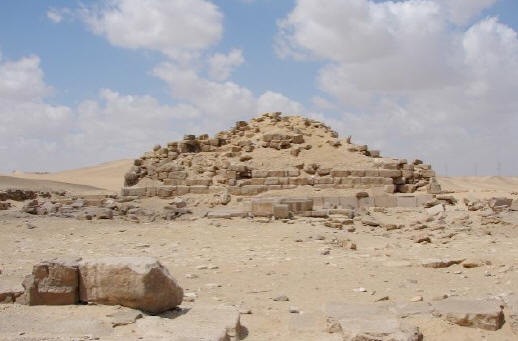
Place Of The Gods – Stargate of Abu Ghurab “the crow’s nest”

We know so little about the ancients times and cultures. We don’t even know how they built the great Pyramids. So here is a place, which we don’t know what these artifact are or what they do. So here is Stargate of Abu Ghurab “the crow’s nest”:

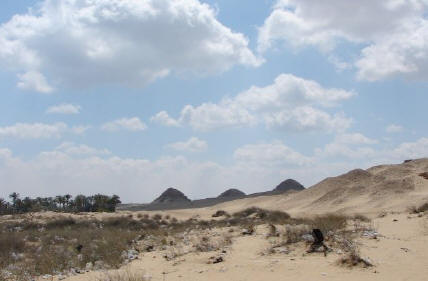
About a 20 minutes drive from the Great Pyramid, and visible from the Giza Plateau on clear day, is one of Egypt’s greatest treasures from antiquity, and one of the most extraordinary places on our planet.


Abu Ghurab, or “the crow’s nest” as it is called, is a closed to the public archaeological site in the pyramid fields that run along side the Nile south of Cairo. Egyptologists quaintly refer to it as a ‘sun temple’, a ‘burial center’ or ‘funerary complex’ for a new cult of Ra (they usually use these terms when the actual function of a place is unclear).


The site of Abu Ghurab is a part of the pyramid complex at Abu Sir.

The name Abu Sir comes from the Greek name for this city, Busiris, which in turn comes from Bu Wizzer or Per Wsir, the “Place of Osiris”, the Egyptian god of resurrection.

 Egyptologists claim it was ‘made’ at the time of the 5th Dynasty of the Old Kingdom Period around 2400 B.C. I use the term ‘made’ for its double meaning. It means ‘created’, but ‘made’ is also a police term for ‘identified’ or ‘discovered’.


In fact, indigenous Egyptian tradition teaches that this site is one of the oldest ceremonial centers on the planet and is a place where the ancients connected with divine energies. Later, it was ‘made’ by a pharaoh.

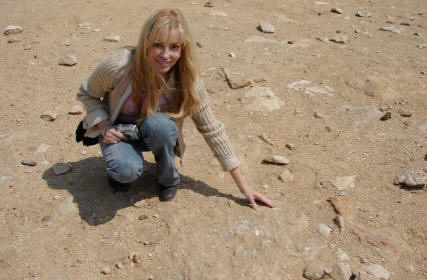
I visited the place three times during my stay in Cairo in March/April 2006 and found some eye-opening connections to both Atlantis and to the Anunnaki gods of Sumeria, which will be shared in these pages.

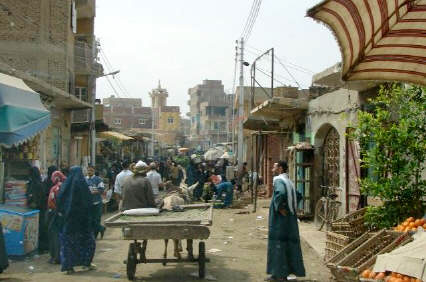
The bustling neighborhood of Abu Gharob is a place where the streets

literally have no names and life has changed little for thousands of years.

Here is a chance to experience ancient Egypt.

On my first visit I was with the National Geographic Channel (NG) who took me to Abu Ghurab to interview me about Egypt’s connections to Atlantis.

According to Plato’s version of the story, which originated in Egypt, Atlantis was a high civilization founded by the gods. They built a temple surrounded by a city formed of concentric rings, which was populated by hybrid god-men.

When this race lost their ‘divine essence’ this brought about the wrath of Zeus, watching from the center of the universe. I believe that Egypt exists in the shadow of Atlantis. It is an echo of this lost realm. After a short Soprano’s style exchange with the Egyptian authorities that guard this site we entered a narrow path cut through a thick mango grove.

When the trees cleared we suddenly entered what felt like a Hollywood movie set for a movie titled Forbidden World, or something like that.

The dunes of the great desert appeared lunar. The three pyramids of Abu Sir, about a mile away, seemed surreal like three elder fires burning for eternity. Strangely, when I stepped onto this ‘set’ I have never felt more at home in a place in my life.
I could hardly wait to get up over the crest of hill in front of me and cross the barrier to Abu Guhrob.

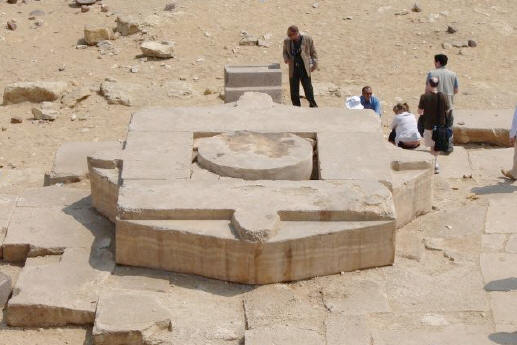
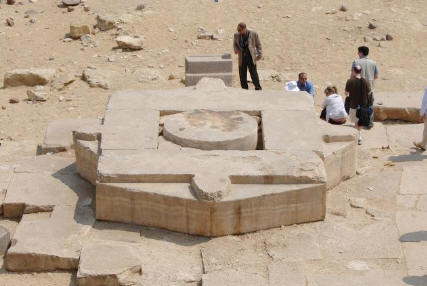
I had been told about a large square structure or platform made of alabaster (‘Egyptian crystal’) that sits in front of the mound where an obelisk stood. The alabaster platform is in the shape of the Khemetian symbol Hotep, translated by Egyptologists as “peace.”


As I mentioned to NG on the way up crest of the hill, to the prophets of the past peace was not the absence of conflict between warring factions or jealous religions. Peace is the unity of heaven and earth.

Was Abu Ghurab where the stargate connection was made?

The Three Pyramids of Abu Sir about a mile south from Abu Ghurab.

After a short walk we entered the gate of the complex. We were alone.

The only sound was that of sand and ancient stones crunching beneath our feet… and a mammoth C-5 military aircraft flying low above us. The stepped pyramid with the alabaster hotep sitting in front of it greeted us. The site appeared as if it had sat undisturbed for millennia.

Everything I knew about Abu Ghurab came from Stephen Mehler, author of Land of Osiris and From Light Into Darkness, and conversations with researcher Bob Vawter. Both men are top-of-the-class students of Abd’El Hakim Awyan, the acclaimed teacher and wayshower of the sacred mysteries of ancient Khemet, the early name for Egypt.

According to Hakim, there exists an immense, relatively unknown oral tradition in Egypt that tells the actual history of Khem. One cannot fully learn this knowledge. Instead, one is ‘gifted’ with it.


Khemet is related to the word alchemy, Al- Khem or Chem, and is thought to designate the mysterious Black Land formed by the Nile. Interestingly, Indian scholars trace it to the Chinese Chin-I or Chin-je, meaning “Juice of Gold.” This alternative definition will appreciate exponentially in significance in a moment once we cross the threshold of the gates of knowledge at Abu Ghurab.


According to traditional Egyptological theory, Abu Ghurab was built by the 5th Dynasty pharaoh Niussere around 2400 B.C.

Known as “the favorite of the Two Ladies” (lucky man) and “the Golden Falcon is divine” he built the temple to worship the god RA or RE (‘ray’).

The mound at Abu Ghurab.

The massive alabaster (Egyptian crystal) platform at Abu Ghurab.

It is a mandala depicting the four directions.


An obelisk (‘sun stick’) once stood atop this mound.

Egyptologists say it was likely around a squat 15 feet tall and was modeled after the sun temple at On or Heliopolis, the site where Akhenaton, and other enlightened ones, was initiated in the esoteric mysteries that made them great mystics.

Pieces of this original sun stick or ben ben are scattered all over the place. In fact, the entire site is one giant debris field with pieces of limestone scattered everywhere that appear to have come from structures that once existed here. According to Mehler’s account in Land of Osiris, ancient Khemetian oral tradition says Abu Ghurab was already ancient by the time of the 5th Dynasty.

Hakim claims this bird’s nest dates deep into pre-history and is one of the oldest ceremonial sites on the entire planet. Moreover, he says the site was designed to create heightened spiritual awareness through the use of vibrations transmitted through the alabaster and other materials. This expanded awareness enabled one to connect with the sacred energies of the universe known as Neters.


In Land of Osiris Mehler notes that indigenous tradition teaches that the Neters themselves, in some sort of physical form, once “landed” and appeared in person at Abu Ghurab.

It is for this reason that this site has been considered sacred for thousands upon thousands of years. Hakim proposes the alabaster platform created a harmonic resonance through sound vibrations to increase the heightened awareness and to further open the senses to “communicate” and be one with the Neters.


Of course, Hakim is describing what is called a “stargate” today.

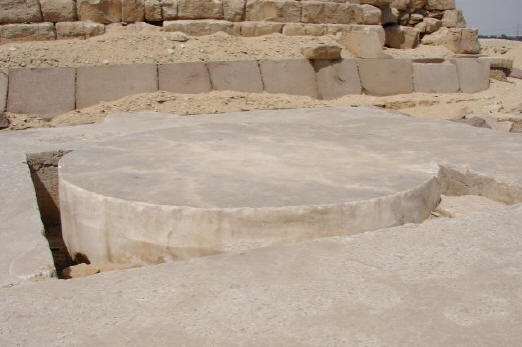
The circular center of the alabaster platform.


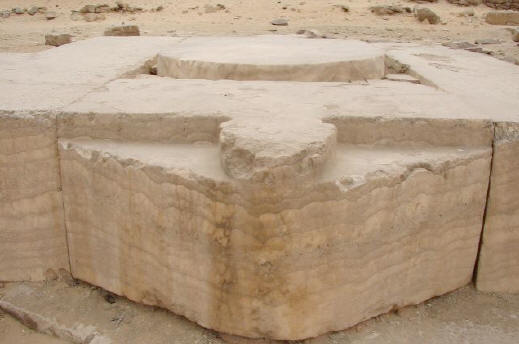
The perfectly smooth sides of the platform suggest advanced machining.

Perfectly circular ‘drill’ mark on the alabaster platform.

Is this also evidence of advanced precision machining?


FORMLESS LIGHT BEINGS


I am highly intrigued by the re-collections and re-memberings concerning the Neter in the Khemetian tradition.

Particularly since Ancient American oral tradition from Tennessee, where I live, retold by Cherokee wisdom keeper Dhyani Yahoo says that formless “thought beings” called TLA beings rode a sound wave from the Pleiades star cluster through a hole in space in East Tennessee and created the Cherokee.

All humans are dream children of these angels or elemental forces who came from the stars. This legend obviously resonates with Khemetian belief concerning Abu Guhrob.

In addition, before my trek to Khem my research was focused on the profound work of Dr. Eve Reymond, a scholar who had explored the ancient Egyptian Building Texts from Edfu, Egypt in her book The Mythical Origin of the Egyptian Temple.

These little known texts also tell of formless beings who came from the stars and created an island civilization in Egypt.

These Sages, as they were called, constructed an original mound where the creation of human kind took place. This island was called the Island of the Egg and was surrounded by the primeval water. By the edge of this lake was a ‘field of reeds’ (Aaru), a fact which will have enormous significance momentarily.

The Edfu tale matches the Atlantis story as told by Plato of a civilization founded by the gods who created a hybrid race of humans. I believe the Edfu Building Texts are the source material for Plato’s story of Atlantis, which he originally learned from Egypt. I further believe that shards of this tale are found in numerous indigenous traditions, and that it may even relate to Abu Guhrob.

The connection is found in the stones.

One telltale characteristic alternative researchers uphold as a trademark of Atlantean temple building is the use of megalithic red granite blocks.

The precision cut and polished red granite facing stones

of the pyramid at Abu Guhrob is a trademark of ‘Atlantean’ construction.

At Abu Gharob one sees colossal red granite blocks weighing several tons that were precision cut, polished and mounted in place as facing stones on the pyramid.

Whoever laid these in place had an accuracy that was extraordinary.

Then, some unknown force caused these casing stones to be scattered like Lego blocks.

The whole place looks as if a massive hand had swatted it like a sand castle. In fact, one gets the compelling feeling that this place was intentionally destroyed by a massive show of force. On my second visit to this ‘stargate’ I learned why this may have been done. As NG cameraman, Rich Confalone, and I surveyed and studied the place together we both agreed that this was one of the strangest places we had ever been.

Rich is a veteran videographer who during the past 18 years has been to virtually every corner of the globe. He’s the cameraman for Josh Bernstein, host of the hit History Channel show Digging for the Truth. He’d said he’d never dug in such mysterious sands before.

About the time I had finished my interview with Rich and the National Geographic producer, Cara Biega, an alarm sounded among the temple guards.

Suddenly, they were telling us in hostile voices that it was time for us to leave, like now. Undeterred, the National Geographic team continued gathering shots while I ran interference with the guards.

Massive granite blocks are strewn about like Lego blocks.

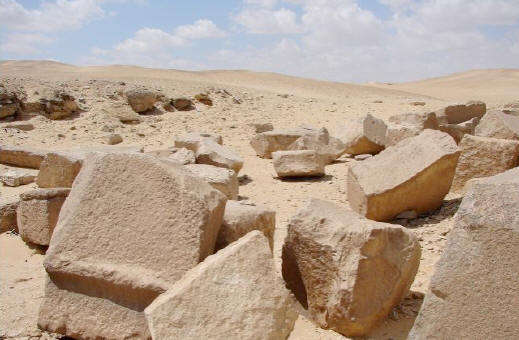
Some titanic force must have scattered these stones.


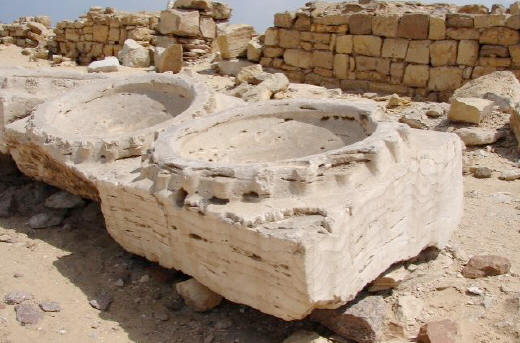
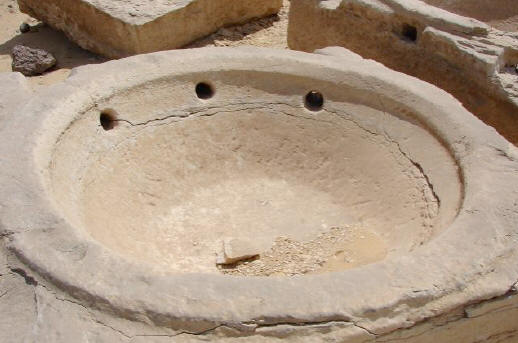
On the way out we took time to examine another of the oddities at Abu Guhrob. Set apart from everything else we had seen were giant square alabaster “dishes” or “basins” with strange gear-like designs on top.

Egyptologists guess that the massive basins were used to hold sacrificial animal blood, which ran through perfectly round channels cut into the paving.

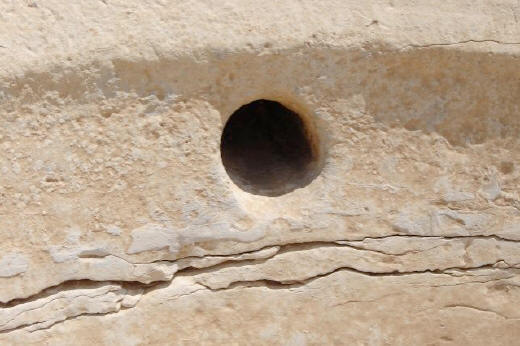
There is not a single drop of DNA or other evidence to support this misconception. Interestingly, the inner surface of the basins are amazingly smooth to the touch and show signs of circular tool marks, suggesting that whoever crafted them did so with a technology we would admire today (and make fortunes marketing, too).

A bunch of the ‘offering basins’ are lined up near the entrance, apparently placed there at some point enroute to another location.

Significantly, a few more are still ‘in situ’.

Two square alabaster basins with strange gear-like tops.


Beautifully round holes in the ‘basins’.

What are they for? How were they drilled?


BLACK SUN RISING


A few days later, the total eclipse of the Sun was approaching. Our ‘cosmic bus’, ‘the Lady Isis’, eased to a stop beside a canal near Abu Guhrob. From the window I noticed that the only way across this particular canal was a bridge made of the trunks of palm trees.

One misstep on this bridge and one would find themselves amalgamating their bodies in a vat of ‘the Nile cocktail’, the filthiest water imaginable. My second trek to Abu Ghurab would prove to be much different from the first. The people that accompanied me there made the difference. One of the greatest pleasures an author can have is to interact with people from the imagi-nation (which fellow traveler Bryan Gore calls the greatest “nation” for man) who passionately follow their bliss.

On this day I participated in a meant-to-be dance of souls that was pure cosmic poetry. The primary cosmic dancer was Ted St. Rain (www.lostartsmedia.com). Any one who has attended a major UFO conference in the past ten years will recognize Ted as the ultra-frenetic video guy who always seems to be running.

What many may not realize is that Ted has an astounding grasp of the ancient mysteries, an understanding that comes from face to face interactions with a who’s who of alternative researchers. Name a UFO, alternative science or ancient history researcher and, chances are, Ted has video taped every major lecture they’ve given. And mastered their material, too.

He’s traveled to Lebanon, Egypt, Palestine and Syria with Sitchin. Few know this genre better than Ted. I’m not sure when the first domino began to fall in Ted’s mind.

However, after only a short time at Abu Ghurab (his first) Ted proclaimed that he had the answer to the question of the purpose of this temple site.

“Has anyone here read The Lost Realms by Zecharia Sitchin?” Ted, began. “I would suggest you get a copy of this book because it will help explain what we are seeing here.”

In his Earth Chronicles series of books Sitchin claims that a race of extraterrestrials called Anunnaki came to Earth over 450,000 years ago in search of gold. In addition to surface mining the Anunnaki used sophisticated water mining techniques to ‘filter’ or the process gold from the waters of Earth.


Abu Ghurab, it seems, may be one of their processing plants.


CROSSING THE THRESHOLD TO THE LOST REALM


The Lost Realms is about the massive pyramids of South American and MesoAmerican cultures and their interactions with gods who set-up pyramid/workshops there.


Sitchin cites the Mexican pyramids of Teotihuacan to support his theory. There are two pyramids – the Pyramid of the Sun and the Pyramid of the Moon – with the Avenue of the Dead running between them. Some scholars believe the Teotihuacan complex was begun 6,000 years ago and was known as the Place of the Gods.

The Pyramid of the Moon is an earthen mound. Some 2,000 feet to the south the path of the Avenue of the Dead reaches the Pyramid of the Sun. These pyramids are virtually identical to the Giza pyramids. Sitchin believes that there is no doubt that the designer of this complex had detailed understanding of the Giza pyramids. The most remarkable correspondence noted by Sitchin is the existence of a lower passageway running underneath the Pyramid of the Sun.

As Sitchin records, in 1971 a complex underground chamber system was discovered directly underneath the Pyramid of the Sun.

A tunnel, seven feet high and extending for almost 200 feet, was also discovered. The floor of this tunnel was divided into segments and drainage pipes (possibly connecting to an underground water source?) were found. The tunnel led to a strange hollowed out area shaped like a cloverleaf and supported by adobe columns and basalt slabs.


The enigma posed by this mysterious subterranean facility was amplified for Sitchin when he observed a path of six segments running along the Avenue of the Dead. These segments were formed by the erection of a series of double walls perpendicular to the course of the Avenue. These six compartments are fitted with sluices at their floor level.

Sitchin proposes that the whole complex served to channel water that flowed down the Avenue. This complex, says Sitchin, was an enormous waterworks, employing water for a technological purpose.


This ceremonial center, notes Sitchin, has artificial water channels running through that diverted water from the nearby San Juan river. The water is channeled into the Ciudadela, a quadrangle that contains at its eastern side a third pyramid, called the Quetzalcoatl Pyramid.


Interestingly, in my lectures at Gouda Fayad’s Tree of Life Conference Center beside the Giza Plateau, I had admonished my tour group that we will be ‘following the water’ in Egypt. Little did I realize at the time that my intuition would prove so accurate.

As Ted continued his brainstorm at Abu Ghurab, he noted a key discovery at Teotihuacan.

Underneath the Pyramid of the Sun archaeologists discovered mica, a dielectric mineral composed of delicate crystal that is a semiconductor. The word “mica” is thought to be derived from the Latin word micare, meaning to shine, in reference to the brilliant appearance of this mineral (especially when in small scales).

Mica has a high dielectric strength and excellent chemical stability, making it a favored material for manufacturing capacitors for radio frequency applications. It has also been used as an insulator in high voltage electrical equipment. Sheet mica is used as an insulating material and as a resonant diaphragm in certain acoustical devices. Sitchin was perplexed by the presence of this mineral beneath the pyramid.

Then he remembered the water flowing from the San Juan River and how it was artificially channeled to this site.

What he proposed is that the river was channeled along the Avenue of the Gods and underneath the pyramid. Through a chemical reaction caused by the mica (or, I wonder, could it have been a harmonic process?) gold was pulled from the river water.


Drainage holes are spread throughout Teotihuacan. Sitchin theorizes these were used to sluice the gold into chambers where the Anunnaki could collect it.

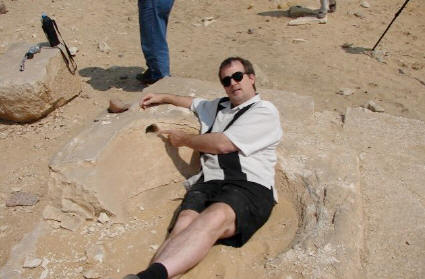
“Just like you see here,” said Ted, pointing to one of the massive square alabaster basins or sluices at Abu Ghurab.

“I was thinking about Sitchin’s theory,” said Ted, “because here’s the pyramid here. Now, keep in mind that 10,000 years ago this area was a lush jungle with water everywhere.”

Indeed, the Abu Ghurab site was beginning to look a lot like the Teotihuacan site.


Those basins, it turns out, were decanters.

The only thing missing was the mica.

Ted St. Rain points to a drainage hole in one of the in-situ alabaster basins.

That’s when Lady Isis intervened. Another traveler in our group was Anya Nadal, an artist and author of Holographic Mandalas (www.eternalimagery.com), who is also a very knowledgeable ‘rock hound’.

It didn’t take very long before she called us together to show us something remarkable: huge sheets of mica in front of the pyramid. Ted was elated with this discovery.

The pieces were falling into place.

Anya Nadal points to the huge sheets of mica in front of the Abu Ghurab pyramid.

As Ted explained,

“the theory is that, like Teotihuacan, Abu Ghurab was a gold refining facility.” (Or, may I suggest, a ‘juice of gold’ production plant?) “What they would do,” Ted proposed, “is bring gold laden water in from the Nile. It would flow over the mica sheets (which may have covered this entire site).”

Through the piezoelectric effect produced by the mica electricity was produced.

The water would be channeled into the basins and would be spun around inside and flow up and out through the round holes in the sides. The gold (or again, how about the juice of gold?) would filter down and remain in the basins to be scooped out at the end of the day.

As Ted proposed, the basins that are today lined up near the entrance were originally placed about every ten feet around the complex. (Stephen Mehler told me in a conversation upon my return that the basins may originally have been arranged in an circular pattern around the pyramid.)


In its original state the Abu Ghurab pyramid may have been a giant machine, especially a water processing plant. We have to imagine water everywhere, in pools in front of the pyramid and perhaps even flowing down from the top of the red granite faced pyramid like a fountain.

The “juice of gold” produced by the piezoelectric effect of the quartz crystal-laden red granite may have been one of the products of this plant. We left Abu Ghurab in high spirits that day.

As Ted remarked,

“this is the third strangest place I’ve ever seen. The first is Baalbek, Lebanon. The second is the Hittite empire.”

For me, it ranks at the top of the list.


Everything I had experienced at Abu Ghurab was ringing in my being when I left Egypt. I wondered it were possible if this – the oldest ceremonial center on the planet – is the original Island of the Egg referred to at Edfu and the original stargate of the gods.

The moment I returned home I hit the books and was intrigued by an initial finding. As noted, the Edfu Texts say the primeval water surrounded the Island of the Egg. By the edge of this island was a ‘field of reeds’ (Aaru).


The use of the word reed is very important. It establishes a link between Abu Ghurab and Teotihuacan. The classic Maya used the word “puh” which meant cat-tail reed, to refer to Teotihuacan.

Although tribes of ancient Mexico reported that they came from a place where reeds grew, no location associated with reeds has been identified as their place of origin.


I believe in coincidences, but like a UFO, I’ve never seen one. In my view, the appellation, “place of reeds,” that identifies both the Egyptian Island of the Egg and Teotihuacan ties these places together. The apparent similarity in purpose of Abu Ghurab and Teotihuacan links these two places together and ties them to the Island of the Egg, the place or stargate of the gods. Tic-tac-toe. All three places are explanatory of one another.


Abu Ghurab is far older than Teotihuacan.

Is it possible, therefore, that this site is the original home of the tribes of ancient Mexico? Interestingly, another name for the place of reeds is Tollan or Tula. The T-L-A root connects with the Cherokee legend of the T-LA beings who came from the Pleiades and settled in East Tennessee.

The T-L-A vibration is also encoded in the place name Atlantis.


FROM OUT OF THE SHADOWS OF ATLANTIS, SHE WALKS LIKE A DREAM


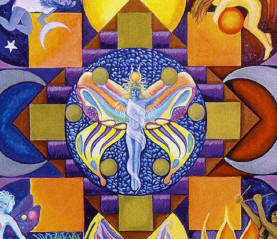
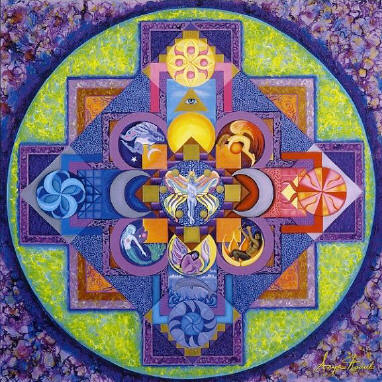
One additional ‘coincidence’ worth mentioning involves the artwork of Anya Nadal. Shown on the next page is Anya’s painting entitled Wisdom from her book Holographic Mandalas. On the next page is the alabaster platform at Abu Ghurab. Not only do the outer patterns of these mandalas match, but also both have a circle in the center.

Anya later told me she immediately recognized the similarity upon seeing the platform. She calls the ethereal being in the center of her painting an ‘Atlantean fairy’. Hmm. I wonder.

Could she have tapped into the ‘stargate consciousness’ of the formless beings, the Neters, who came to Abu Guhrob deep in prehistory?

The ‘Atlantean fairy’

at the center of Anya Nadal’s mandala titled “Wisdom”.

Wisdom, a painting by Anya Nadal, bears a striking similarity to the alabaster platform at Abu Ghurab. Anya’s mandala’s are a form of visual meditation that combine colors and sacred geometry to amplify heightened states of awareness. Gaze at this mandala and connect with hidden parts of yourself.


William Henry with the temple keepers at Abu Ghurab (top) and standing beside the alabaster platform (bottom).


When people discover strange or unusual things on our planet, such as pyramids as gold processing plants or giant alabaster landing platforms, there are, generally speaking, two paths one can take.

  • They are discarded as meaningless out of place artifacts. The inner eye of light closes.
  • Or, they are exalted as evidence of a lost advanced civilization. The inner eye of light opens.

With luck I will one day return to Abu Ghurab to bask in the rays of Ra.

I am certain there is much more here than meets the eye.

Source

Here is the Youtube video of this Stargate:


So if you think wars around the World. Are those wars fought because of oil or are there something more? Maybe technology of the ancients.

Mystery Of The Rosetta Stone


"A large dark grey-coloured slab of stone with text that uses Ancient Egyptian hieroglyphs, demotic and Greek script in three separate horizontal registers"
 

One of the fascinating archeological finding is an artifact called The Rosetta Stone. This piece of history made possible to translate some mysteries of the ancient Pyramids, because it bears three inscriptions: the top register in Ancient Egyptian hieroglyphs, the second in the Egyptian demotic script, and the third in Ancient Greek. Here is the description about the artifact:

The Rosetta Stone is an ancient Egyptiangranodioritestele inscribed with a decree issued at Memphis in 196 BC on behalf of King Ptolemy V. The decree appears in three scripts: the upper text is Ancient Egyptianhieroglyphs, the middle portion Demotic script, and the lowest Ancient Greek. Because it presents essentially the same text in all three scripts (with some minor differences between them), it provided the key to the modern understanding of Egyptian hieroglyphs.

Originally displayed within a temple, the stone was probably moved during the early Christian or medieval period and eventually used as building material in the construction of Fort Julien near the town of Rashid (Rosetta) in the Nile Delta. It was rediscovered there in 1799 by a soldier, Pierre-François Bouchard, of the French expedition to Egypt. As the first Ancient Egyptian bilingual text recovered in modern times, the Rosetta Stone aroused widespread public interest with its potential to decipher this hitherto untranslated ancient language. Lithographic copies and plaster casts began circulating among European museums and scholars. Meanwhile, British troops defeated the French in Egypt in 1801, and the original stone came into British possession under the Capitulation of Alexandria. Transported to London, it has been on public display at the British Museum since 1802. It is the most-visited object in the British Museum.

Study of the decree was already under way as the first full translation of the Greek text appeared in 1803. It was 20 years, however, before the transliteration of the Egyptian scripts was announced by Jean-François Champollion in Paris in 1822; it took longer still before scholars were able to read Ancient Egyptian inscriptions and literature confidently. Major advances in the decoding were: recognition that the stone offered three versions of the same text (1799); that the demotic text used phonetic characters to spell foreign names (1802); that the hieroglyphic text did so as well, and had pervasive similarities to the demotic (Thomas Young, 1814); and that, in addition to being used for foreign names, phonetic characters were also used to spell native Egyptian words (Champollion, 1822–1824).

Ever since its rediscovery, the stone has been the focus of nationalist rivalries, including its transfer from French to British possession during the Napoleonic Wars, a long-running dispute over the relative value of Young’s and Champollion’s contributions to the decipherment, and since 2003, demands for the stone’s return to Egypt.

Two other fragmentary copies of the same decree were discovered later, and several similar Egyptian bilingual or trilingual inscriptions are now known, including two slightly earlier Ptolemaic decrees (the Decree of Canopus in 238 BC, and the Memphis decree of Ptolemy IV, ca. 218 BC). The Rosetta Stone is therefore no longer unique, but it was the essential key to modern understanding of Ancient Egyptian literature and civilization. The term Rosetta Stone is now used in other contexts as the name for the essential clue to a new field of knowledge.

Description

The Rosetta Stone is listed as “a stone of black granite, bearing three inscriptions … found at Rosetta”, in a contemporary catalogue of the artifacts discovered by the French expedition and surrendered to British troops in 1801.[1] At some period after its arrival in London, the inscriptions on the stone were coloured in white chalk to make them more legible, and the remaining surface was covered with a layer of carnauba wax designed to protect the Rosetta Stone from visitors’ fingers.[2] This gave a dark colour to the stone that led to its mistaken identification as black basalt.[3] These additions were removed when the stone was cleaned in 1999, revealing the original dark grey tint of the rock, the sparkle of its crystalline structure, and a pink vein running across the top left corner.[4] Comparisons with the Klemm collection of Egyptian rock samples showed a close resemblance to rock from a small granodiorite quarry at Gebel Tingar on the west bank of the Nile, west of Elephantine in the region of Aswan; the pink vein is typical of granodiorite from this region.[5]

The Rosetta Stone is currently 114.4 centimetres (45 in) high at its highest point, 72.3 cm (28.5 in) wide, and 27.9 cm (11 in) thick. It weighs approximately 760 kilograms (1,700 lb).[6] It bears three inscriptions: the top register in Ancient Egyptian hieroglyphs, the second in the Egyptian demotic script, and the third in Ancient Greek.[7] The front surface is polished and the inscriptions lightly incised on it; the sides of the stone are smoothed, but the back is only roughly worked, presumably because this would have not been visible when it was erected.

Original stele

The Rosetta Stone is a fragment of a larger stele. No additional fragments were found in later searches of the Rosetta site.[9] Owing to its damaged state, none of the three texts is absolutely complete. The top register composed of Egyptian hieroglyphs suffered the most damage. Only the last 14 lines of the hieroglyphic text can be seen; all of them are broken on the right side, and 12 of them on the left. The following register of demotic text has survived best: it has 32 lines, of which the first 14 are slightly damaged on the right side. The final register of Greek text contains 54 lines, of which the first 27 survive in full; the rest are increasingly fragmentary due to a diagonal break at the bottom right of the stone.[10]

The full length of the hieroglyphic text and the total size of the original stele, of which the Rosetta Stone is a fragment, can be estimated based on comparable stelae that have survived, including other copies of the same order. The slightly earlier decree of Canopus, erected in 238 BC during the reign of Ptolemy III, is 219 centimetres (86 in) high and 82 centimetres (32 in) wide, and contains 36 lines of hieroglyphic text, 73 of demotic text, and 74 of Greek. The texts are of similar length.[11] From such comparisons it can be estimated that an additional 14 or 15 lines of hieroglyphic inscription are missing from the top register of the Rosetta Stone, amounting to another 30 centimetres (12 in).[12] In addition to the inscriptions, there would probably have been a scene depicting the king being presented to the gods, topped with a winged disk, as on the Canopus Stele. These parallels, and a hieroglyphic sign for “stela” on the stone itself (Gardiner’s SignO26)

O26

suggest that it originally had a rounded top.[7][13] The height of the original stele is estimated to have been about 149 centimetres (59 in).

Memphis decree and its context

The stele was erected after the coronation of King Ptolemy V, and was inscribed with a decree that established the divine cult of the new ruler.[14] The decree was issued by a congress of priests who gathered at Memphis. The date is given as “4 Xandicus” in the Macedonian calendar and “18 Meshir” in the Egyptian calendar, which corresponds to March 27, 196 BC. The year is stated as the ninth year of Ptolemy V’s reign (equated with 197/196 BC), and it is confirmed by naming four priests who officiated in that same year: Aëtus son of Aëtus was priest of the divine cults of Alexander the Great and the five Ptolemies down to Ptolemy V himself; his three colleagues, named in turn in the inscription, led the worship of Berenice Euergetis (wife of Ptolemy III), Arsinoe Philadelpha (wife and sister of Ptolemy II) and Arsinoe Philopator, mother of Ptolemy V.[15] However, a second date is also given in the Greek and hieroglyphic texts, corresponding to 27 November 197 BC, the official anniversary of Ptolemy’s coronation.[16] The inscription in demotic conflicts with this, listing consecutive days in March for the decree and the anniversary;[16] although it is uncertain why such discrepancies exist, it is clear that the decree was issued in 196 BC and that it was designed to re-establish the rule of the Ptolemaic kings over Egypt.[17]

The decree was issued during a turbulent period in Egyptian history. Ptolemy V Epiphanes (reigned 204–181 BC), son of Ptolemy IV Philopator and his wife and sister Arsinoe, had become ruler at the age of five after the sudden death of both of his parents, murdered, according to contemporary sources, in a conspiracy that involved Ptolemy IV’s mistress Agathoclea. The conspirators effectively ruled Egypt as Ptolemy V’s guardians,[18][19] until, two years later, a revolt broke out under the general Tlepolemus and Agathoclea and her family were lynched by a mob in Alexandria. Tlepolemus, in turn, was replaced as guardian in 201 BC by Aristomenes of Alyzia, who was chief minister at the time of the Memphis decree.[20]

Political forces beyond the borders of Egypt exacerbated the internal problems of the Ptolemaic kingdom. Antiochus III the Great and Philip V of Macedon had made a pact to divide Egypt’s overseas possessions. Philip had seized several islands and cities in Caria and Thrace, while the Battle of Panium (198 BC) had resulted in the transfer of Coele-Syria, including Judea, from the Ptolemies to the Seleucids. Meanwhile, in the south of Egypt, there was a long-standing revolt that had begun during the reign of Ptolemy IV,[16] led by Horwennefer and by his successor Ankhwennefer.[21] Both the war and the internal revolt were still ongoing when the young Ptolemy V was officially crowned at Memphis at the age of 12 (seven years after the start of his reign), and the Memphis decree issued.

The stele is a late example of a class of donation stelae, which depicts the reigning monarch granting a tax exemption to the resident priesthood.[22] Pharaohs had erected these stelae over the previous 2,000 years, the earliest examples dating from the Egyptian Old Kingdom. In earlier periods all such decrees were issued by the king himself, but the Memphis decree was issued by the priests, as the maintainers of traditional Egyptian culture.[23] The decree records that Ptolemy V gave a gift of silver and grain to the temples.[24] It also records that in the eighth year of his reign during a particularly high Nile flood, he had the excess waters dammed for the benefit of the farmers.[24] In return for these concessions, the priesthood pledged that the king’s birthday and coronation days would be celebrated annually, and that all the priests of Egypt would serve him alongside the other gods. The decree concludes with the instruction that a copy was to be placed in every temple, inscribed in the “language of the gods” (hieroglyphs), the “language of documents” (demotic), and the “language of the Greeks” as used by the Ptolemaic government.[25][26]

Securing the favour of the priesthood was essential for the Ptolemaic kings to retain effective rule over the populace. The High Priests of Memphis—where the king was crowned—were particularly important, as they were the highest religious authority of the time and had influence throughout the kingdom.[27] Given that the decree was issued at Memphis, the ancient capital of Egypt, rather than Alexandria, the centre of government of the ruling Ptolemies, it is evident that the young king was anxious to gain their active support.[28] Hence, although the government of Egypt had been Greek-speaking ever since the conquests of Alexander the Great, the Memphis decree, like the two preceding decrees in the series, included texts in Egyptian to display its relevance to the general populace by way of the literate Egyptian priesthood.[29]

There exists no one definitive English translation of the decree because of the minor differences between the three original texts and because modern understanding of the ancient languages continues to develop. An up-to-date translation by R. S. Simpson, based on the demotic text, appears on the British Museum website.[30] It can be compared with Edwyn R. Bevan‘s full translation in The House of Ptolemy (1927),[31] based on the Greek text with footnote comments on variations between this and the two Egyptian texts.

The stele almost certainly did not originate in the town of Rashid (Rosetta) where it was found, but more likely came from a temple site farther inland, possibly the royal town of Sais.[32] The temple it originally came from was probably closed around AD 392 when Eastern Roman emperor Theodosius I ordered the closing of all non-Christian temples of worship.[33] At some point the original stele broke, its largest piece becoming what we now know as the Rosetta Stone.[34] Ancient Egyptian temples were later used as quarries for new construction, and the Rosetta Stone probably was re-used in this manner. Later it was incorporated in the foundations of a fortress constructed by the MamelukeSultanQaitbay (ca. 1416/18–1496) to defend the Bolbitine branch of the Nile at Rashid.[34] There it would lie for at least another three centuries until its rediscovery.[34]

Two other inscriptions of the Memphis decrees have been found since the discovery of the Rosetta Stone: the Nubayrah Stele and an inscription found at the Temple of Philae. Unlike the Rosetta Stone, their hieroglyphic inscriptions were relatively intact, and though the inscriptions on the Rosetta Stone had been deciphered long before the discovery of the other copies of the decree, subsequent Egyptologists including Wallis Budge used these other inscriptions to further refine the actual hieroglyphs that must have been used in the lost portions of the hieroglyphic register on the Rosetta Stone.[35]

Rediscovery

On Napoleon‘s 1798 campaign in Egypt, the expeditionary army was accompanied by the Commission des Sciences et des Arts, a corps of 167 technical experts (savants). On July 15, 1799, as French soldiers under the command of Colonel d’Hautpoul were strengthening the defences of Fort Julien, a couple of miles north-east of the Egyptian port city of Rosetta (Modern day Rashid), Lieutenant Pierre-François Bouchard spotted a slab with inscriptions on one side that the soldiers had uncovered.[36] He and d’Hautpoul saw at once that it might be important and informed general Jacques-François Menou, who happened to be at Rosetta.[A] The find was announced to Napoleon’s newly founded scientific association in Cairo, the Institut d’Égypte, in a report by Commission member Michel Ange Lancret noting that it contained three inscriptions, the first in hieroglyphs and the third in Greek, and rightly suggesting that the three inscriptions would be versions of the same text. Lancret’s report, dated July 19, 1799, was read to a meeting of the Institute soon after July 25. Bouchard, meanwhile, transported the stone to Cairo for examination by scholars. Napoleon himself inspected what had already begun to be called la Pierre de Rosette, the Rosetta Stone, shortly before his return to France in August 1799.[9]

The discovery was reported in Courrier de l’Égypte, the official newspaper of the French expedition, in September: the anonymous reporter expressed a hope that the stone might one day be the key to deciphering hieroglyphs.[A][9] In 1800, three of the Commission’s technical experts devised ways to make copies of the texts on the stone. One of these, the printer and gifted linguist Jean-Joseph Marcel, is credited as the first to recognise that the middle text, originally guessed to be Syriac, was, in fact, written in the Egyptian demotic script, rarely used for stone inscriptions and, therefore, seldom seen by scholars at that time.[9] It was the artist and inventor Nicolas-Jacques Conté who found a way to use the stone itself as a printing block;[37] a slightly different method for reproducing the inscriptions was adopted by Antoine Galland. The prints that resulted were taken to Paris by General Charles Dugua. Scholars in Europe were now able to see the inscriptions and attempt to read them.[38]

After Napoleon’s departure, French troops held off British and Ottoman attacks for a further 18 months. In March 1801, the British landed at Aboukir Bay. General Jacques-François Menou, who had been one of the first to see the stone in 1799, was now in command of the French expedition. His troops, including the Commission, marched north towards the Mediterranean coast to meet the enemy, transporting the stone along with other antiquities of all kinds. Defeated in battle, Menou and the remnant of his army retreated to Alexandria where they were surrounded and besieged, the stone now inside the city. He admitted defeat and surrendered on August 30.[39][40]

From French to British possession

After the surrender, a dispute arose over the fate of French archaeological and scientific discoveries in Egypt, including a group of artifacts, biological specimens, notes, plans and drawings collected by the members of the commission. Menou refused to hand them over, claiming that they belonged to the Institute. British General John Hely-Hutchinson refused to relieve the city until Menou gave in. Scholars Edward Daniel Clarke and William Richard Hamilton, newly arrived from England, agreed to examine the collections in Alexandria and claimed to have found many artefacts that the French had not revealed. In a letter home, Clarke said that “we found much more in their possession than was represented or imagined”.[41]

When Hutchinson claimed all materials were property of the British Crown, a French scholar, Étienne Geoffroy Saint-Hilaire, said to Clarke and Hamilton that they would rather burn all their discoveries—referring ominously to the destruction of the Library of Alexandria—than turn them over. Clarke and Hamilton pleaded the French scholars’ case and Hutchinson finally agreed that items such as natural history specimens would be the scholars’ private property.[40][42] Menou quickly claimed the stone, too, as his private property;[43] had this been accepted, he would have been able to take it to France.[40] Equally aware of the stone’s unique value, General Hutchinson rejected Menou’s claim. Eventually an agreement was reached, and the transfer of the objects was incorporated into the Capitulation of Alexandria signed by representatives of the British, French and Ottoman forces.

How exactly the stone was transferred into British hands is not clear, as contemporary accounts differ. Colonel Tomkyns Hilgrove Turner, who was to escort it to England, claimed later that he had personally seized it from Menou and carried it away on a gun-carriage. In a much more detailed account, Edward Daniel Clarke stated that a French “officer and member of the Institute” had taken him, his student John Cripps, and Hamilton secretly into the back streets behind Menou’s residence and revealed the stone hidden under protective carpets among Menou’s baggage. According to Clarke, their informant feared that the stone might be stolen if French soldiers saw it. Hutchinson was informed at once and the stone was taken away—possibly by Turner and his gun-carriage.[44]

Turner brought the stone to England aboard the captured French frigate HMS Egyptienne, landing in Portsmouth in February 1802.[45] His orders were to present it and the other antiquities to King George III. The King, represented by the War SecretaryLord Hobart, directed that it should be placed in the British Museum. According to Turner’s narrative, he urged—and Hobart agreed—that before its final deposit in the museum, the stone should be presented to scholars at the Society of Antiquaries of London, of which Turner was a member. It was first seen and discussed there at a meeting on March 11, 1802.[B][H]

During the course of 1802, the Society created four plaster casts of the inscriptions, which were given to the universities of Oxford, Cambridge and Edinburgh and to Trinity College Dublin. Soon afterwards, prints of the inscriptions were made and circulated to European scholars.[E] Before the end of 1802, the stone was transferred to the British Museum, where it is located today.[45] New inscriptions painted in white on the left and right edges of the slab stated that it was “Captured in Egypt by the British Army in 1801″ and “Presented by King George III”.[2]

The stone has been exhibited almost continuously in the British Museum since June 1802.[6] During the middle of the 19th century, it was given the inventory number “EA 24”, “EA” standing for “Egyptian Antiquities”. It was part of a collection of ancient Egyptian monuments captured from the French expedition, including a sarcophagus of Nectanebo II (EA 10), the statue of a high priest of Amun (EA 81) and a large granite fist (EA 9).[46] The objects were soon discovered to be too heavy for the floors of Montagu House (the original building of The British Museum), and they were transferred to a new extension that was built onto the mansion. The Rosetta Stone was transferred to the sculpture gallery in 1834 shortly after Montagu House was demolished and replaced by the building that now houses the British Museum.[47] According to the museum’s records, the Rosetta Stone is its most-visited single object[48] and a simple image of it has been the museum’s best selling postcard for several decades.[49]

The Rosetta Stone was originally displayed at a slight angle from the horizontal, and rested within a metal cradle that was made for it, which involved shaving off very small portions of its sides to ensure that the cradle fitted securely.[47] It originally had no protective covering, and despite the efforts of attendants to ensure that it was not touched by visitors, by 1847 it was found necessary to place it in a protective frame.[50] Since 2004, the conserved stone has been on display in a specially built case in the centre of the Egyptian Sculpture Gallery. A replica of the Rosetta Stone as it would have appeared to early 19th-century visitors—without a case and free to touch—is now available in the King’s Library of the British Museum.[51]

Toward the end of the First World War, in 1917, the museum was concerned about heavy bombing in London and moved the Rosetta Stone to safety along with other portable objects of value. The stone spent the next two years 15.24 metres (50 ft) below ground level in a station of the Postal Tube Railway at Mount Pleasant near Holborn.[6] Other than during wartime, the Rosetta Stone has left the British Museum only once: for one month in October 1972, to be displayed alongside Champollion’s Lettre at the Louvre in Paris on the 150th anniversary of its publication.[49] Even when the Rosetta Stone was undergoing conservation measures in 1999, the work was done in the gallery so that it could remain visible to the public.[52]

Reading the Rosetta Stone

Prior to the discovery of the Rosetta Stone and its eventual decipherment, there had been no understanding of the Ancient Egyptian language and script since shortly before the fall of the Roman Empire. The usage of the hieroglyphic script had become increasingly specialised even in the later Pharaonic period; by the 4th century AD, few Egyptians were capable of reading hieroglyphs. Monumental use of hieroglyphs ceased after the closing of all non-Christian temples in the year 391 by the Roman Emperor Theodosius I; the last known inscription, found at Philae and known as The Graffito of Esmet-Akhom, is dated to 24 August 396 AD.[53]

Hieroglyphs retained their pictorial appearance and classical authors emphasised this aspect, in sharp contrast to the Greek and Roman alphabets. For example, in the 5th century the priest Horapollo wrote Hieroglyphica, an explanation of almost 200 glyphs. Believed to be authoritative yet in many ways misleading, this and other works were a lasting impediment to the understanding of Egyptian writing.[54] Later attempts at deciphering hieroglyphs were made by Arab historians in medieval Egypt during the 9th and 10th centuries. Dhul-Nun al-Misri and Ibn Wahshiyya were the first historians to study this ancient script, by relating them to the contemporary Coptic language used by Coptic priests in their time.[55][56] The study of hieroglyphs continued with fruitless attempts at decipherment by European scholars, notably Johannes Goropius Becanus in the 16th century, Athanasius Kircher in the 17th and Georg Zoëga in the 18th.[57] The discovery of the Rosetta Stone in 1799 provided critical missing information, gradually revealed by a succession of scholars, that eventually allowed Jean-François Champollion to determine the nature of this mysterious script.

Greek text

The Greek text on the Rosetta Stone provided the starting point. Ancient Greek was widely known to scholars, but the details of its use in the Hellenistic period as a government language in Ptolemaic Egypt were not familiar: large scale discoveries of Greek papyri were a long way in the future. Thus the earliest translations of the Greek text of the stone show the translators still struggling with the historical context and with administrative and religious jargon. Stephen Weston verbally presented an English translation of the Greek text at a Society of Antiquaries meeting in April 1802.[35][58] Meanwhile, two of the lithographic copies made in Egypt had reached the Institut de France in Paris, in 1801. There, the librarian and antiquarian Gabriel de La Porte du Theil set to work on a translation of the Greek. Almost immediately dispatched elsewhere on Napoleon’s orders, he left his unfinished work in the hands of a colleague, Hubert-Pascal Ameilhon, who in 1803 produced the first published translations of the Greek text, in both Latin and French to ensure that they would circulate widely.[F] At Cambridge, Richard Porson worked on the missing lower right corner of the Greek text. He produced a skillful suggested reconstruction, which was soon being circulated by the Society of Antiquaries alongside its prints of the inscription. At Göttingen at almost the same moment, the Classical historian Christian Gottlob Heyne, working from one of these prints, made a new Latin translation of the Greek text that was more reliable than Ameilhon’s. First published in 1803,[G] it was reprinted by the Society of Antiquaries, alongside Weston’s previously unpublished English translation, Colonel Turner’s narrative, and other documents, in a special issue of its journal Archaeologia in 1811.[H][59][60]

Demotic text

At the time of the stone’s discovery, the Swedishdiplomat and scholar Johan David Åkerblad was working on a little-known script of which some examples had recently been found in Egypt, which came to be known as Demotic. He called it “cursive Coptic” because, although it had few similarities with the later Coptic script, he was convinced that it was used to record some form of the Coptic language (the direct descendant of Ancient Egyptian). The French Orientalist Antoine-Isaac Silvestre de Sacy, who had been discussing this work with Åkerblad, received in 1801 from Jean-Antoine Chaptal, French minister of the interior, one of the early lithographic prints of the Rosetta Stone, and realised that the middle text was in this same script. He and Åkerblad set to work, both focusing on the middle text and assuming that the script was alphabetic. They attempted, by comparison with the Greek, to identify within this unknown text the points where Greek names ought to occur. In 1802, Silvestre de Sacy reported to Chaptal that he had successfully identified five names (“Alexandros“, “Alexandreia“, “Ptolemaios“, “Arsinoe” and Ptolemy’s title “Epiphanes“),[C] while Åkerblad published an alphabet of 29 letters (more than half of which were correct) that he had identified from the Greek names in the demotic text.[D][35] They could not, however, identify the remaining characters in the Demotic text, which, as is now known, included ideographic and other symbols alongside the phonetic ones.[61]

Hieroglyphic text

Silvestre de Sacy eventually gave up work on the stone, but he was to make another contribution. In 1811, prompted by discussions with a Chinese student about Chinese script, Silvestre de Sacy considered a suggestion made by Georg Zoëga in 1797 that the foreign names in Egyptian hieroglyphic inscriptions might be written phonetically; he also recalled that as long ago as 1761, Jean-Jacques Barthélemy had suggested that the characters enclosed in cartouches in hieroglyphic inscriptions were proper names. Thus, when Thomas Young, foreign secretary of the Royal Society of London, wrote to him about the stone in 1814, Silvestre de Sacy suggested in reply that in attempting to read the hieroglyphic text, Young might look for cartouches that ought to contain Greek names and try to identify phonetic characters in them.[62]

Young did so, with two results that together paved the way for the final decipherment. He discovered in the hieroglyphic text the phonetic characters “p t o l m e s” (in today’s transliteration “p t w l m y s“), that were used to write the Greek name “Ptolemaios“. He also noticed that these characters resembled the equivalent ones in the Demotic script, and went on to note as many as 80 similarities between the hieroglyphic and demotic texts on the stone, an important discovery because the two scripts were previously thought to be entirely different from one another. This led him to deduce correctly that the demotic script was only partly phonetic, also consisting of ideographic characters imitated from hieroglyphs.[I] Young’s new insights were prominent in the long article “Egypt” that he contributed to the Encyclopædia Britannica in 1819.[J] He could, however, get no further.[63]

In 1814, Young first exchanged correspondence about the stone with Jean-François Champollion, a teacher at Grenoble who had produced a scholarly work on ancient Egypt. Champollion, in 1822, saw copies of the brief hieroglyphic and Greek inscriptions of the Philae obelisk, on which William John Bankes had tentatively noted the names “Ptolemaios” and “Kleopatra” in both languages.[64] From this, Champollion identified the phonetic characters k l e o p a t r a (in today’s transliteration q l i҆ w p ꜣ d r ꜣ.t).[65] On the basis of this and the foreign names on the Rosetta Stone, he quickly constructed an alphabet of phonetic hieroglyphic characters, which appears, printed from his hand-drawn chart, in his “Lettre à M. Dacier“, addressed at the end of 1822 to Bon-Joseph Dacier, secretary of the Paris Académie des Inscriptions et Belles-Lettres and immediately published by the Académie.[K] This “Letter” marks the real breakthrough to reading Egyptian hieroglyphs, for not only the alphabet chart and the main text, but also the postscript in which Champollion notes that similar phonetic characters seemed to occur in not only Greek names but also native Egyptian names. During 1823, he confirmed this, identifying the names of pharaohs Ramesses and Thutmose written in cartouches in far older hieroglyphic inscriptions that had been copied by Bankes at Abu Simbel and sent on to Champollion by Jean-Nicolas Huyot.[M] From this point, the stories of the Rosetta Stone and the decipherment of Egyptian hieroglyphs diverge, as Champollion drew on many other texts to develop a first Ancient Egyptian grammar and a hieroglyphic dictionary, both of which were to be published after his death.[66]

Later work

Work on the stone now focused on fuller understanding of the texts and their contexts by comparing the three versions with one another. In 1824, the Classical scholar Antoine-Jean Letronne promised to prepare a new literal translation of the Greek text for Champollion’s use; Champollion promised in return an analysis of all the points at which the three texts seemed to differ. Following Champollion’s sudden death in 1832, his draft of this analysis could not be found, and Letronne’s work stalled. At the death in 1838 of François Salvolini, Champollion’s former student and assistant, this and other missing drafts were found among his papers (incidentally demonstrating that Salvolini’s own publication on the stone, in 1837, was plagiarism).[O] Letronne was at last able to complete his commentary on the Greek text and his new French translation of it, which appeared in 1841.[P] During the early 1850s, two German Egyptologists, Heinrich Brugsch and Max Uhlemann, produced revised Latin translations based on the demotic and hieroglyphic texts;[Q][R] the first English translation, the work of three members of the Philomathean Society at the University of Pennsylvania, followed in 1858.[S]

The question of whether one of the three texts was the standard version from which the other two were originally translated has remained controversial. Letronne, in 1841, attempted to show that the Greek version (that of the Egyptian government under its Ptolemaic dynasty) was the original.[P] Among recent authors, John Ray has stated that “the hieroglyphs were the most important of the scripts on the stone: they were there for the gods to read, and the more learned of their priesthood”.[7] Philippe Derchain and Heinz Josef Thissen have argued that all three versions were composed simultaneously, while Stephen Quirke sees in the decree “an intricate coalescence of three vital textual traditions”.[67]Richard Parkinson points out that the hieroglyphic version, straying from archaic formalism, occasionally lapses into language closer to that of the demotic register that the priests more commonly used in everyday life.[23] The fact that the three versions cannot be matched word for word helps to explain why its decipherment has been more difficult than originally expected, especially for those original scholars who were expecting an exact bilingual key to Egyptian hieroglyphs.[68]

Rivalries

Even before the Salvolini affair, disputes over precedence and plagiarism punctuated the decipherment story. Thomas Young’s work is acknowledged in Champollion’s 1822 Lettre à M. Dacier, but incompletely, according to British critics: for example, James Browne, a sub-editor on the Encyclopædia Britannica (which had published Young’s 1819 article), contributed anonymously a series of review articles to the Edinburgh Review in 1823, praising Young’s work highly and alleging that the “unscrupulous” Champollion plagiarised it.[69][70] These articles were translated into French by Julius Klaproth and published in book form in 1827.[N] Young’s own 1823 publication reasserted the contribution that he had made.[L] The early deaths of Young and Champollion, in 1829 and 1832, did not put an end to these disputes; the authoritative work on the stone by the British Museum curator E. A. Wallis Budge, published in 1904, gives special emphasis to Young’s contribution by contrast with Champollion’s.[71] In the early 1970s, French visitors complained that the portrait of Champollion was smaller than one of Young on an adjacent information panel; English visitors complained that the opposite was true. Both portraits were in fact the same size.[49]

Requests for repatriation to Egypt

In July 2003, on the occasion of the British Museum’s 250th anniversary, Egypt first requested the return of the Rosetta Stone. Zahi Hawass, the former chief of Egypt’s Supreme Council of Antiquities, asked that the stele be repatriated to Egypt, urging in comments to reporters: “If the British want to be remembered, if they want to restore their reputation, they should volunteer to return the Rosetta Stone because it is the icon of our Egyptian identity”.[72] Two years later in Paris he repeated the proposal, listing the stone as one of several key items belonging to Egypt’s cultural heritage, a list which also included the iconic bust of Nefertiti in the Egyptian Museum of Berlin; a statue of the Great Pyramid architect Hemiunu in the Roemer-und-Pelizaeus-Museum in Hildesheim, Germany; the Dendara Temple Zodiac in the Louvre in Paris; and the bust of Ankhhaf from the Museum of Fine Arts, Boston.[73] During 2005, the British Museum presented to Egypt a full-size replica of the stele. This was initially displayed in the renovated Rashid National Museum, close to the site where the stone was found.[74] By November 2005, Hawass was suggesting a three-month loan of the Rosetta Stone, while reiterating the eventual goal of a permanent return;[75] in December 2009, he proposed to drop his claim for the permanent return of the Rosetta Stone if the British Museum loaned the stone to Egypt for three months, for the opening of the Grand Egyptian Museum at Giza in 2013.[76]

As John Ray has observed, “the day may come when the stone has spent longer in the British Museum than it ever did in Rosetta.”[77] There is strong opposition among national museums to the repatriation of objects of international cultural significance such as the Rosetta Stone. In response to repeated Greek requests for return of the Elgin Marbles and similar requests to other museums around the world, in 2002, over 30 of the world’s leading museums — including the British Museum, the Louvre, the Pergamon Museum in Berlin and the Metropolitan Museum in New York City — issued a joint statement declaring that “objects acquired in earlier times must be viewed in the light of different sensitivities and values reflective of that earlier era” and that “museums serve not just the citizens of one nation but the people of every nation”.[78]

Idiomatic use

The term Rosetta stone has been used idiomatically to represent a crucial key to the process of decryption of encoded information, especially when a small but representative sample is recognized as the clue to understanding a larger whole.[79] According to the Oxford English Dictionary, the first figurative use of the term appeared in the 1902 edition of the Encyclopædia Britannica relating to an entry on the chemical analysis of glucose.[79] An almost literal use of the phrase appears in popular fiction within H. G. Wells‘ 1933 novel The Shape of Things to Come, where the protagonist finds a manuscript written in shorthand that provides a key to understanding additional scattered material that is sketched out in both longhand and on typewriter.[79] Perhaps its most important and prominent usage in scientific literature was Nobel laureateTheodor W. Hänsch‘s reference in a 1979 Scientific American article on spectroscopy where he says that “the spectrum of the hydrogen atoms has proved to be the Rosetta stone of modern physics: once this pattern of lines had been deciphered much else could also be understood”.[79]

Since then the term has been widely used in other contexts. For example, fully understanding the key set of genes to the human leucocyte antigen has been described as being “the Rosetta Stone of immunology”.[80] The flowering plant Arabidopsis thaliana has been called the “Rosetta Stone of flowering time”.[81] A Gamma ray burst (GRB) found in conjunction with a supernova has been called a Rosetta Stone for understanding the origin of GRBs.[82] The technique of Doppler echocardiography has been called a Rosetta Stone for clinicians trying to understand the complex process by which the left ventricle of the human heart can be filled during various forms of diastolic dysfunction.[83]

The name has also become used in various forms of translation software. Rosetta Stone is a brand of language-learning software published by Rosetta Stone Ltd., headquartered in Arlington County, Virginia, US. “Rosetta” is the name of a “lightweight dynamic translator” that enables applications compiled for PowerPC processor to run on Apple systems using an x86 processor. “Rosetta” is an online language translation tool to help localisation of software, developed and maintained by Canonical as part of the Launchpad project. Similarly, Rosetta@home is a distributed computing project for predicting (or translating) protein structures. The Rosetta Project brings language specialists and native speakers together to develop a meaningful survey and near permanent archive of 1,500 languages, intended to last from AD 2000 to 12,000. The Rosetta spacecraft is on a ten-year mission to study the comet67P/Churyumov-Gerasimenko, in the hopes that determining its composition will reveal the origins of the Solar System.

Source

So there you have a nice information pack and then we have a nice document about the stone and the story how French and British fought about these archeological findings. I find it fascinating that we the “people” can’t make cooperation with these findings. We are always fighting about anything, sad really:


And here is the Rosetta Stone’s text in translated in English:

The Rosetta Stone is an ancient Egyptian granodiorite stele inscribed with a decree issued at Memphis in 196 BC on behalf of King Ptolemy V. The decree appears in three scripts: the upper text is Ancient Egyptian hieroglyphs, the middle portion Demotic script, and the lowest Ancient Greek. Because it presents essentially the same text in all three scripts (with some minor differences between them), it provided the key to the modern understanding of Egyptian hieroglyphs.


Nice piece of history and very interesting artifact. This was the key to understand the ancient hieroglyphs in the Egypt and in the Pyramids. It’s like an ancient dictionary if you like.  More ancient and secret sites coming, so stay tuned and keep on searching!